

Alta Badia is not one village and it is not only a ski destination. It is a network of Ladin-speaking communities beneath the Dolomite peaks, where Corvara, Colfosco, La Villa, San Cassiano, Badia, and La Val each make sense for slightly different vacations. In summer, lifts help visitors reach mountain meadows, walking areas, and panoramic viewpoints. In winter, the same valley becomes part of the broad Dolomiti Superski world. The result is an area with extraordinary choice, which can also feel complicated when you are booking your first stay.
The best approach is to select a base according to what you actually plan to do. A family looking for easy lift-assisted walks needs different conveniences from a group of confident skiers planning long interconnected days. A couple hoping to explore Ladin villages may be happier farther from the busiest lift base. Distances between neighboring communities are short enough for day trips, but not so short that every walk or bus transfer is effortless. This guide compares the main villages and helps you build a trip that balances dramatic mountain scenery with relaxed valley life.
Extend a visit to Alta Badia Travel with the suggestions in our Trentino-Alto Adige travel guide, which covers regional transport and where to base yourself.
On this page
At a glance
| Planning point | Practical advice |
|---|---|
| Best for | Ladin villages and lift-connected mountains |
| Suggested stay | 4–7 nights |
| Getting here | Bus and road from rail corridors |
| Plan around | Pass coverage and village choice |
Corvara: convenience at the heart of the action
Corvara is one of the area’s best-known centers, with strong access to lifts, restaurants, shops, and mountain activities. It suits travelers who want facilities close at hand and a convenient starting point for exploring the Dolomite ski or summer lift network. The surroundings are remarkable, with broad mountain views appearing between the buildings. Accommodation near a particular lift can save a great deal of time when you are carrying skis or planning an early hike. Before booking, check the exact walking route rather than assuming every Corvara property is similarly central.
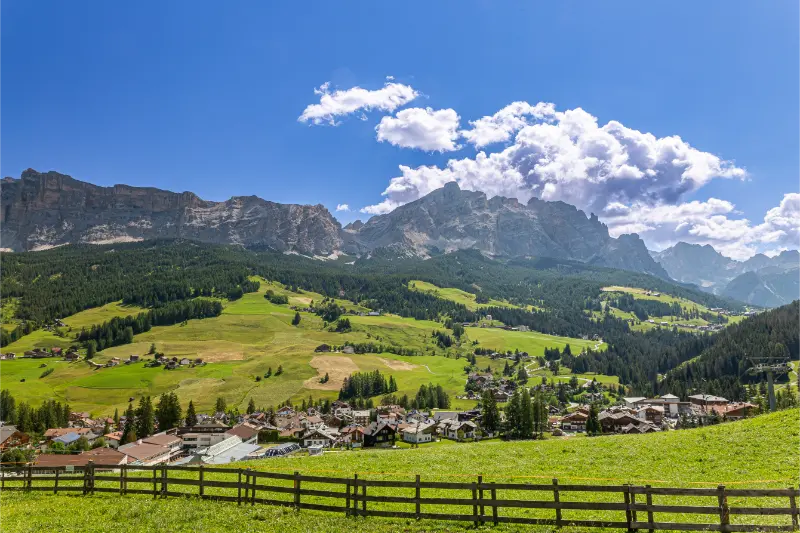
The resort character means that Corvara can be busy in peak weeks, and prices often reflect its convenience. Families may appreciate the services but should still review which lift serves their preferred activities and whether there are easy paths appropriate for young walkers. Non-skiers will find places to enjoy a café or a scenic ride, yet some of the most celebrated mountain routes require more experience than their attractive photographs suggest. A good first day might feature a gentle walk and time to orient yourself instead of immediately committing to an expensive multi-day pass.
Colfosco and its distinctive mountain backdrop
Colfosco sits close to Corvara but has a more directly dramatic setting beneath steep Dolomite walls. It can feel appealing to visitors who want a quieter village atmosphere with access to the larger network. The Borest lift offers a connection between Colfosco and Corvara during applicable operating seasons, illustrating how lifts can sometimes make neighboring villages easier to link than roads or long walks. Confirm current service and ticket requirements before building your daily commute around a mountain connection.
For families, Colfosco’s appeal lies in the ability to enjoy mountain scenery without necessarily taking on a high-level expedition. Suitable routes and mountain huts may be available when lifts are operating, but choose according to difficulty and current conditions. The village itself has accommodation and places to eat, though its evening choice can differ from the larger centers. Some properties are on slopes or away from the main bus line, so check gradients if traveling with a stroller or someone who has mobility limitations. Colfosco is worth choosing deliberately rather than as an interchangeable label for Corvara.
La Villa and San Cassiano: two different rhythms
La Villa, or La Ila, is a central valley base associated with the Piz La Ila lift and winter skiing. It is practical for visitors whose plans revolve around this part of the mountain network. San Cassiano has a more compact village atmosphere and access toward Piz Sorega, along with a reputation for food and mountain hospitality. Both can be excellent, but the best choice depends on where you want to spend your mornings. If a particular ski school or trailhead is central to your vacation, the daily trip from your hotel matters more than the number of stars beside its name.
Take an evening to explore one of these villages at walking pace. Local architecture, Ladin names, and the relationship between farms and modern tourism become easier to appreciate when you are not looking for the next gondola. In summer, lift connections can link different walking areas, but access changes across seasons and some routes require much more effort than a map suggests. For a cultural day, you may prefer a short village visit and a regional meal over another demanding hike. That variety makes a longer stay more satisfying than repeating the same lift each morning.
Badia and La Val for a slower holiday
Badia and La Val reveal a quieter side of Alta Badia, with rural landscapes, churches, and walking possibilities that do not always revolve around the most famous resort views. La Val is particularly appealing to visitors who enjoy farm scenery and a more measured pace. These places can suit couples or experienced independent travelers who value peace over immediate access to every major lift. They are less ideal if you intend to walk from the hotel to a large choice of evening restaurants or participate in ski-school activities in another village every morning.
When comparing accommodation, assess local transport realistically. A hillside farm stay can be wonderful with a car, but it may create daily logistical challenges without one. Ask about the nearest bus stop, the timetable during your exact season, and the walk from that stop to the property. Families seeking calm may enjoy these villages, provided daily activities have been chosen accordingly. The pleasure is in noticing pastures, traditional buildings, and open landscapes rather than checking off a long list of attractions. Staying a little farther from the main resorts can be rewarding if it is a conscious decision.
Summer lifts and the right mountain pass
Alta Badia’s summer lifts make many panoramic areas more accessible. In the 2026 season, the official operator published dates for different facilities rather than one identical calendar for the whole valley, a detail worth remembering for future trips. Buying an Alta Badia Summer Card or another lift product can be worthwhile if you will use several covered facilities, but the coverage and operating dates must match your actual plans. Some prominent neighboring lifts, including the Lagazuoi cable car at Passo Falzarego, may not be included in the same way as Alta Badia’s local facilities.
A mountain day should begin by checking the specific lift, its final descent, and the difficulty of the paths above it. The upper station may provide a wonderful easy viewpoint, or it may be the start of a demanding hike. Choose deliberately. The high plateaus around Pralongiá and Piz Sorega are associated with broad scenery and huts, but route surfaces and gradients vary. Families with strollers should seek official accessibility guidance for a precise circuit rather than assuming every meadow path is smooth. Even in midsummer, pack layers and waterproof clothing because the weather above the valleys can change quickly.
Skiing and the Sella connection
Winter visitors often think of Alta Badia in relation to the Sella Ronda and larger Dolomiti Superski network. Interconnected ski areas are a major attraction, but they are not appropriate for everyone. Completing a long circuit requires the right ability, weather conditions, and enough time to return to the correct valley before lifts close. Beginners and families may be happier with local slopes and a consistent meeting point for lessons. A ski pass covering many areas is not good value if you plan to remain near one beginner zone throughout your stay.
Ask the ski school about the exact lesson meeting point and plan the route from your accommodation. Walking several steep blocks in ski boots with children can become an unpleasant daily routine. Ski lockers or rentals near a lift may simplify mornings. When non-skiers accompany the group, look for winter walking, wellness, and restaurants that can be reached independently; not every lift accepts pedestrians on the same terms. Snow conditions and wind influence operations, so build flexibility into a ski-focused holiday. If a long circuit is cancelled, a relaxed local ski day can still be enjoyable.
Walks, mountain huts, and the temptation to overreach
Alta Badia offers paths for different levels, from gentle meadow walks to challenging alpine routes. The scenery can be so inviting that visitors underestimate distance, elevation, or exposure. Read official route descriptions, understand the difference between a walking trail and a via ferrata, and never plan a technical route simply because there is a mountain hut at its destination. Families should prioritize marked paths with reliable return options; experienced hikers may choose longer traverses after consulting weather and trail conditions.
A mountain hut lunch can become a highlight of the trip. Check whether the hut is operating and whether a reservation is advisable at busy times. Meals often feature regional ingredients, and the experience is as much about the setting as the menu. Carry water regardless of the planned lunch stop, and do not depend entirely on refreshments being available. Summer storms can develop rapidly, and winter snow changes familiar paths completely. Turning back when clouds build is a practical decision. The valley rewards repeat visits; there is no need to complete every celebrated route on one vacation.
Ladin heritage and food beyond the slopes
Ladin culture is central to Alta Badia’s identity, and its language appears in names and daily life. The valley’s communities preserve traditions that extend beyond winter tourism. Visitors can learn about local history through museums, cultural activities, and conversations in shops or restaurants, while being respectful of the fact that homes and farms are not visitor attractions. Food is another accessible way to appreciate the area. Look for Ladin specialties and seasonal mountain cooking instead of assuming that every menu represents a single uniform Alpine tradition.
Dining ranges from informal family restaurants to more elaborate experiences. Reserve in advance for special meals during peak holiday weeks, and confirm whether a remote restaurant can actually be reached from your hotel without a car. A cultural outing fits particularly well on a day when the mountain forecast is uncertain. Younger visitors may enjoy seeing traditional buildings and learning a few local words, while adults could choose a museum or regional tasting. The distinctive atmosphere of Alta Badia comes from this mix of culture and scenery, not solely from the number of ski lifts.
Getting around and choosing accommodation
Travelers commonly arrive via railway and bus connections from wider South Tyrol or by car through the surrounding mountain roads. Alta Badia does not have a train station in each village, so the last part of the trip needs attention. Check direct bus connections, transfer times, and the last departure if you plan to go out for dinner in another town. Summer lifts may connect certain villages and walking areas, but cannot replace the regular transport network at all times. A car offers flexibility, though parking at popular trailheads and ski stations can fill quickly.
For a first stay, choose Corvara if convenience and broad access are your main goals; consider Colfosco for dramatic scenery, La Villa for certain ski connections, San Cassiano for village atmosphere, and Badia or La Val for quieter rural surroundings. These are broad tendencies, not fixed rules. An individual property can differ greatly from its village stereotype. Compare total costs, including parking, ski storage, final cleaning, and local taxes. When traveling without a car, a reliable bus stop is a genuine amenity. Book early for peak ski weeks and busy summer periods if you need a specific room configuration.
Seasons and a balanced first itinerary
Summer brings lift-supported walks, cycling, and long days; winter centers on skiing and snow activities. Spring and late autumn can be peaceful but may not suit travelers who expect every lift or hut to be operating. Always check the exact facility calendar rather than relying on a general ‘summer season’ label. During the busiest weeks, early starts help with parking and crowded viewpoints, but a slower valley afternoon can provide welcome balance. Families in particular often benefit from alternating active days with village time.
For a four-night introduction, choose one day in your base village and a nearby lift area, another day for a different scenic zone, a quieter cultural afternoon, and a final day adapted to weather or energy. If skiing, replace high-level hiking with local slopes or one carefully planned circuit suited to your group. Avoid trying to visit every Alta Badia village on the same day; moving constantly can erase the feeling of being in the mountains. The valley’s beauty becomes clearer when you return to familiar streets after an excursion and begin to recognize the peaks around your chosen home base.
Map and official visitor information
Opening times, access arrangements, trail restrictions and transport schedules can change. The following official resources are useful before your visit.
Plan the rest of your trip
- Trentino-Alto Adige Travel Guide
- Where to Stay in Trentino-Alto Adige
- Val di Fassa Travel Guide: Moena, Canazei and Ladin Dolomites
- Val Gardena Travel Guide
Frequently asked questions
Which village is best to stay in Alta Badia?
Corvara is convenient for facilities and connections; Colfosco, La Villa, San Cassiano, Badia and La Val suit other priorities.
Does one summer lift pass include every nearby cable car?
Not necessarily. Check the current pass coverage; some neighboring facilities have different ticket rules.
Is Alta Badia only for skiers?
No. Summer walks, culture, Ladin villages, cycling, and scenic lifts are major attractions when seasonal services operate.
Last updated: October 17, 2026