
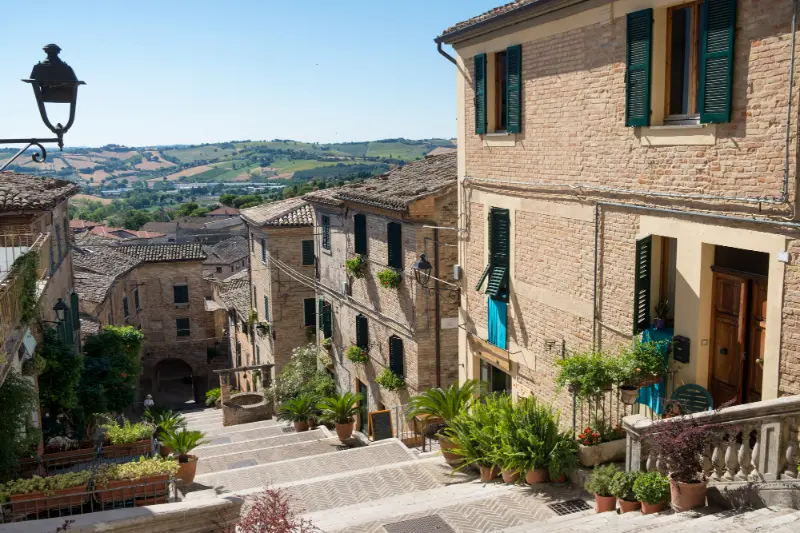
Corinaldo is not a place where one monument explains everything. Its appeal comes from the relationship between a fortified hilltop, an unusually coherent circuit of walls, steep lanes and a lively local tradition built around the Piaggia staircase. In northern Marche, within reach of the Adriatic resorts around Senigallia, it offers a genuinely different day from the beach: an old town to explore at walking pace rather than a list of famous rooms to rush through. The recommended first visit is a loop of the walls followed by the staircase and central streets, with a stop for local food. Check museum access separately instead of assuming the whole heritage circuit uses one ticket.
In this guide
- Start with the defensive geography
- Make the Piaggia staircase the centerpiece
- Understand the walls rather than just counting towers
- Add the central streets and churches
- Build a half-day walking route
- Arrive from the coast or inland
- Food, festivals and the season that suits you
- Decide whether to sleep in Corinaldo
- Small mistakes that change the visit
Start with the defensive geography
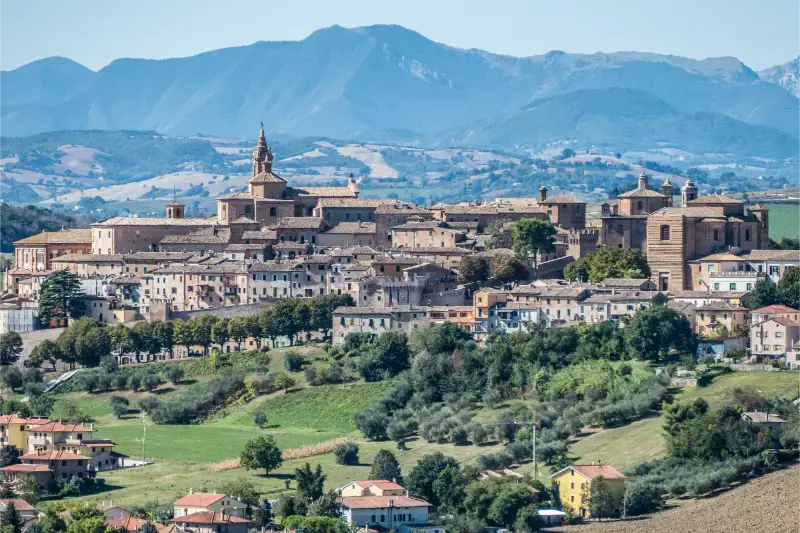
Corinaldo's position matters as much as its buildings. Looking from the surrounding countryside, you can understand why a settlement on high ground needed a substantial belt of protection: approaching forces would have been visible across the rolling agricultural landscape long before reaching the gates. The town's fortifications still give a readable outline of that defensive purpose. Begin outside or near a surviving gateway, where the slope and relationship between wall and road are easier to appreciate, rather than immediately climbing to the busiest square. What seems like a picturesque brick boundary from one angle becomes a designed military barrier when viewed from below.
For travel beyond Corinaldo Travel, consult our Marche travel guide; it explains how to choose a base and link nearby destinations.
Walk the permitted stretches slowly and notice interruptions in the masonry, projecting towers and changing views between town and countryside. A medieval circuit was not intended as a continuous panoramic walkway for tourists, so do not assume every tower or parapet is open. A short circuit on public streets is usually more rewarding than hunting for a complete elevated loop that may not exist. For photography, the transition from a fortified gate to an ordinary residential lane captures Corinaldo better than a wide shot with no recognizable details. Keep respectful distance from private doors and driveways, particularly where homes back directly onto the historic walls.
Make the Piaggia staircase the centerpiece
The Piaggia is the scene most visitors remember: a long, sloping staircase lined with buildings and the well at its center. It is tempting to treat it as a photographic prop, but its importance is spatial. The climb connects different levels of Corinaldo and reveals how daily movement through the town depended on gradients, steps and small landings. Walk down once, then turn and climb back in stages. The change of perspective helps you see the houses, doorways and view lines that are almost invisible when concentrating on your footing. Comfortable shoes with traction are much more useful here than elegant but slippery soles.
The well is commonly associated with the local legend of the Polenta Well. According to the story, a sack of cornmeal fell into the water and an implausible sequence of events produced jokes about someone eating polenta inside the well. The story is folklore, not a documented account of actual communal cooking. The tourist office explains that the well's historical predecessor was built in the late fifteenth century and that the present feature was reconstructed in the twentieth century. This distinction makes the stop more interesting: visitors see a physical place through which Corinaldo has chosen to remember and perform its local identity.
Understand the walls rather than just counting towers
Look for the differences between the older eastern defenses and later Renaissance extensions. The official town account distinguishes gateways and sections built or altered in different periods; the wall circuit was not created in one uninterrupted construction campaign. At certain points an angular approach or projecting tower makes sense only when you imagine a former entry road. You do not need specialist architectural vocabulary to read this landscape. Ask a simple question at each surviving entrance: how would someone have arrived here before the ring roads and car parks existed?
The wall is also the best introduction to the town's modest scale. Corinaldo can be explored in a half day without sacrificing the places that make it distinctive. Rushing to add several more hill towns in the same morning usually reduces them to similar photographs. A better approach is to pair Corinaldo with a slower afternoon at Senigallia or another nearby stop. That contrast—brick fortification inland, flat sandy coast on the Adriatic—helps explain why northern Marche offers a varied itinerary even over a short stay.
Add the central streets and churches
Once you have seen the defensive ring, move inward. The town's small squares and parish buildings reveal a later layer of civic and religious life that is not always obvious from the walls. You may encounter churches that open only for worship, volunteer-led visits or limited hours. If interiors are important, check locally in advance; an attractive doorway does not guarantee access. Even when a church is closed, look at its placement along a route or at the edge of a square. Such buildings often mark the places where people met, traded and organized town life.
Give some time to unplanned exploration between the staircase and central streets. Ordinary details—the width of a lane, an old lintel, a shop with seasonal produce, a small view over fields—allow Corinaldo to feel inhabited rather than staged. The town can be quiet on weekdays outside the summer season, and that quiet is a feature, not a defect. There is no need to fill every minute with scheduled attractions. If you are traveling with children, the changes in level and sightlines can become a game of spotting gates and towers; however, supervise them closely on steps, steep edges and road crossings.
Build a half-day walking route
For a first visit of three or four hours, park legally outside the most constrained old-town streets and approach through a recognizable gate. Spend the first part of the morning reading the defensive perimeter, then enter the center and walk the Piaggia with enough time to stop at the well. Continue to a small square for coffee or lunch and use the last portion for a church or museum whose opening has been confirmed. This sequence reduces unnecessary backtracking, although the exact entry gate will depend on where parking is available.
A slower full day changes the emphasis. Rather than adding artificial checklist items, linger over lunch and take another wall-side stroll in different light. A visitor interested in fortifications may spend longer studying towers; someone drawn by folklore may arrange a local guided visit that explains the historical reenactment tradition. In either case leave space for delays. Historic centers can have temporary works, market restrictions or festivals that change pedestrian routes. Save the official town map offline when possible and treat online driving directions through old lanes with skepticism.
Arrive from the coast or inland
A car generally makes Corinaldo easier to combine with rural viewpoints, vineyards or another small hill town. The town is inland from Senigallia rather than on the railway, so the last leg requires road transport. Public bus connections may exist, but services on weekends, public holidays and school-free days can differ considerably. Check the current operator timetable both ways, especially the return trip; do not rely on an app's estimate that ignores a midday gap. For a car journey, navigate to a confirmed visitor car park or city entrance rather than typing the name of a staircase into the satnav.
Those staying in Urbino or Ancona should think of the visit as one part of a longer regional route and not assume that a rail journey to the coast puts them within walking distance. Allow time for winding approaches through the hills and for finding a legal parking space. If you have limited mobility, ask the tourism office which entry point minimizes steps. Corinaldo's layout includes slopes and stairs, and there is no truthful way to promise a completely step-free experience across the historic center.
Food, festivals and the season that suits you
The Polenta Well story makes local food part of the town's visitor identity, but it would be a mistake to assume every restaurant serves the same special dish year-round. Regional menus may feature fresh pasta, seasonal vegetables, cured meats and wines from the surrounding hills. Choose a restaurant by its current menu and opening day rather than by a list published years earlier. If you plan to visit during a town festival, reserve food and lodging earlier and be prepared for road restrictions, noise and crowds around the staircase.
Spring and early fall are often comfortable for walking because the sun is less punishing on open paving. High summer brings a lively holiday atmosphere, but the climb up the Piaggia can feel more strenuous in midday heat. In winter, cold wind and wet stone make footwear and daylight more important. Families may enjoy a festive reenactment if the dates align, while travelers seeking architectural details and quiet photographs may prefer an ordinary weekday. Before fixing plans, verify the official event calendar rather than assuming an annual celebration always falls on the same weekend.
Decide whether to sleep in Corinaldo
A night in town works especially well for couples, slow-travel photographers and travelers following a route through the lesser-known Marche hills. After day visitors have left, the streets regain a very local rhythm, and an early-morning walk can be more memorable than an additional museum. Check whether your chosen accommodation is inside the walls and whether it provides practical luggage instructions. A room with character may involve stairs, limited vehicle access and no elevator; accessibility claims should be checked at the room level, not just the property's entrance.
For a beach-based holiday, however, a Senigallia hotel may be the more efficient choice. You can spend the afternoon inland without moving suitcases, and the coast offers simpler rail connections. Corinaldo's value is not measured by whether it deserves a hotel reservation for everyone. It earns a place in an itinerary because it reveals a defended rural Marche that feels different from the region's better-known seaside towns. Use it as a purposeful contrast, not an interchangeable stop added to an overstuffed road trip.
Small mistakes that change the visit
The most common mistake is underestimating the slope. A traveler who arrives in sandals, hurries straight up the Piaggia and immediately leaves may find the town tiring rather than interesting. Another is treating the Polenta Well story as literal medieval history. Distinguish the surviving fortifications, the rebuilt feature and the folklore around it, and the visit becomes richer. A third mistake is expecting a timetable-driven museum experience in a small town where some sites operate only on designated days or during events.
Finally, do not confuse proximity on the map with effortless travel by public transportation. A town only a short distance inland can require careful planning if your itinerary relies on infrequent buses. Confirm opening days and transport first; once those constraints are solved, Corinaldo is one of the easiest hill towns in northern Marche to enjoy without an elaborate schedule. Leave with a memory of the walls, the stairs and the surrounding countryside rather than the feeling that you missed a long list of attractions.
Quick planning reference
| Best use of time | Treat Corinaldo Travel Guide as a focused day or overnight stop rather than adding it as a rushed detour. |
|---|---|
| Arrival | Confirm the current road or transit options for Corinaldo, Marche, Italy before departure. |
| Reservations | Check official opening and reservation notices for interior visits, activities and special-access sites. |
| Footwear and mobility | Expect uneven paving or terrain; confirm step-free routes with the relevant venue. |
| Weather | Keep an indoor or shorter backup plan if conditions change. |
Continue planning your Marche trip
- Marche travel planning guide
- Best things to do in marche
- Senigallia beach guide
- Jesi wine and architecture guide
Official resources and final checks
Before departure, check the official sources below for the latest museum hours, access rules, trail notices and any seasonal services. Their current information should take precedence over older guides, especially for visits planned in 2028.
If you prefer to stay overnight rather than return after a long drive, compare accommodations and read recent guest reviews before booking.
Compare places to stay near Corinaldo, Marche, Italy
Frequently asked questions
How much time should I allow for Corinaldo?
A relaxed half day is usually enough for the walls, the Piaggia staircase, and an unhurried meal. Allow longer if you have confirmed a museum or guided visit.
Can I walk on all of Corinaldo’s walls?
Do not assume the entire medieval wall circuit is open at parapet level. Follow designated public routes and current local access information.
What is the Polenta Well?
The well by the Piaggia staircase is associated with a local story celebrated in Corinaldo. Learn the tradition, but distinguish folklore from verified history.
Is Corinaldo a good trip from the Adriatic coast?
Yes, it can be paired with a stay around Senigallia if you arrange road travel. Check parking and allow extra time for the hilltop approach.
Is the town easy with a stroller?
Some central streets are steep, stepped, or uneven. Choose a shorter route and check alternatives to the Piaggia staircase.
Last updated: October 17, 2026