
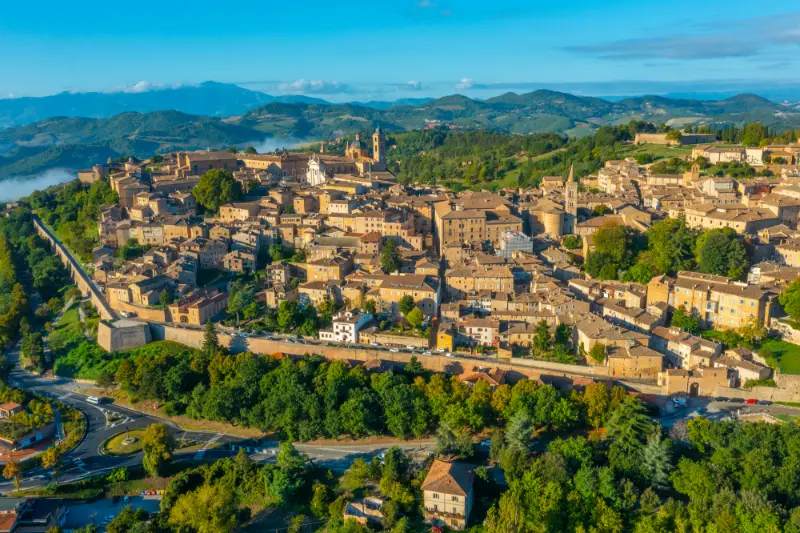
Urbino is one of the rare Italian towns where the main attraction is not simply the museum you enter but the way an entire urban landscape has survived. Its Renaissance palace, intimate streets, terracotta roofs and steep setting were shaped by the court of Federico da Montefeltro, and the historic center has been recognized by UNESCO since 1998. The town is much smaller than Florence, yet its influence on Renaissance culture was substantial. Visit to understand how a powerful court combined art, scholarship and architecture; stay a little longer to discover a living university town rather than a city frozen behind museum glass. A successful day requires a plan for the steep approaches and realistic time inside Palazzo Ducale.
In this guide
- Begin with Palazzo Ducale, not a random walking circuit
- Read the city through Federico da Montefeltro
- Walk the Cathedral area and nearby streets
- Find the connections with Raphael
- Seek out Urbino's oratories and small artistic interiors
- Enjoy the viewpoints without risking restricted areas
- Arrive from Pesaro and plan the last bus
- Decide whether to visit for a day or stay overnight
- Eat and explore the countryside responsibly
- A sensible one-day Urbino route
- Practical information
- Frequently asked questions
Begin with Palazzo Ducale, not a random walking circuit
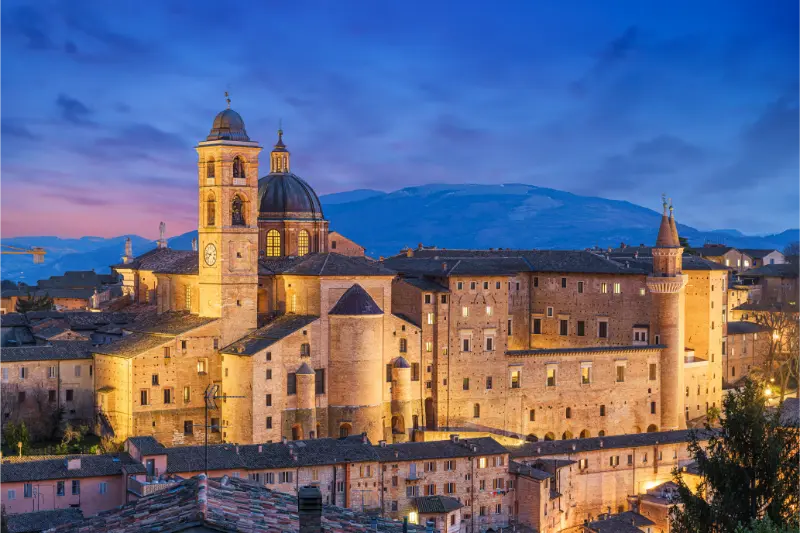
Palazzo Ducale is the intellectual and architectural center of Urbino. The residence created for Federico da Montefeltro was conceived with a scale and sophistication that made it a statement of political as well as cultural authority. Outside, the famous torricini form an unmistakable skyline; inside, courtyards, halls and the museum collection tell a more complex story. Stand in the courtyard and pay attention to its measured geometry before moving into the galleries. The building works as architecture in its own right, not merely as a container for masterpieces.
To see where Urbino Travel fits into a wider Marche itinerary, use our Marche travel guide for transport, bases and possible neighbouring stops.
Allow enough time for the Galleria Nazionale delle Marche, housed in the palace, which includes major Renaissance works. Visitors often remember the celebrated painting of the Ideal City, but the context is just as important: court patronage, perspective and the ambition to represent an ordered world. Exhibitions and specific rooms can change due to conservation or museum operations; check the Ministry of Culture information rather than assuming every artwork will always be displayed. If you have only a morning, prioritize the palace over an ambitious circuit of peripheral sights. You can return to lanes and viewpoints after lunch.
Read the city through Federico da Montefeltro
Federico’s military career and political influence helped support a court that attracted humanists, architects and artists. Urbino’s achievement lies partly in the interaction between these figures and an existing medieval hill settlement. The result was not a completely new city laid out on flat ground but an architectural adaptation to uneven slopes and earlier streets. That adaptation is a major part of its UNESCO significance. As you move between the palace and other buildings, look at changes in level, the way roofs step down the hillside and how grand spaces connect to ordinary lanes.
It is tempting to imagine the court as a purely aesthetic project, yet the palace also communicated status, order and control. Comparing the ceremonial rooms with the smaller street network gives more insight than treating the building as a backdrop for photographs. Travelers interested in Renaissance Italy should consider spending one night here, because the light and atmosphere shift as day visitors depart. Early and late hours are also useful for seeing the skyline from different viewpoints without competing with large tour groups.
Walk the Cathedral area and nearby streets
Urbino Cathedral stands close to the ducal complex, and the surrounding streets make a natural continuation of a palace visit. The cathedral’s appearance reflects later interventions as well as the city’s long religious history, so do not expect every visible detail to belong to Federico’s fifteenth-century project. Check current access before planning to enter; religious services and conservation works can affect visitor availability. The important experience is also spatial: the cathedral, palace approaches and civic buildings sit close together yet at subtly different levels.
From this district, leave the busiest route and explore smaller streets carefully. Urbino rewards walking without a strict checklist as long as you are prepared for climbs. Pause where the urban fabric opens to countryside rather than focusing only on famous façades. If you travel with children, make a loose loop that allows a café stop rather than a long sequence of interior visits. Visitors with limited mobility should identify step-free alternatives and the position of their arrival stop before setting off.
Find the connections with Raphael
Raphael was born in Urbino in 1483, and the town’s artistic culture helped shape the early environment of one of the Renaissance’s most celebrated painters. The Casa Natale di Raffaello, associated with his early life, offers an additional perspective to the grander narrative of court art. It is a more intimate attraction than Palazzo Ducale and should not be approached with expectations of a huge museum collection. Its value lies in location, atmosphere and the opportunity to connect artistic biography with the physical streets of the town.
If Raphael is your primary interest, check opening hours and current displays before arriving; small museums can have schedules different from national galleries. Consider the contrast between his family environment and the scale of the ducal palace. This juxtaposition reveals the importance of local artistic networks in a relatively compact city. You do not need to rush from the birth house to another destination: spend time in the surrounding streets and imagine the movement between workshops, churches and the court at the end of the fifteenth century.
Seek out Urbino's oratories and small artistic interiors
Among Urbino’s rewarding smaller spaces are the historic oratories, including the Oratorio di San Giovanni Battista, noted for its medieval fresco cycle. Such places demonstrate that the town’s history extends beyond the Renaissance court and that significant art survives in modest-sized religious settings. Visiting an oratory after Palazzo Ducale can be an effective change of scale: instead of grand geometry, you encounter a more immediate devotional environment and painted stories intended for close attention.
Because smaller interiors have limited opening hours or admission procedures, identify the one that interests you most and verify it before the trip. Do not assume two adjacent-looking monuments can always be visited back to back. If a site is closed, use the time for the town itself rather than turning the day into a frustrating search for another ticket counter. Architecture enthusiasts may enjoy tracing different building materials, portals and street edges while moving between the palace area and the quieter sections of town.
Enjoy the viewpoints without risking restricted areas
Urbino’s hillside setting creates impressive views across the rooftops and surrounding countryside. Some of the best moments come while walking toward higher ground and seeing the relationship between the town’s monumental center and its enclosing hills. Look for public paths and established viewpoints rather than assuming every nearby wall or garden is accessible. Early morning light can reveal the terracotta skyline especially well, while late afternoon often adds warmth and shadows to the brick architecture.
The walk to any viewpoint is part of the experience, so judge it by your mobility and the day’s weather. Slippery stone surfaces after rain and long uphill routes are not ideal for everyone. In hot weather, schedule elevated walks outside the strongest midday sun. Photographers should bring a lens appropriate for wider urban scenes rather than concentrating solely on palace details. A slower visit makes the view more meaningful because you recognize buildings you have already explored.
Arrive from Pesaro and plan the last bus
Urbino is inland, and the historic center is not served by a direct mainline train station. Many visitors reach it by bus from Pesaro or drive from coastal and inland roads. The connection is feasible for a day trip but requires attention to actual service patterns, especially on Sundays and public holidays. Consult the current bus timetable in both directions and allow a buffer between arrival and timed museum entry. The journey itself introduces the rolling countryside, but it is not a short walk from the beach.
Drivers should use official parking and approach directions rather than following a navigation system through restricted center streets. Old-town hotels may give special instructions for unloading, which do not necessarily authorize unrestricted vehicle entry. If you are staying overnight, ask your host precisely where to park and whether there are steps between the car and accommodation. Urbino is compact once reached, but its gradients can make moving with heavy luggage challenging.
Decide whether to visit for a day or stay overnight
A day trip works if you focus on Palazzo Ducale, one smaller site, lunch and a short viewpoint walk. It is ideal for travelers based in Pesaro who do not want to move accommodation. The limitation is that museum schedules, bus times and walking gradients can compress the visit. If your interests extend to art history, the Raphael sites and several religious interiors, one overnight stay offers more flexibility and a less hurried atmosphere.
An overnight plan also lets you enjoy the city as a lived-in place. Universities, students and local residents shape the daily rhythm, so evenings are not simply empty versions of sightseeing hours. Choose a central room if you want to walk to dinner, but verify access if climbing stairs is difficult. Visitors who prefer beaches, pool time or a flat promenade should keep Urbino as a dedicated cultural excursion rather than expecting it to function like a resort.
Eat and explore the countryside responsibly
After a day of art, an unhurried meal is a good way to connect Urbino with the wider Marche landscape. Menus may include local cheeses, pasta, truffles or seasonal ingredients, but avoid assuming that every restaurant serves a definitive regional specialty. Urbino’s surroundings are agricultural as well as historic. If you drive, a nearby countryside stop can add context, provided you give the town itself enough time first and avoid complicated rural roads late at night.
For a second day, consider returning toward Pesaro or exploring a selected village in the Montefeltro area rather than setting out to conquer the entire region. A well-planned trip might pair Renaissance Urbino with a coast day, revealing how different northern Marche settings are. You can read more about the regional balance in our first-time Italy planning guide and confirm palace operations on the official Ministry website.
A sensible one-day Urbino route
Start with the palace at an opening time you have checked, then walk around its immediate historic quarter. Take lunch before exploring Raphael’s house or an oratory, depending on personal interests and which site is actually open. Spend late afternoon on a public viewpoint or quiet street, then return to your base or stay for dinner if buses and accommodation allow. This sequence minimizes unnecessary climbing and avoids treating every attraction as a separate cross-town errand.
What matters most is the quality of attention you bring to the place. Urbino’s buildings were meant to function together, and a rushed tour of isolated highlights misses the relationship that makes the UNESCO-listed center special. Even on a short visit, allow yourself time to notice the street patterns and the extraordinary way Renaissance architecture meets the slopes of the hill.
Practical information
| Main attraction | Palazzo Ducale / Galleria Nazionale delle Marche |
|---|---|
| UNESCO recognition | Historic center inscribed in 1998 |
| Ideal visit length | Full day; overnight if you love Renaissance art |
| Getting there | Road or connecting bus from a coastal rail hub |
Related travel planning
For connected questions about transport, timing and logistics, explore these published guides: Italy Travel Guide for First-Time Visitors, Train Travel in Italy, How to Book Attractions in Italy, Accessible Travel in Italy.
When staying in Urbino, confirm how far luggage must be carried uphill from legal parking or the bus stop, especially in historic buildings without elevators. Compare relevant accommodation on Booking.com. Review current cancellation and accessibility conditions rather than relying only on a destination label.
Frequently asked questions
How much time does Urbino need?
Allow a full day if the Ducal Palace and smaller sites interest you, or one overnight to enjoy the city at a slower pace.
Is Urbino a UNESCO site?
Yes. Its historic center was inscribed on the UNESCO World Heritage List in 1998.
Can I reach Urbino by train?
Not directly in its historic center. Check onward bus connections from a coastal rail hub such as Pesaro.
What is the most important museum?
The Galleria Nazionale delle Marche inside Palazzo Ducale is the central art attraction.
Is Urbino easy for visitors with limited mobility?
It is a steep historic hill town. Confirm access, parking, steps and museum arrangements before booking.
Official information and sources
Last updated: October 17, 2026