

Fano is an appealing northern Marche city because its historic streets preserve traces of Roman Fanum Fortunae while the contemporary town remains closely tied to fishing, the Adriatic and a long carnival tradition. Visitors can move between the Arch of Augustus, Piazza XX Settembre, churches, museums and the waterfront without treating the town solely as a summer resort. Its railway connection makes an independent cultural stop feasible, and beaches provide a good reason to stay longer. The most rewarding visit begins in the old center, where the Roman street pattern helps orient an itinerary, then allows time to discover how the modern seaside city developed around it.
In this guide
- Enter the old town at the Arch of Augustus
- Trace Roman Fanum Fortunae beyond the gate
- Pause in Piazza XX Settembre and see the civic center
- Explore the Malatesta legacy and later town history
- Visit churches and museums selectively
- Understand the two main beach settings
- Discover Carnival traditions without assuming event dates
- Eat brodetto and enjoy the fishing culture
- Plan rail arrival, parking and accommodation
- Build a satisfying one- or two-day Fano stay
- Practical information
- Frequently asked questions
Enter the old town at the Arch of Augustus
The so-called Arch of Augustus was originally a monumental city gate, not an isolated triumphal arch set in a ceremonial field. It marks a major entry into Roman Fano, where the Via Flaminia reached the settlement’s principal urban route. Dating to the Augustan period, the surviving structure offers a clear starting point for understanding the city’s layout. Take time to examine its position in relation to the walls and adjacent streets. The monument’s partly altered appearance tells a story of later military and urban changes as well as imperial construction.
Our Marche travel guide places Fano Travel in the context of the wider region, including travel times and alternative bases.
This is a public urban monument, so it can be experienced without a lengthy museum appointment, but you should still respect traffic and pedestrian safety around it. Use marked crossings rather than stepping into the roadway for a symmetrical photograph. Nearby historical interpretation, where available, can explain the gate’s design and missing upper elements. Standing here before walking toward the center makes the grid of streets more meaningful: you are following a route that connects layers of Roman planning with medieval and modern daily life.
Trace Roman Fanum Fortunae beyond the gate
Fano’s Roman heritage extends beyond its famous gateway. The surviving sections of city walls and the orientation of certain streets help reveal the ancient settlement. You do not need to be a professional archaeologist to look for how buildings and streets relate to one another, but it is wise to distinguish securely identified remains from modern reconstructions or speculative attributions. Where archaeological displays are open, use museum labels and local official materials to understand what has been excavated and how scholars interpret it.
The name Fanum Fortunae refers to the city’s ancient association with Fortuna, yet the modern streets cannot be reduced to one surviving shrine. Roman urban centers changed considerably over centuries, and some evidence lies beneath later buildings. A practical walking route moves from the Arch of Augustus toward the main civic center, stopping at publicly accessible fragments and explanatory panels. Families can turn this into an exercise in seeing historical layers, but avoid entering construction or fenced excavation areas. The best discoveries often arise from careful looking at an ordinary streetscape.
Pause in Piazza XX Settembre and see the civic center
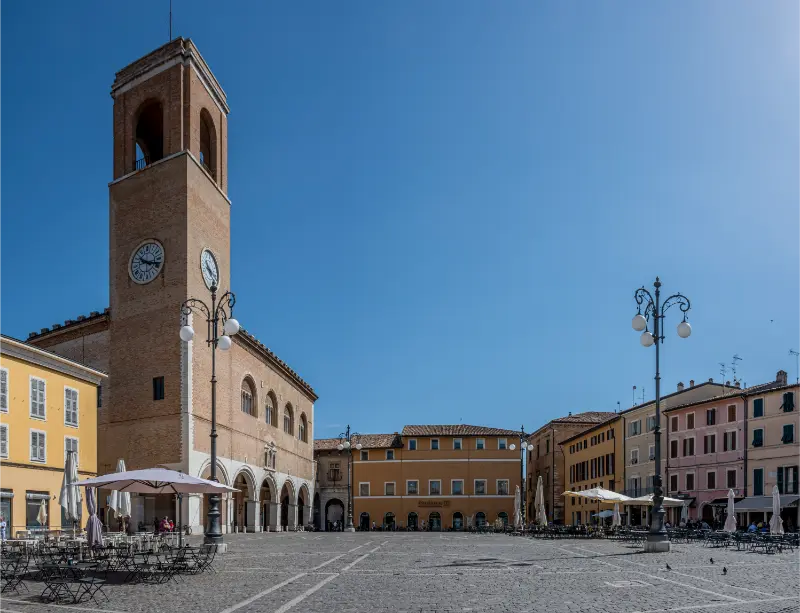
Piazza XX Settembre is an important public space for understanding Fano after the Roman era. Its proportions, monuments and adjacent buildings show how civic life continued to evolve in the historical center. It is a natural place to stop for coffee and orient the next part of your walk. Look beyond the most photographed angle: observe how surrounding streets bring local residents into the square and how the setting changes between market hours, quiet afternoons and cultural events. Such everyday use is part of the town’s appeal.
Teatro della Fortuna is associated with the square and illustrates Fano’s cultural ambitions. An evening performance may be available during your visit, but do not assume the theater is open for unscheduled daytime sightseeing. Check the calendar, available tours and accessibility directly with the operator. If art or architecture is your priority, allow enough time for a museum or church rather than committing to every site on a list. The historic center is compact enough to encourage wandering, and it is worth letting that freedom shape the day.
Explore the Malatesta legacy and later town history
Fano’s relationship with the Malatesta family forms an important chapter in its medieval and Renaissance story. Historical buildings and museum collections preserve aspects of this period, although individual works and interiors may be temporarily unavailable. Read the interpretation on site and distinguish architectural remains from displays assembled to explain them. The point is not to find a single building that explains the entire dynasty. Instead, the combination of urban defenses, civic palaces and collections shows how authority was expressed across the city.
If you are particularly interested in this period, consider pairing Fano with another northern Marche fortified town on a separate day. Gradara provides a dramatically different castle environment, while Fano illustrates a larger urban setting where Roman and later layers overlap. Do not attempt to squeeze both into a short afternoon if you have a museum reservation in Fano. Allow time for the transitions between historical periods; these are what distinguish Fano from coastal resort towns whose older centers are less prominent in the visitor experience.
Visit churches and museums selectively
Fano has churches, civic collections and historical interiors that reward curious visitors, but their access may vary by season and institution. A good approach is to identify one museum or collection and one religious building before arriving, then check which are open. This is more reliable than relying on a dated checklist of attractions. Religious services take priority in active churches, and artworks can be removed temporarily for conservation. Ask about current displays when a specific painting or chapel is the reason for your trip.
For travelers interested in architecture, the contrast between ecclesiastical spaces, the Roman gate and the civic square provides enough variety for a full day. Families can combine a short museum visit with a longer outdoor walk. Visitors with mobility needs should ask about stairs and entrances for each interior, since a flat city center does not guarantee step-free access inside historic buildings. The goal is not to maximize the number of admission tickets; it is to gain a rounded understanding of Fano’s evolving urban history.
Understand the two main beach settings
Fano’s coastal identity is distinct from its old town. Visitors often encounter the Lido and Sassonia areas, whose beach characteristics and settings are not identical. Compare the actual shoreline surface, promenade atmosphere, accommodation and family facilities before choosing where to spend time. One area may appeal more for nearby services, while another may be better suited to your particular preference for swimming, restaurants or a relaxed walk. Do not assume every stretch is fine sand or that all managed beach facilities operate outside the summer season.
As elsewhere on the Adriatic, pay attention to current swimming conditions, lifeguard arrangements, beach concessions and accessible entrances. Travelers with children should confirm whether the route from their accommodation requires crossing busy roads. In summer, the waterfront may be crowded and parking limited, so a property within walking distance can simplify the day. A beach stay can be enjoyable without seeing much history, but Fano becomes far more rewarding when you reserve a morning for its Roman and Malatesta heritage rather than limiting the itinerary to the promenade.
Discover Carnival traditions without assuming event dates
Fano is known for its long carnival tradition, and the event contributes significantly to the city’s cultural identity. However, annual editions, parade routes, tickets and traffic arrangements can change. If carnival is the reason for your trip, consult current official announcements and book transport and accommodation accordingly. A historic connection with carnival does not mean that a parade takes place during an arbitrary winter weekend or that all festivities are suitable for every traveler.
Even when no event is running, knowing about carnival can enrich a walk through the town. Public festivals reveal how urban streets and squares become shared performance spaces. For families, it may be worth investigating the event’s program and quieter viewing arrangements rather than simply choosing the busiest parade day. If you prefer a calm museum visit, avoid scheduling it during major street closures without first checking access. Fano is enjoyable year-round, and the event should be treated as a special possibility rather than the only reason to visit.
Eat brodetto and enjoy the fishing culture
Fano’s maritime tradition is expressed in its fish cuisine, particularly brodetto, a regional fish stew with many local interpretations. A good meal is an opportunity to learn about ingredients, cooking methods and the relationship between the port and restaurants. Do not expect every bowl of brodetto across Marche to follow one identical recipe. Ask restaurants how they prepare their version, whether it is available that day and whether an advance order is required. Seasonal fishing conditions and local availability can influence the menu.
Another well-known local specialty is moretta, a layered coffee drink traditionally associated with Fano. Visitors interested in trying it should understand that its classic preparation includes alcohol; request a suitable alternative if that is not desired. Fish dishes also require care for allergies and dietary restrictions. A casual waterfront lunch and a meal in the historic center can offer different experiences, both valuable. Eating well in Fano does not require a luxury restaurant: thoughtful preparation and good local products are often the main attraction.
Plan rail arrival, parking and accommodation
Fano is on the Adriatic railway, which makes a car-free visit possible from other coastal cities. Check the actual train service and walking distance from the station to your accommodation. The historic center, Lido and Sassonia are different practical locations even within the same town. A hotel advertised as near the beach may be less convenient for an early train, while a central guesthouse can place cultural sights close at hand. Compare these details on a map before booking.
Drivers should avoid restricted historic lanes and confirm where legal parking is available, especially in summer or around major events. If your accommodation is within the center, ask for specific unloading instructions and avoid assuming general permission to enter a ZTL. For families staying several nights, an apartment near the preferred beach may be most convenient. For a one-night cultural stop, the historic core or a location with easy station access may serve better. The right base depends on the type of trip, not on a single ‘best neighborhood’ claim.
Build a satisfying one- or two-day Fano stay
On a one-day visit, begin at the Arch of Augustus, trace the old streets to Piazza XX Settembre, choose one museum or historic interior and stop for lunch before walking to the water. This arrangement lets the layers of history unfold in a logical order. If you have two days, keep the first for culture and the second for beach time, cycling or a relaxed promenade. Visitors planning an onward trip to Pesaro or another coast town should confirm transport rather than assuming every short-distance journey operates at the same frequency.
Fano is worth treating as a destination rather than merely a place to sleep along the Adriatic. Its Roman gateway, later civic heritage, active fishing culture and beaches create several possible trip styles within a manageable setting. It is also a useful example of why the Marche coast should not be regarded as one interchangeable line of resorts. Spend time in the old town, choose the beach area that fits you, and let the ordinary rhythm of the city connect the two.
Practical information
| Roman landmark | Arch of Augustus, originally a city gate |
|---|---|
| Civic focus | Piazza XX Settembre |
| Coastal areas | Lido and Sassonia have different settings |
| Arrival | Adriatic rail corridor |
Continue planning your Marche trip
To build a wider trip without repeating the same route, compare our Pesaro travel guide, our Marche travel guide, the Marche highlights guide, the seven-day Marche road trip. These are published guides already present in this database.
For accommodation, compare the exact location, legal parking access, cancellation conditions and distance to the sights before booking. Compare accommodation on Booking.com.
Frequently asked questions
What is the Arch of Augustus in Fano?
It is a monumental Roman city gate associated with the Via Flaminia and Augustan urban fabric.
Does Fano have beaches?
Yes, including different settings around Lido and Sassonia; check the surface and services.
Is Fano possible as a day trip?
Yes. One day can cover the core and a waterfront walk.
What is brodetto?
A regional fish-stew tradition with a distinctive local version in Fano.
When is Fano Carnival?
Dates and program vary; check the official current-year schedule.
Official sources and current visitor information
Last updated: October 17, 2026