
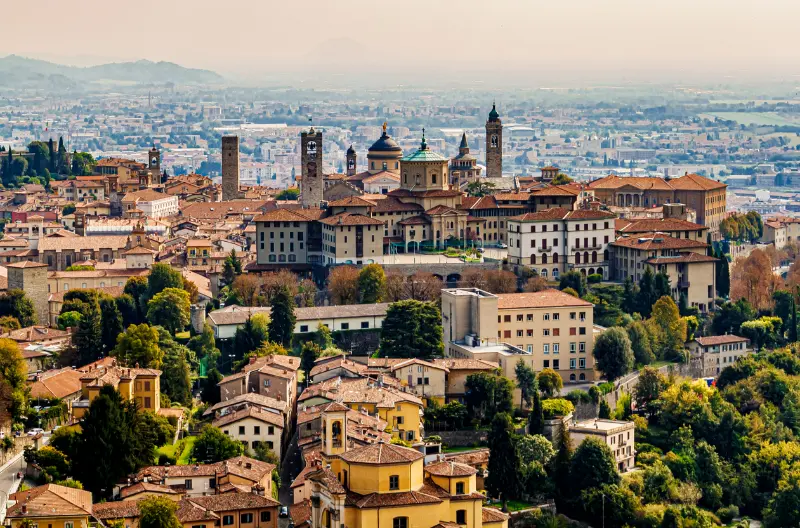
The best things to do in Bergamo are not all inside Città Alta. The old hilltop city contains the famous squares, churches and Venetian Walls, but the lower town adds major art, historic neighbourhoods, shopping streets and the everyday city that keeps Bergamo from feeling like an open-air museum. The right list therefore mixes landmarks with routes and experiences rather than ranking eighteen isolated photo stops.
| Top first-time priority | Piazza Vecchia + Piazza Duomo |
|---|---|
| Best free experience | Walk the Venetian Walls |
| Best art museum | Accademia Carrara |
| Best extra view | San Vigilio hill |
1. Piazza Vecchia
Piazza Vecchia is the natural orientation point in Città Alta. The Palazzo della Ragione, Palazzo del Podestà, Contarini Fountain and civic architecture make it worth more than a quick photograph. Arrive early or return in the evening to understand the square without the heaviest day-trip traffic. The arcades also lead directly toward Piazza Duomo, so this is the hinge between the civic and religious centre.
For the wider destination context behind Best Things to Do in Bergamo, see our Bergamo Travel Guide, including sights, transport and useful planning choices.
2. Piazza Duomo, Santa Maria Maggiore and Cappella Colleoni
Piazza Duomo compresses several major monuments into a very small space. Santa Maria Maggiore is particularly rewarding inside, where the decoration, tapestries and wooden inlays contrast with the Romanesque exterior. Next door, the Cappella Colleoni is one of the city’s most recognisable Renaissance façades. The cathedral completes the group. Check current opening periods because worship and visitor access do not always follow identical schedules.
3. Climb the Campanone
The civic tower rises above Piazza Vecchia and provides one of the clearest ways to read the urban form of Città Alta. The Museo delle Storie currently publishes combined access to the Campanone and Palazzo del Podestà, with different weekday and weekend hours. The tower’s bell still recalls the old closing of the city gates with evening chimes, making it one attraction that connects skyline, ritual and history.

4. Walk the Venetian Walls
The Venetian Walls are more than a scenic terrace. Built from the sixteenth century as part of the Republic of Venice’s defensive system, they encircle the upper town for more than six kilometres and form part of a transnational UNESCO World Heritage property. Walk at least the stretch between Porta Sant’Alessandro, the viewpoints and Porta San Giacomo, ideally near sunset when the lower city and plain become part of the experience.
5. Enter through Porta San Giacomo
Porta San Giacomo is the most theatrical arrival on foot. Its pale stone façade faces the lower city, and the approach gives a strong sense of the elevation that shaped Bergamo’s defence. It is also a practical connection if you walk up from Città Bassa rather than using the funicular. Avoid treating the gate only as an Instagram backdrop; continue along the wall to see how it belongs to a much larger fortification system.
6. Ride the historic funicular
The city funicular has linked the lower and upper parts of Bergamo for more than a century. The ride is short, but it is useful transport and part of the city’s identity. If queues are long, take an ATB bus to Colle Aperto and use the funicular on the way down. That is often a better use of time than waiting simply because the funicular appears on every checklist.
7. Continue to San Vigilio
A second funicular climbs from the upper town toward San Vigilio. This is an optional extension for travellers with at least a full day or an overnight. The hill feels less compressed than the core around Piazza Vecchia, and the viewpoints explain why Bergamo sits between the plain and the pre-Alpine valleys. Pair it with a slow walk rather than going up solely for five minutes of photographs.
8. Explore the Rocca and its viewpoints
The Rocca occupies the hill of Sant’Eufemia and gives another perspective over roofs and walls. Even when museum spaces or specific sections have temporary changes, the surrounding area is worth including in an upper-town loop. The location also helps connect the eastern side of Città Alta with Porta Sant’Agostino and the descent toward the art-museum district.
9. Visit the Accademia Carrara
The Accademia Carrara is the city’s major art museum and belongs in the plan of anyone interested in Italian painting. Its collection includes works associated with masters such as Raphael, Botticelli, Mantegna, Lotto and Moroni. The museum is in the lower city near Via San Tomaso, making it easy to combine with a downhill route from Porta Sant’Agostino rather than forcing a return to the station area first.
10. Give Città Bassa a real walk
Porta Nuova, the Sentierone, Teatro Donizetti and Via XX Settembre show a different Bergamo from the medieval lanes above. The official lower-town itinerary covers a compact loop through nineteenth- and twentieth-century urban fabric, shopping streets and older borghi. This part of the city is especially useful at the end of a day when you want level walking, cafés and easier access to the railway station.
11. Walk Borgo Pignolo
Borgo Pignolo is a strong transition zone between Città Alta and the Carrara. Noble façades, churches and a more residential rhythm make it useful for travellers who want to see how the city developed outside the walls. The stairway connections toward the upper town also provide a more atmospheric alternative to repeating the funicular route.
12. Hear Donizetti’s Bergamo
Bergamo is the birthplace of composer Gaetano Donizetti. Even visitors who do not attend a performance can notice his presence through the Teatro Donizetti, museum collections and local cultural references. If opera is central to your trip, check the theatre calendar well before arrival; if not, a walk past the theatre and through the Sentierone is enough to place his legacy in the modern city.
13. Taste casoncelli
Casoncelli alla bergamasca are one of the city’s essential dishes, not just a generic Lombard pasta. The filling and butter-sage-pancetta dressing create a richer plate than it may appear on a menu. Order them when you have time for a proper meal rather than between two timed entries. For a deeper food plan, use the Bergamo food guide.
14. Try polenta and local cheeses
Polenta is deeply rooted in Bergamo and its valleys, and taragna adds cheese and butter for a heavier mountain-style version. The province’s dairy tradition is unusually strong, with several protected cheeses connected to the surrounding valleys. A tasting plate can be more informative than ordering three heavy courses, especially in warm weather.
15. Have stracciatella gelato where it began
Stracciatella gelato was created in Bergamo, making it one of the easiest local stories to taste. The important point is not to turn the stop into a pilgrimage that dictates the whole route; enjoy it when you are already around Colle Aperto or the upper-town streets and use it as a break between walking sections.
16. Watch sunset from the walls
Sunset is one of the few Bergamo experiences where timing matters more than a ticket. The western and southern wall sections open views across the lower city and plain, and the stone catches different light than it does at midday. If you stay overnight, this is the moment when Bergamo most clearly repays the decision not to rush back to Milan on the first afternoon train.
17. Take a self-guided stairway route
Bergamo’s scalette—historic pedestrian stairways—turn the vertical separation of the city into an attraction. Choose one uphill or downhill route and keep footwear practical. The reward is not a single monument but a sequence of gardens, walls, residential lanes and unexpected views. In rain, polished stone can be slippery, so the bus or funicular is the sensible alternative.
18. Use Bergamo as a base for eastern Lombardy
After the city itself, Bergamo works as a base for Lake Iseo, the Brembana and Seriana valleys, Crespi d’Adda and other destinations. Do not try to add these to a six-hour city visit. The best day trips from Bergamo guide separates excursions that work by public transport from those that are easier with a car.
How to choose from this list
With half a day, focus on Città Alta, Piazza Duomo and the walls. With a full day, add the lower town or Carrara. With two days, include San Vigilio, a museum and slower food. The one-day Bergamo itinerary and two-day itinerary put these sights in geographic order so you spend less time backtracking.
Tours and tickets: when booking adds value
A guided experience makes the most sense when it adds interpretation or removes a logistical problem rather than simply replacing an easy walk. In Bergamo, a well-led Città Alta or food tour can be useful for first-time visitors who want historical context, while independent travellers can comfortably explore most central sights on their own. Check the meeting point, language, inclusions and cancellation policy before paying.
Where to stay
Bergamo is compact enough that location often matters more than hotel category. Città Alta gives atmosphere after day-trippers leave, Città Bassa is easier for the station and airport bus, and the streets around Borgo Pignolo can offer a useful middle ground. Compare hotels and apartments in Bergamo and check the exact walking route to the station, bus stop or funicular before booking.
How to build your own priority list
Rank activities by type rather than fame. Choose one elevated viewpoint, one major church interior, one museum, one long outdoor walk and one food experience. This prevents duplication: after the Campanone, another tower may add less value than the Carrara; after a long wall walk, another panoramic detour may add less than sitting in a square.
Also consider opening days. The Carrara’s Tuesday closure can make Monday or Wednesday a better art day, while church access changes with worship. A personalised sequence built around actual hours is more reliable than copying a fixed online “top ten.”
Useful official sources
- Visit Bergamo – things to do
- Visit Bergamo – Upper Town
- Museo delle Storie di Bergamo
- Accademia Carrara
Final planning advice
Do not measure Bergamo by the number of monuments completed. The strongest visit combines one tower or museum, one church complex, one long section of walls, one local meal and enough unplanned walking to notice the city between the highlights. That balance gives you both the postcard Bergamo and the living one.
Last updated: October 17, 2026