
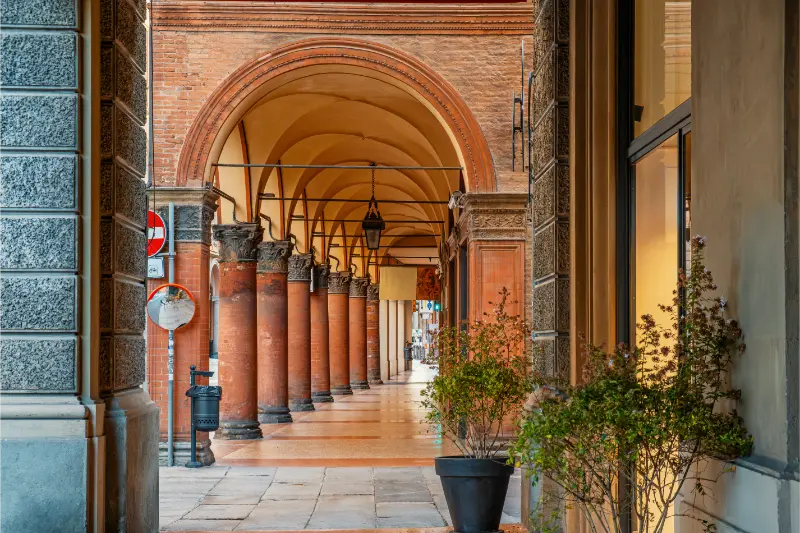
Bologna’s porticoes are not a single monument but the city’s operating system. Roughly 62 kilometres of covered walkways connect houses, churches, shops, university buildings and hills, and UNESCO recognises 12 representative components as a World Heritage property. The best way to experience them is to walk contrasting routes rather than chasing one “most beautiful” arcade.
At a glance
| UNESCO inscription | 2021 |
|---|---|
| Total network | About 62 km |
| UNESCO property | 12 component parts |
| Most famous long walk | Portico of San Luca |
| Best approach | Combine central and hillside sections |
What UNESCO actually inscribed
UNESCO did not designate every portico in Bologna individually. The World Heritage property is a serial site made up of 12 representative components, selected from the wider 62-kilometre network. They demonstrate different periods, building materials, social functions and urban contexts, from historic central streets to modern residential architecture.
For a fuller understanding of the surrounding area, use our Bologna Travel Guide alongside these more focused recommendations.
This distinction matters when planning. You do not need to visit all 12 components to “complete” the site. Instead, choose examples that reveal variation: Pavaglione and Piazza Maggiore for the central monumental city, Santo Stefano or Strada Maggiore for historic residential character, and San Luca for the dramatic hillside route.
Why Bologna has so many porticoes
Porticoes developed as the city expanded and property owners extended upper floors over public space. Over time they became regulated, normalised and integrated into daily urban life. The result is an unusual public-private arrangement: many porticoes belong structurally to private buildings but function as publicly used walkways.
Their value is therefore social as much as architectural. They support commerce, conversation, walking and shelter from rain or sun. A visitor understands Bologna better by noticing how people use the spaces than by photographing columns alone.
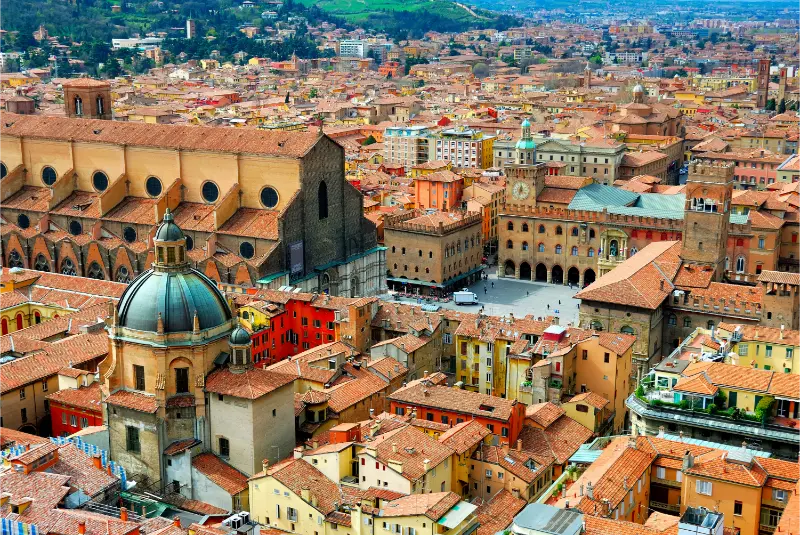
Route 1: Piazza Maggiore and the Pavaglione
The easiest introduction begins around Piazza Maggiore and continues under the Pavaglione toward the Archiginnasio. This route is short, flat and filled with major sights, making it ideal for a first morning. It also belongs to one of the UNESCO component areas.
Look at shopfronts, paving, ceiling height and the way arcades frame views into side streets. Walk the same section in both directions: porticoes often reveal different architectural rhythms depending on where you stand.
Route 2: Santo Stefano and Strada Maggiore
The eastern side of the centre offers a more residential and atmospheric experience. Piazza Santo Stefano is surrounded by historic façades and leads naturally into streets where porticoes feel less ceremonial than around Piazza Maggiore. Strada Maggiore is especially useful for observing changes in width, column style and building age.
This route combines well with the Two Towers area and can fill a relaxed afternoon without a single ticketed attraction.
Route 3: Via Saragozza to San Luca
The portico to the Sanctuary of San Luca is the most famous long covered walk. It stretches from the city toward the hills, passing the Arco del Meloncello before climbing. The experience is partly architectural and partly physical: the gradient becomes significant and the route can feel long in heat or poor footwear.
Allow several hours if you plan to walk up, visit the sanctuary and return on foot. Many travellers prefer to walk one direction and use public transport or a tourist service for the other. Carry water and avoid the hottest part of summer days.
The 12 UNESCO components
The UNESCO serial property includes areas such as Santa Caterina and Saragozza; Santo Stefano and Mercanzia; Galliera; Baraccano; Pavaglione, Banchi and Piazza Maggiore; San Luca; University and Academy; Certosa; Cavour, Farini and Minghetti; Strada Maggiore; MAMbo; and the Treno della Barca residential complex.
You do not need to memorise the list, but it demonstrates the range of the designation. The inclusion of modern components is particularly important: Bologna’s portico tradition did not end in the Middle Ages but continued adapting to new materials and urban forms.
Best route for one hour
If you only have an hour, start at Piazza Maggiore, walk under Pavaglione to the Archiginnasio, cut toward Via Farini and Piazza Minghetti, then continue to Santo Stefano before returning through the Two Towers area. You will see ceremonial, commercial and residential porticoes without leaving the centre.
Use this route in rain, but remember that wind can blow water into open sides and paving may become slippery. Covered does not mean weatherproof.
Best route for half a day
For half a day, begin with the central UNESCO components and continue west along Via Saragozza toward Arco del Meloncello. Decide there whether you have the energy and time to continue uphill toward San Luca. This creates a narrative from civic centre to residential streets to pilgrimage landscape.
Alternatively, combine central porticoes with a museum such as MAMbo, which represents a different component of the UNESCO property. This is a good choice in unstable weather.
Walking to San Luca: physical reality
The San Luca route is frequently described as an easy must-do, but travellers should judge it like a genuine uphill walk. Distance, gradient and temperature matter. Comfortable shoes, water and sun protection are more important than having the perfect outfit for photographs.
If you have knee problems or limited stamina, use transport uphill and walk a shorter section instead. Experiencing part of the route is better than turning the day into an endurance test.
Porticoes in rain and summer heat
Porticoes are one reason Bologna remains enjoyable in less-than-perfect weather. They reduce direct sun exposure and keep central walking routes viable during rain. But they can also trap humidity and do not protect every crossing between streets, so carry a compact umbrella and water.
In hot weather, schedule open spaces such as Piazza Maggiore early, then use porticoed routes during midday. This simple adjustment can make a summer visit significantly more comfortable.
Photography and architecture
Porticoes are ideal for perspective photography because repeated columns create strong lines, but avoid blocking busy passages while composing a shot. Step to the edge, wait for pedestrian gaps and look upward for painted ceilings, capitals and different construction materials.
The best photographs often include people because the UNESCO value includes the social function of these spaces. Empty arcades are beautiful, but inhabited porticoes are more truthful to Bologna.
Accessibility
Many central porticoes are level or gently graded and provide shade, making them useful for travellers with limited mobility. However, historic paving, steps at shop entrances and steep routes such as San Luca can create barriers. Choose central components if step-free movement is a priority.
For a specific museum or sanctuary, verify accessibility separately. The existence of a porticoed approach does not guarantee that the interior is accessible.
How to connect the porticoes with the rest of Bologna
Use the porticoes as the structure of your day rather than adding them as another item. Walk under Pavaglione between San Petronio and the Archiginnasio; use Santo Stefano porticoes between the Two Towers and dinner; choose Via Saragozza when going toward San Luca. This eliminates unnecessary transport and makes architecture part of every transition.
The Bologna travel guide and two-day itinerary are built around this principle.
Official UNESCO information
UNESCO describes the property as 12 component parts representing a wider network of about 62 kilometres, with examples dating from the 12th century to the present. For detailed maps of the designated components, use the official UNESCO World Heritage page.
This is the best reference when you want to distinguish the formal World Heritage components from Bologna’s broader portico network.
Final thoughts
The porticoes are Bologna’s most distinctive urban experience because they are both heritage and infrastructure. Walk several contrasting sections, include San Luca only if the physical effort fits your trip, and pay attention to how residents use the spaces. You will understand more about Bologna from two hours under its arcades than from rushing through several unrelated attractions.
One more practical note
For a deeper architectural visit, compare column materials, ceiling forms and the relationship between private façades and public passage. Notice where a portico widens into a social space, where it narrows into circulation and where modern construction reinterprets the form. Those observations reveal why UNESCO considered the system an urban model rather than merely a decorative feature.
Last updated: October 17, 2026