
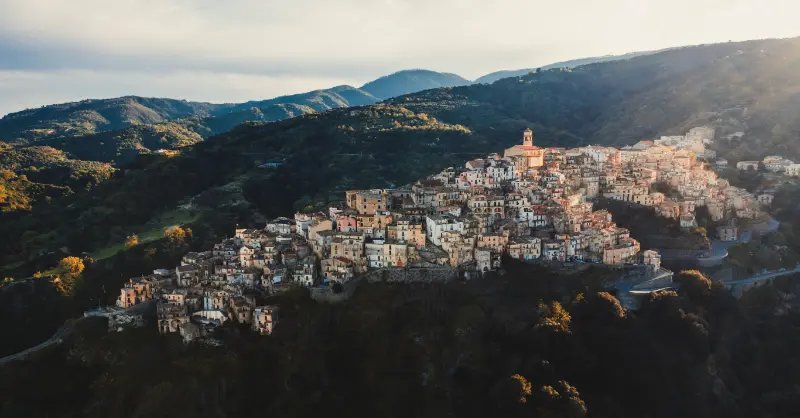
Badolato is easy to misunderstand if you see only the name on a map. One part of the municipality faces the Ionian Sea, where visitors come for the beach and practical holiday services. The other is Badolato Superiore, a hill village where stone streets and religious buildings cling to the landscape above the coast. The distinction is the key to planning a satisfying visit. You can enjoy a seaside stay and a historical excursion in a single trip, but do not assume the two districts are connected by a flat pedestrian promenade. This guide explains how to experience the old town without rushing, where a car helps, and how to avoid the common mistake of booking accommodation in the wrong part of Badolato.
In this guide
- Badolato Superiore and Badolato Marina are two different experiences
- What the upper village actually feels like
- Churches and sacred heritage in a small hill town
- Understanding the village’s past without romanticizing decline
- Panoramic viewpoints and photography
- A realistic walking circuit in Badolato Superiore
- The Ionian coast and your beach-day options
- Getting there by car, rail or bus
- Where to stay and how long is enough
- Food, local rhythm and seasonality
- Pair Badolato with a sensible Ionian itinerary
- Frequently asked questions
Badolato Superiore and Badolato Marina are two different experiences
Badolato Marina is the practical seaside side of the municipality, with access to the Ionian coast, modern roads and seasonal services. Badolato Superiore stands inland and uphill. While both belong to the same local identity, they suit different types of vacation. A traveler who wants to walk to the water after breakfast should look at the marina. Someone who enjoys quiet evening lanes, old houses and hillside views may prefer the upper village. A property using the municipality’s name alone may not make the distinction obvious.
For a broader Calabria itinerary, see the Calabria travel guide before deciding which destinations to combine with Badolato.
If you have just one day, think of the itinerary as a deliberate pairing: historical walk in the cooler hours and beach time later, or the reverse in summer. Avoid trying to move between the districts repeatedly. The journey is much simpler with a car, especially outside the busiest holiday season when public transport can be infrequent. A transfer should be treated as a real part of the plan, not an invisible line on a map.

What the upper village actually feels like
The pleasure of Badolato Superiore comes from its urban texture. Narrow lanes turn through compact buildings, arches and stairways, revealing glimpses of hills and water beyond the rooftops. It is not a theme park of medieval architecture. Some houses have been restored, while others show the passage of time. That mix is part of the visit: a genuine settlement changing through different periods, with residents and community uses rather than endless visitor-only attractions.
Give yourself time to walk without a rigid objective. Instead of heading straight to the highest viewpoint, explore a sequence of small piazzas and note how the streets connect. The difference between a steep side lane and an easier route becomes important in the heat, particularly with a stroller. If the village seems unusually quiet, remember that this may be a normal weekday rather than evidence that everything is abandoned. Keep your expectations grounded and observe the details that a quick driving tour would miss.
Churches and sacred heritage in a small hill town
Religious buildings are among the main landmarks of Badolato’s older center. They reflect the way worship, confraternities and community life helped structure the settlement. A church façade can be meaningful even when the interior is closed, but a respectful visit inside may reveal altars, paintings or later rebuilding that complicate the idea of a town frozen in one medieval era. Opening hours can depend on services, volunteers, repairs and special occasions.
Do not build the entire trip around an assurance that a particular church will be accessible on demand. If interior viewing matters, ask the local tourism office or parish for current arrangements before arriving. In the village, avoid walking into buildings that look ecclesiastical but function as community spaces or residences. Quiet observation is usually enough. For travelers interested in religious history, Badolato is best paired with a broader itinerary through Calabria’s Ionian villages rather than treated as a single isolated shrine.
Understanding the village’s past without romanticizing decline
Like many hill settlements in southern Italy, Badolato has experienced demographic changes and migration. The older fabric tells a story of adaptation, not simply a picturesque ruin. It is tempting to describe every weathered doorway as abandoned and every restored house as a revival project; both are simplifications. Families, local institutions and newcomers have shaped the town in different ways, and some houses that look empty from outside are private properties used seasonally.
Read heritage signage carefully when available and distinguish documented dates from local tradition. Earthquakes and later rebuilding affected many towns in Calabria, so the presence of a medieval street layout does not prove every building has survived unchanged. The historically interesting question is how the community occupied a defensible inland position and later developed stronger links with the coast. Keeping that perspective makes a slow walk more informative than a sensational story about a ‘ghost village.’
Panoramic viewpoints and photography
The upper town offers rewarding views across the Ionian landscape. Depending on the exact viewpoint and visibility, you can read the relationship between the village, agricultural slopes, coastal plain and the sea. The best photographs often include a foreground of stone houses or a church tower rather than a wide empty horizon. Late afternoon may soften the light, but it also places you in the village as some shops begin closing. Plan your return drive accordingly.
Be particularly careful near old walls, narrow terraces or unsupervised steps. A missing safety rail is not a challenge to take one step closer. Use public lookouts and avoid blocking residents’ doorways with tripods. Drones are subject to aviation, privacy and local restrictions; do not assume a remote village is an unrestricted flying area. Weather can also reduce the distant sea view, so photography should be one pleasure among many, not the sole purpose of your journey.
A realistic walking circuit in Badolato Superiore
Park legally near an appropriate entrance to the historic area, identify a return route and begin with the most comfortable lane. Spend an initial period simply orienting yourself before approaching the main religious landmarks and viewpoints. If a church is open, step inside quietly and take time to understand its details. Continue through smaller lanes only where pedestrian passage is clearly public. Finish in a piazza or café if businesses are operating that day.
Allow at least a couple of relaxed hours, more if photography, lunch or conversations with local residents are part of the experience. A rushed twenty-minute detour rarely justifies the ascent. If driving with a family group, agree on a meeting point because mobile navigation can send people to different sides of a tangle of historic alleys. Do not assume everyone in the party will enjoy the same number of stairs; one person may prefer to wait comfortably in a central square.
The Ionian coast and your beach-day options
Badolato Marina is the natural place to add time by the water. As elsewhere on the Ionian side of Calabria, the characteristics of sand, small stones, beach facilities and swimming depth change from one stretch to another. Choose a specific beach on the basis of its actual access, available lifeguard services and conditions on the day. The sea can become rough when wind direction changes, and descriptions promising permanently calm, child-safe water are not reliable.
A family beach day is easiest with shade, water and access to restrooms. Organized beach establishments may simplify that routine in summer, while free beach areas provide more flexibility for travelers bringing their own equipment. Respect marked pathways and never drive onto dunes or vegetation. If you are staying in the hill village and plan to swim daily, calculate the repetitive car trip honestly before reserving your room. A romantic historic address is not automatically the most convenient holiday base.
Getting there by car, rail or bus
Road access is generally the most convenient way to combine Badolato Marina with Badolato Superiore. Use the SS106 coastal corridor for regional travel, then follow the appropriate inland approach to the upper village. Because the old streets are narrow, the last section should often be on foot. Check parking rules and never rely on a navigation app to judge whether a street is suitable for a rental car.
Rail travelers should check the current timetable for the relevant coastal station and confirm the onward connection before buying tickets. A station name linked to Badolato does not automatically mean you can walk to Badolato Superiore with luggage. Local buses and taxis may operate with limited frequency, particularly on Sundays. If public transport does not align with your day, choose a different outing instead of arranging a hazardous walk along roads designed primarily for vehicles.
Where to stay and how long is enough
For a summer beach vacation, choose a hotel or apartment in the marina with verified walking access to the beach. Read reviews for noise, parking, air conditioning and whether the immediate environment matches your expectations. In the upper village, accommodation may be atmospheric and quiet, but questions about stairs, luggage transport, heating and shops are essential. Check if the property is reached by car or whether you will carry bags through narrow lanes.
Badolato Superiore itself is a strong half-day excursion. One night in the old village can add a completely different perspective, especially in the evening, but it is not necessary to make a meaningful visit. Two or three nights in the area work if you want a balance of beach time and nearby villages, including other points along the Jasmine Coast. Base decisions on your main activity, not simply on the most photogenic accommodation listing.
Food, local rhythm and seasonality
Meals here should feel like part of Calabria rather than a generic seaside resort menu. Look for seasonal vegetables, pasta preparations, local cheeses, preserved produce and fish dishes where available, while remembering that restaurants adapt their menus to daily supplies. Ask what is in season instead of assuming every traditional dish is served every day. In smaller hill towns, a restaurant may open only on selected evenings outside the summer period.
Spring and fall favor the ascent and walking in the upper settlement; summer suits a mixed holiday with the sea, but afternoon heat can make stone streets uncomfortable. Winter is possible for a contemplative visit, though many visitor services may close or keep limited schedules. Carry water and sun protection and check the forecast before the drive. If an event or religious procession interests you, consult the municipal calendar because dates and arrangements can change.
Pair Badolato with a sensible Ionian itinerary
Badolato combines naturally with Soverato or Roccella Ionica on a multi-day coastal route, while the inland villages of the area offer a different cultural dimension. Keep drive times realistic: Calabria looks narrow on a small map but mountain roads and coastal traffic can stretch journeys. A full day might reasonably include the upper village, a seaside lunch and an afternoon swim. Adding several separate castles and archaeological parks may turn it into a race.
Help preserve the character that attracted you. Park outside constrained lanes, do not enter private houses, avoid treating worn buildings as props and dispose of waste responsibly. If the village appears quiet, that is not permission to ignore residents’ privacy. A good visit leaves you with an understanding of why the hill settlement and marina developed different roles, and with enough time to appreciate both without forcing them into the same picture.
At a glance
| Destination | Badolato, Calabria |
| Main historic sight | Badolato Superiore lanes and religious buildings |
| Coastal addition | Badolato Marina on the Ionian Sea |
| Best transport | A car or confirmed transfer between the two districts |
| Watch out for | Steep steps and confusion over hotel locations |
| Time to allow | A generous half day for the main visit; extend it for a second stop |
Related Calabria guides
- Calabria Travel Guide: Where to Go, Stay and How to Plan
- Where to Stay in Calabria: Best Areas and Bases
- Catanzaro: Historic Streets, Views and the Ionian Waterfront
- Soverato: Ionian Beaches, Promenade and the Old Hill Village
Official information and travel planning
Confirm access, visitor arrangements and protected-area rules at the relevant official sources before departing: calabriastraordinaria.it, calabriastraordinaria.it.
Frequently asked questions
What is the difference between Badolato Superiore and Marina?
Badolato Superiore is the historic inland hilltop; Badolato Marina is the coastal district for beach services and accommodation.
Is Badolato an abandoned village?
No. It is a lived-in village with historic buildings and evidence of demographic change; do not enter houses or assume quiet streets are abandoned.
Can I walk from the beach to the old town?
They are separate locations with a substantial elevation difference. Plan a drive or confirmed local transfer.
Is the old village suitable for a stroller?
Some historic streets have steps and uneven stone. Ask about a limited accessible circuit rather than assuming an easy stroller route.
How much time should I allow?
Allow a few hours in the old town, plus separate time at the coast if you want a swim or seaside meal.
Last updated: October 17, 2026