
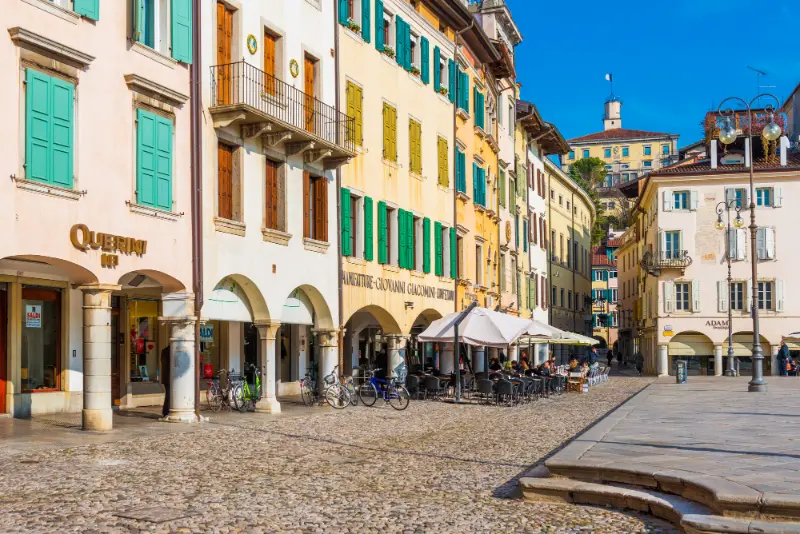
Friuli Venezia Giulia rewards travelers who like contrasts. A single week might include a Roman mosaic floor, an Adriatic swim, a border-city walk and a mountain lake framed by forest. The challenge is deciding what belongs in your own itinerary. The following places are chosen for distinct experiences rather than for how often they appear on a postcard. You do not need to visit them all; a family looking for a relaxed coast trip will make different choices from a traveler interested in the architecture and politics of Europe’s borderlands.
On this page
- 1. Walk Trieste's great seafront square and Molo Audace
- 2. Give Miramare Castle its own half-day
- 3. Experience Trieste's café and literary culture
- 4. Climb to San Giusto for the city from above
- 5. Explore Udine's Piazza Libertà and castle hill
- 6. See Tiepolo's work in Udine
- 7. Stand over Aquileia's ancient mosaics
- 8. Follow the Roman city beyond Aquileia's basilica
- 9. Cross Cividale's Devil's Bridge
- 10. Visit Cividale's Lombard Temple
- 11. Walk through the shared story of Gorizia and Nova Gorica
- 12. Explore Gorizia Castle and the old hill district
- 13. Spend a beach day in Grado
- 14. See the lagoon from a boat or reserve path
- 15. Discover the star-shaped city of Palmanova
- 16. Taste Friulian food and the wines of the hills
- 17. Walk around the Fusine Lakes near Tarvisio
- 18. Explore the Friulian Dolomites and Carnia
- 19. Spend time in Pordenone and nearby towns
- 20. Follow part of the Alpe Adria cycling route
- How to choose without overpacking the trip
At a glance
| Interest | Start with |
|---|---|
| UNESCO history | Aquileia, Cividale, Palmanova |
| Seafront | Trieste, Grado |
| Art | Udine, Trieste museums |
| Outdoors | Fusine Lakes, Carnia, lagoon reserves |
1. Walk Trieste's great seafront square and Molo Audace
Piazza Unità d’Italia is an unusually open civic space: grand facades face the sea instead of enclosing the square. It is the clearest starting point for understanding Trieste as a port city. Continue onto Molo Audace for water views and look back toward the buildings, especially in early or late light. The area works as a short stop, but it becomes more interesting when combined with the city’s waterfront history and nearby old streets. Rather than rushing to the next landmark, make room for a café break and notice the mix of Italian, Habsburg and maritime influences. Wind can be strong, and an exposed pier is not always the best place to linger with a stroller in bad weather.
To see where Best Things to Do in Friuli Venezia Giulia fits into a wider Friuli Venezia Giulia itinerary, use our Friuli Venezia Giulia travel guide for transport, bases and possible neighbouring stops.

2. Give Miramare Castle its own half-day
Miramare is associated with Archduke Maximilian and Charlotte and sits on a dramatic promontory north of central Trieste. The historic rooms and coastal park are two complementary reasons to go. Check museum ticketing separately from park access, and do not assume every garden zone or indoor space is open on the same schedule. Arrive with enough time to stroll rather than treating the castle as a quick photo stop. Combining Miramare with a Barcola waterfront break can create an excellent outdoor-focused day, while San Giusto hill is better saved for another city walk. Travelers who dislike crowded interiors may find the grounds especially rewarding on a fine day.
3. Experience Trieste's café and literary culture
James Joyce, Italo Svevo and Umberto Saba are tied to the city’s literary story, and historical cafés help give that story a physical setting. Instead of choosing a café purely for its décor, look for a place where you can sit comfortably and take in everyday city life. Coffee names and customs can differ from elsewhere in Italy, so read the menu or ask the staff rather than assuming your regular order means exactly the same thing. Combine a café stop with Canal Grande, the Serbian Orthodox church area and a gentle walk around the Borgo Teresiano district. This is an easy activity to move to a rainy afternoon and suits mixed-age groups better than another long museum visit.
4. Climb to San Giusto for the city from above
The cathedral and castle on San Giusto hill offer a transition from Trieste’s seafront elegance to earlier layers of the city. The ascent is part of the experience, but it can be tiring in the heat; use public transport or plan a slower route when necessary. The castle ramparts reward visitors with views over roofs and the gulf, and Roman remains add context to the hill’s long history. Check separate access rules for museum spaces and elevated walkways. For an efficient half-day, explore the cathedral area first, then decide whether the castle interiors justify extra time based on your interests.
5. Explore Udine's Piazza Libertà and castle hill
Udine provides a very different city experience from Trieste. Piazza Libertà and the Loggia del Lionello express the historic Venetian connection, while the castle hill looks out toward the surrounding plain. Walk down through the lanes to Piazza Matteotti, where arcades, shops and bars create an easygoing atmosphere. This is an excellent city for people who like to explore on foot without spending the entire day in transit. If you enjoy art, add the museums; if you are traveling with children, alternate the uphill visit with a relaxed lunch and square time. Most of the lower-center circuit is straightforward, but historic paving can be uneven.
6. See Tiepolo's work in Udine
The frescoes connected with Giambattista Tiepolo make Udine especially compelling for art lovers. The Museo Diocesano e Gallerie del Tiepolo preserves important works, while other churches and museums reveal the city’s artistic heritage. It pays to confirm the correct entrance, admissions and exhibition arrangements rather than assuming one combined ticket covers everything. An hour spent thoughtfully with a small number of paintings or frescoed rooms can be more rewarding than trying to visit every venue. Pair art stops with the nearby historic centre and leave time to sit down afterward; this is a cultural excursion, not a race between gallery addresses.
7. Stand over Aquileia's ancient mosaics
The Patriarchal Basilica at Aquileia holds an extraordinary early Christian mosaic floor within a UNESCO-listed setting. The floor is more than decorative: its images, scale and setting tell the story of a major Roman and religious centre. Read interpretive material before or during the visit so that details do not blur together. Outside, archaeological areas such as the forum and old river-port remains widen the picture beyond the basilica itself. Museum schedules and ticketing can differ between the various spaces, so decide in advance whether you are planning a focused two-hour visit or a full archaeological day. Sun protection matters on exposed outdoor stretches.
8. Follow the Roman city beyond Aquileia's basilica
For visitors who enjoy archaeology, the National Archaeological Museum and excavated sites around Aquileia deserve attention in their own right. The ancient city was a key Adriatic junction, and seeing domestic, civic and commercial remains helps explain why it mattered. The site is dispersed rather than arranged as a compact theme park. Map your stops before arrival, keep museum closing times in mind and wear comfortable shoes. Pairing everything with Grado is possible, but a dedicated Aquileia day usually produces a calmer and more satisfying visit. Families may do better choosing one museum section plus the basilica instead of attempting every excavation area.
9. Cross Cividale's Devil's Bridge
Cividale del Friuli is set over the Natisone River, and the Devil’s Bridge provides one of the region’s most recognizable views. The bridge is an atmospheric introduction, not the whole attraction. Move through the historic lanes to understand the town’s Lombard past, and look back at the river from different angles. Down toward the riverbed, conditions and paths may change with weather and water levels, so keep to permitted routes. Cividale can be reached from Udine by a dedicated train service, making it an excellent choice for visitors without a car. Allow enough time for both the outdoor walk and the historic interiors.
10. Visit Cividale's Lombard Temple
The Tempietto Longobardo in the Monastery of Santa Maria in Valle belongs to the UNESCO serial site devoted to Lombard places of power in Italy. It is a concentrated experience: architectural details and early medieval artistry reward attentive viewing. Confirm current entrance arrangements, and consider adding the Christian Museum or archaeological collection for greater historical context. This makes an especially good stop for travelers interested in periods of Italian history that receive less attention than the Roman Empire or Renaissance. Avoid scheduling it only as an add-on after a large lunch; you will appreciate the visit more with time and a little energy left.
11. Walk through the shared story of Gorizia and Nova Gorica
The Italian city of Gorizia and its Slovenian neighbor Nova Gorica jointly carried the European Capital of Culture title in 2025. Their shared story can be approached on foot, from Gorizia’s castle quarter to the symbolic cross-border space at Piazza Transalpina. The streets reveal how twentieth-century borders cut through local life and how cross-border cooperation has changed the experience of visiting. You do not need to rush between countries to make the point: take time with the signs, museums and public spaces. Check current exhibits and bus services, and carry identification when crossing borders. This is particularly meaningful for travelers interested in European history.
12. Explore Gorizia Castle and the old hill district
Gorizia Castle stands above the city and offers a satisfying combination of military history, town views and quiet lanes in Borgo Castello. The walk from the lower centre climbs steadily; choose your approach to match the group’s mobility. A museum visit can be combined with Piazza della Vittoria and Via Rastello for a rounded city day. The castle was altered and restored over the centuries, so the present building is not a completely untouched medieval monument. Read the interpretation as you explore rather than expecting one continuous architectural period. If the castle has temporary closures, the surrounding district still warrants attention.
13. Spend a beach day in Grado
Grado is one of the more accessible seaside choices for families, with sandy beaches, organized services and a walkable historic centre. Choose your beach area carefully: reserved umbrella zones, public access points and facilities have different conditions. The water is generally shallow near the shore, but children still need supervision and local flags and sea conditions always take priority. Later, explore the old streets around Sant’Eufemia and enjoy the town after day visitors leave. Grado can support a few relaxed nights or a long day paired with nearby heritage sites. It is not the same as a rocky Trieste bathing terrace.
14. See the lagoon from a boat or reserve path
The Grado lagoon is a world of waterways, small islands, fishing traditions and bird habitats. A guided boat outing offers perspectives you cannot get from a beach promenade; a nature-reserve visit can work well for travelers preferring to stay on land. Look into Valle Cavanata or the mouth of the Isonzo for wildlife-focused possibilities, respecting access restrictions. Some cruises and coastal links are seasonal, and boats may cancel for weather. Avoid assuming that every route includes Barbana Island or that every reserve path is open year-round. Bring binoculars for birds and allow time to enjoy a quieter landscape than the resort beaches.
15. Discover the star-shaped city of Palmanova
Palmanova is a planned fortified town whose nine-pointed layout makes sense most clearly on a map and from its ramparts. It forms part of the UNESCO serial property relating to Venetian defense works. The central Piazza Grande, city gates and earthworks are highlights, but the most rewarding visit connects their geometry with the military history of the area. A short walk can be enough for a first taste; history enthusiasts can spend longer on designated fortification routes and museum spaces. Check permitted access on the ramparts and be cautious around slopes or former military structures. Palmanova pairs naturally with Aquileia for a day focused on historical landscapes.
16. Taste Friulian food and the wines of the hills
Eating is not a filler between attractions here. Try frico, prosciutto di San Daniele, local cheeses and seasonal dishes; along the coast look for seafood rooted in Adriatic tradition. The Collio hills around Cormòns and the Colli Orientali near Udine are good choices for wine lovers. Select one or two producers and book in advance rather than rushing through a series of tastings. If a driver would otherwise need to abstain, consider organized transport. For non-drinkers, the hills still offer scenery, villages and food, so a vineyard afternoon does not need to revolve around alcohol.
17. Walk around the Fusine Lakes near Tarvisio
The Fusine Lakes offer impressive mountain scenery where forests, water and the Julian Alps meet. This is not an extension of a casual Trieste city walk: travel time, mountain weather, parking and trail surface all need attention. Choose a short lakeside route if visiting with children or less-experienced walkers, and verify whether particular paths are suitable for strollers. Conditions change after rain and snow, while the upper slopes demand appropriate equipment. The scenery is a powerful reason to spend time in the northern part of the region, but it deserves to be planned as a mountain outing rather than an afterthought on the way to another town.
18. Explore the Friulian Dolomites and Carnia
Western and northern Friuli reward travelers who want a slower mountain stay rather than a famous resort. The Dolomiti Friulane are rugged, and Carnia has villages, traditional food and trail networks with varying difficulty. Some roads are narrow, and public transport to individual trailheads may be limited. Choose a single valley and a realistic walking objective instead of plotting a long mountain loop around several disconnected highlights. Check seasonal lodging and mountain-hut openings before committing. The reward is time in a landscape where the regional identity feels different again from both Trieste’s port and the Adriatic plain.
19. Spend time in Pordenone and nearby towns
Pordenone does not always lead the region’s first-visit lists, but its historic streets, frescoed facades and cultural calendar make it worth considering, especially when traveling toward Venice. It can be combined with nearby towns such as Spilimbergo, noted for its mosaic tradition, or Sacile along the Livenza River. This western section often works better as a separate stop than as a long round trip from Trieste. Check specific events and museum hours before choosing a date. For travelers who have seen the major cities, the area offers a welcome reason to explore beyond the usual east-focused itinerary.
20. Follow part of the Alpe Adria cycling route
The Alpe Adria corridor links Alpine landscapes with the Adriatic and showcases how varied this small region can be. You do not need to commit to a long-distance journey to enjoy it: a short, manageable stage can add a rewarding outdoor day. Select a section based on distance, gradient, surface and bicycle availability, not simply an attractive image. Children may enjoy flatter segments near the plain or coast, while northern stretches can involve more demanding terrain. Check road crossings, railway connections for returning and the rules for taking bicycles aboard. A planned one-way ride works only if the return transport is reliable.
How to choose without overpacking the trip
For a three-day city break, concentrate on Trieste, Miramare and one second destination. For five days of culture, combine Udine, Cividale and Aquileia with a night or two in Trieste. For beach-focused families, use Grado as the base and add one historic outing. Hikers should protect several nights for the north instead of commuting repeatedly from the sea. Remember that these activities have different best seasons: museums are flexible, lagoons depend on boat operations, and Alpine routes depend on conditions. Build the trip around your strongest interests, then leave room for a few discoveries along the way.
Related My Italy Experience guides
- Trieste Travel Guide: What to See, Where to Stay and How to Explore the City
- Aquileia Travel Guide: Basilica Mosaics, Roman Ruins and Practical Visit Tips
- Cividale del Friuli Travel Guide: Lombard Temple, Devil's Bridge and Natisone
- Gorizia Travel Guide: Castle, Nova Gorica, Border History and Collio Wine
Frequently asked questions
What are the three most important sights?
For a short first visit, Trieste, Aquileia and Cividale provide an outstanding combination of city atmosphere, Roman archaeology and early medieval history. The coast or mountains can replace one depending on the season.
Which attractions work for children?
Grado beaches, a manageable part of Trieste waterfront, a short Fusine Lakes walk in suitable conditions and selected museum visits work well. Check age-specific facilities, weather and access.
Can I see the region in a weekend?
A weekend can cover Trieste plus Miramare, or Udine plus Cividale. Covering coast, Alps, Roman ruins and multiple cities in the same weekend would be rushed.
Map and visitor information
Official planning sources
Check the actual location, parking or train links, beach arrangements and cancellation rules before choosing your base.
Last updated: October 17, 2026