
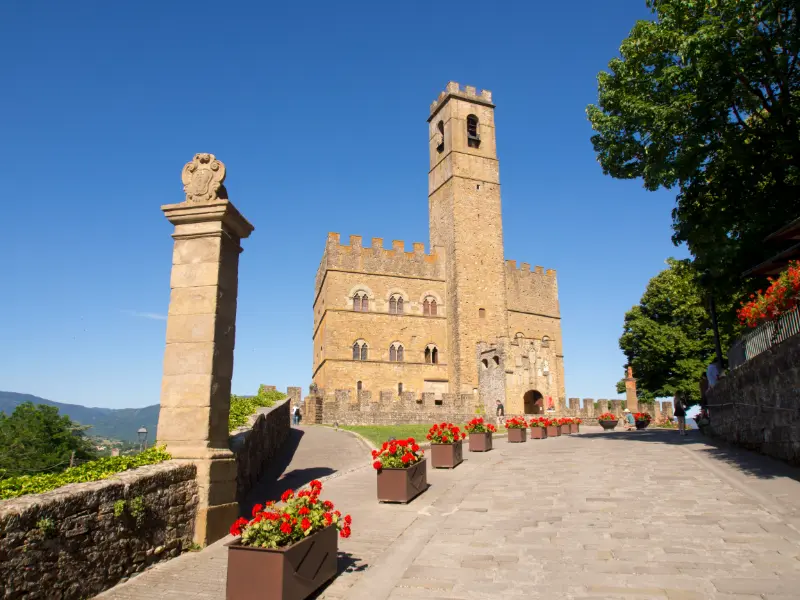
Casentino is the upper Arno valley enclosed by wooded mountains, medieval castles and major religious sites. Poppi provides the most recognizable castle, while Camaldoli and La Verna add centuries of spiritual history inside the landscape of the Foreste Casentinesi. For travellers who think Tuscany means vineyards and cypress roads, this is one of the best regions to expand the picture.
At a glance
| Ideal time | 3–5 nights |
|---|---|
| Best for | Forests, castles, monasteries, hiking, quiet eastern Tuscany |
| Car needed? | Strongly recommended for a varied itinerary |
| Best base | Poppi, Bibbiena, Stia or a rural stay near the national park |
| Official planning | Visit Tuscany / official visitor information |
Why Casentino deserves time in your Tuscany itinerary
Build the trip around three themes—castle, forest and monastery—and give each its own half-day. Trying to visit Poppi, Camaldoli, La Verna and a serious hike between breakfast and dinner produces driving rather than understanding.
Planning more than Casentino and Poppi? The Tuscany travel guide compares the main areas and helps you put this stop into a manageable route.
The practical advantage is that you can shape the visit around your own travel style. Art-focused travellers can give more time to churches and museums; food travellers can protect a long lunch; families can reduce the number of interiors; road trippers can use the destination as an anchor rather than as one more pin on the map. The goal is not to see everything. It is to leave with a clear sense of place.
Poppi Castle
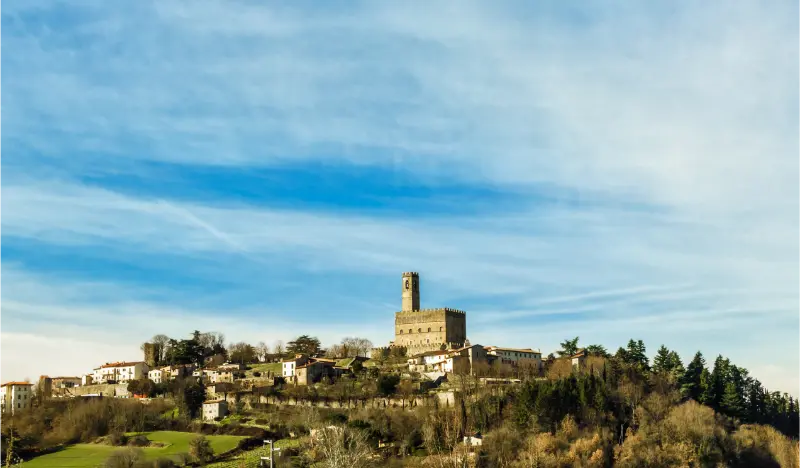
The Castle of the Counts Guidi dominates Poppi and provides the clearest architectural introduction to Casentino’s medieval history. Its position over the valley makes the visit as much about geography as about rooms and collections.
Check tower or upper-level access if stairs are a concern. The surrounding village deserves a walk after the castle rather than an immediate return to the car.
Camaldoli
Camaldoli combines monastic history with deep forest. The monastery and hermitage have different functions and atmospheres, so approach them respectfully and check current visitor rules.
Silence is part of the place. Avoid turning the religious complex into merely a scenic parking stop on the way to a hike.
La Verna
The Sanctuary of La Verna is associated with Saint Francis and stands dramatically within the mountain landscape. Even non-religious visitors can appreciate the architecture, forest and sense of remoteness.
Dress for cooler conditions than in the valley, especially outside summer. Services and religious activity shape access; sightseeing should adapt to them.
Foreste Casentinesi National Park
The national park protects extensive forest and a network of hiking routes. Trail choice should match fitness, weather and daylight, not just scenic photos found online.
Use official park information, carry water and layers, and avoid assuming mobile coverage. Autumn foliage is famous, but wet leaves and shorter days change trail difficulty.
Stia, Romena and valley villages
Stia adds craft and textile history, while Romena and other smaller sites reveal the valley’s network of castles and parish churches. They are most rewarding when used to connect bigger stops rather than as boxes to tick.
Choose one village per day and leave time for a local meal. Casentino’s strength is the absence of constant sightseeing pressure.
How long should you stay?
3–5 nights is the useful starting point, but the right answer depends on what comes before and after. If you are moving hotels every night, add less; if this is one of only two bases in Tuscany, stay longer. Travel time, parking, check-in and meals consume more of a day than first-time itineraries usually allow.
A rushed schedule also makes weather and closures more damaging. With margin, a late museum opening or a slow lunch is simply part of the trip. Without margin, it forces you to abandon the next stop. Build one “optional” item into every day so the itinerary can contract without feeling like a failure.
Getting there and moving around
A car provides the flexibility Casentino requires, though rail reaches parts of the valley such as Bibbiena/Stia depending on current services. Mountain roads are slower, darker and more weather-sensitive than lowland routes. Keep fuel, water and offline maps available, especially when moving between monasteries and trailheads.
Before driving anywhere in Tuscany, review our driving in Italy guide, especially ZTL rules, parking signs and rural-road timing. If you are travelling without a car, compare the plan with our Italy without a car guide and simplify the number of same-day stops rather than replacing every drive with a complicated chain of buses.
Where to stay
Poppi, Bibbiena, Stia or a rural stay near the national park. The best accommodation is the one that reduces the most annoying part of your itinerary: parking if you have a car, station access if you rely on public transport, or evening driving if food and wine matter. A beautiful countryside property can be a poor choice when every dinner requires a dark 25-minute drive.
Compare current accommodation options on Booking.com. Check parking, air conditioning, stairs, breakfast times and the exact distance from the historic centre rather than relying only on the property’s marketing description.
What and where to eat
Mountain and forest products shape the table: chestnuts, mushrooms, game, cheeses, potatoes and hearty soups appear alongside standard Tuscan staples. Seasonal food can be a major reason to visit in autumn. Rural restaurants may close on unexpected weekdays, so reserve dinner when your accommodation is isolated.
Reserve only the meals that genuinely matter to you. Leaving one lunch flexible makes a road trip more resilient, while booking every dinner can turn a relaxed region into a sequence of deadlines. In small towns, however, restaurant capacity may be limited on weekends or outside high season, so ask your accommodation whether advance reservations are sensible.
A realistic first-day itinerary
Day one: Poppi and nearby valley. Day two: Camaldoli plus a moderate forest walk. Day three: La Verna and one smaller village or scenic stop. With extra time, add Stia, Romena or a longer national-park hike instead of commuting to Florence each night.
Protect at least one unstructured hour. It can become a café stop, a shop visit, a longer museum, a rest in the hotel or simply time lost to parking without damaging the rest of the day. This buffer is one of the simplest ways to make a Tuscany itinerary feel independent rather than tour-like.
Best time to visit
Late spring through autumn is strongest for hiking. Autumn foliage can be spectacular but popular. Summer is cooler than cities, while winter requires road and trail caution and may suit monastery-focused visits more than high-level hiking.
For the wider seasonal picture, use our guide to the best time to visit Italy. Always check attraction hours close to your date: church access, museums, ferries, trails and small businesses can change seasonally, and a timetable copied from an old article is not a reliable planning tool.
How to avoid turning the visit into a checklist
Choose one “must-do,” two “would-like” stops and let everything else remain optional. This is particularly important in Tuscany because the distance between towns looks short on a map while parking, hillside walking and meals expand the real day. If you have already seen three churches and a museum before lunch, the best next stop may be a bench with a view.
Crowd strategy is usually simple: start earlier than day-trip groups, stay later than they do, or sleep in the destination. You do not need to discover a “secret” viewpoint to have a quieter experience; you often just need to be in a famous place at a less compressed time.
Families, accessibility and slower travel
For families, alternate cultural stops with movement and food. One castle, tower, beach, short trail or open square can reset the day after a museum. Do not assume a stroller will be comfortable on medieval paving, steep lanes or natural paths; a carrier may be more practical for smaller children in some destinations.
Travellers with limited mobility should investigate gradients, stairs, parking and accessible entrances attraction by attraction. Historic Tuscany is not uniformly accessible, but a visit can often be redesigned around viewpoints, lower-town routes, taxis and selected museums. Asking a hotel about the actual number of steps is more useful than relying on a general “central location” description.
How to connect this stop with the rest of Tuscany
Useful next reads are our Arezzo guide, our Cortona guide, our Tuscany travel guide and our Italy road-trip planning guide. Build clusters geographically: pair places that share the same road or rail corridor and avoid crossing Florence or Siena repeatedly just to keep a hotel booking.
If this is your first trip to the region, step back occasionally and compare the route with the larger Tuscany travel guide. A strong itinerary normally includes contrast—at least one art city, one smaller town and one landscape or coast experience—rather than ten versions of the same hill-town day.
What to book in advance
Book only capacity-limited experiences that matter: a specific museum slot, winery tour, ferry with a vehicle, guided cave, concert, spa entry or restaurant during a major event. For everything else, preserve flexibility. Before paying a third-party seller, compare the offer with the official visitor page linked above and read cancellation terms.
Our broader guide to booking Italy attractions explains how to distinguish official tickets, timed-entry requirements and convenience products. Save confirmations offline because mobile reception can be unreliable in rural or mountain areas.
Practical planning notes that make a real difference
Carry water, a small amount of cash, a charged phone and footwear suitable for stone or uneven ground. In summer, move exposed walks to the morning; in shoulder seasons, carry a light waterproof layer. Do not let a sunny forecast in Florence convince you that an island, mountain valley or elevated hill town will feel identical.
Use offline maps but follow local signs when they disagree with navigation. ZTL cameras, market closures, ferry lanes and temporary road works are local realities that an app may not understand in real time. On rural roads, never stop around a blind bend for a photograph and never block farm access.
Finally, leave space for local information. A hotel owner, museum desk or tourist office may know that a path is muddy, a road is closed, a church has a special opening or a festival is changing parking that day. Good independent travel is not rigid self-sufficiency; it is the ability to update the plan when better information appears.
Final thoughts
Casentino earns its place in a Tuscany itinerary when you let its strongest qualities determine the pace. Plan transport first, choose a small number of meaningful experiences, eat locally and leave enough margin for the landscape or street life that cannot be reserved. That approach produces a richer day than trying to prove how many Tuscan names you can fit on one route.
Last updated: October 17, 2026