
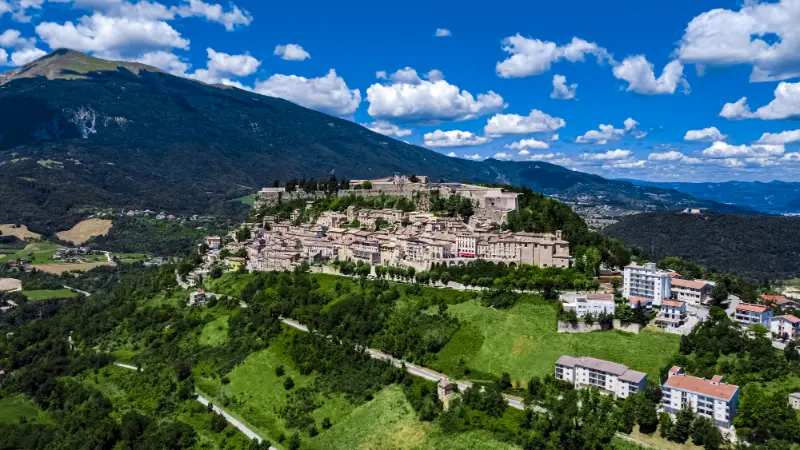
Civitella di Romagna and Cusercoli Guide: Bidente Valley, Castle, Suasia Sanctuary and Local Food — Civitella di Romagna and nearby Cusercoli make one of the easiest small-village combinations in the Bidente valley. Civitella retains a medieval street plan and the Sanctuary of the Beata Vergine della Suasia, while Cusercoli rises dramatically on a limestone spur beneath the historic Guidi di Bagno castle complex. The two places are close enough to share one half day, but they reward different kinds of attention: Civitella for town structure and local traditions, Cusercoli for topography, castle views and food events.
| Best for | Small villages, hill scenery, food festivals and a relaxed Bidente Valley drive |
|---|---|
| Ideal time | 3–5 hours for both villages; longer with lunch or an event |
| Key contrast | Civitella’s compact centre versus Cusercoli’s steep castle setting |
| Seasonal strengths | Spring prugnolo mushroom traditions and autumn Bidente truffle events |
How this fits into a wider Forlì-Cesena trip
This destination works best when it is placed in the right sequence rather than treated as an isolated pin on the map. Useful related planning guides already on the site include Santa Sofia and Campigna guide; Forlì-Cesena food guide; Forlì-Cesena hills and Apennines road trip. Use them to decide whether you need a city base, a spa base or a mountain base before adding extra driving.
Start in Civitella and walk the old structure
Visit Romagna notes that Civitella still shows its medieval urban form, including surviving bastioned walls and the rebuilt tower with its nineteenth-century clock. The town does not require a long monument checklist. Park, walk the central streets and use the remains to understand how the settlement controlled the valley. Forty-five minutes to an hour is enough for orientation without reducing the place to a coffee stop.
Sanctuary of the Beata Vergine della Suasia
The sanctuary, built in the second half of the sixteenth century, is one of Civitella’s principal historic buildings. Check current access and service times if an interior visit matters, because active religious sites do not function like museums. Dress and timing should reflect that. If the church is closed, the exterior and surrounding setting still fit naturally into the town walk.

Move to Cusercoli for the stronger landscape drama
Cusercoli sits on a limestone spur a few kilometres away. Its old entrance, locally known as the Purtaza, and the climb toward the castle make the topography immediately legible. This is the place to slow down and look back over the Bidente valley. The uphill streets can be awkward for anyone with limited mobility, so assess the surface and gradient before committing to the highest point.
Castle of the Guidi di Bagno: check access rather than assuming
The complex above Cusercoli includes the historic castle, church, bell tower, small Italian garden and sundials. Visit Romagna highlights the Meridiana room and its seventeenth-century terracotta Via Crucis panels. Small castle sites often open for events, guided visits or limited hours, so verify the current arrangement. Even without interior access, the climb remains worthwhile for the setting and architecture.
Prugnolo mushrooms and Bidente truffle are real seasonal reasons to come
Cusercoli is known for a spring fair dedicated to the prugnolo mushroom, while truffles from the Bidente valley are celebrated in autumn. These events offer something ordinary sightseeing cannot: producers, local recipes and a reason for residents to use the historic spaces. They also mean crowds and altered parking. If your aim is food, plan around the festival; if your aim is quiet photography, choose another weekend.
The Morandina cherry and local sweets
Visit Romagna also points to the Morandina cherry and local preserves used in traditional fried tortelli and the Pancion. This is valuable because it widens the local-food story beyond mushrooms and truffles. Ask bakeries or producers what is in season rather than expecting a fixed souvenir shelf year-round. Small quantities and local production are part of the appeal.
How to combine both villages efficiently
Drive to Civitella first, walk the centre and sanctuary, then continue to Cusercoli for the castle setting and lunch. Reversing the order is fine if an event or guided visit has a fixed start time. What you should not do is drive back and forth between the two. Their value is precisely that they can be experienced as one continuous valley narrative.
Best season
April through June is excellent for green hills and spring food traditions. September and October bring comfortable temperatures and autumn products. High summer can be hot in exposed streets, so move the climb to Cusercoli to early morning or late afternoon. Winter is quiet and atmospheric but services may be limited; confirm restaurants and small-site openings before making a dedicated trip.
Families and pace
This is a good family half day if children are comfortable with slopes. The villages are more successful when you give children a clear objective—find the old gate, reach the viewpoint, identify the clock tower—rather than expecting enthusiasm for architectural detail. Pair the visit with a relaxed meal or short nature stop rather than another museum-heavy destination.
Driving and parking
The Bidente valley is straightforward compared with higher mountain roads, but village centres still have narrow sections and limited spaces. Park where signed and walk. Do not follow a navigation app into restricted or extremely narrow lanes simply because the destination pin is near the castle. For onward travel to Galeata or Santa Sofia, keep the same valley direction and avoid unnecessary backtracking.
When to skip one of the two
If you have only ninety minutes, choose Cusercoli for the stronger visual setting or Civitella if the sanctuary and medieval plan interest you more. Trying to rush both in under two hours usually means more time finding parking than actually seeing the places. A short, deliberate visit is better than a hurried two-village badge.
Where to stay
Civitella and Cusercoli have limited lodging compared with larger centres. Santa Sofia is the best small-town base for continuing deeper into the Bidente valley; Forlì works for travellers who prefer city hotels. If your visit revolves around a food festival, book closer to the event because parking and return driving are the main practical constraints.
Official sources and final checks
Opening hours, guided-access arrangements, trail conditions and seasonal services can change. Recheck the official sources shortly before departure, especially when your day depends on a museum opening, a guided visit, a mountain road or a weather-sensitive trail.
Final planning advice
Plan the two villages as one half-day story and let a meal or seasonal food event provide the centre of gravity. The landscape is the link between them, so avoid turning the visit into a race between isolated monuments.
A final way to improve the day
Before leaving, identify the one experience that would make the trip feel unsuccessful if you missed it, then protect that time first. In small Apennine destinations, opening windows, mountain weather and meal hours matter more than the nominal driving distance. Keep at least thirty minutes of unallocated time in each half day. That buffer absorbs parking, a slower road, an unexpectedly interesting church or a local recommendation. It also prevents the itinerary from turning every stop into a deadline. Travellers who build the day around one priority usually see less on paper but understand far more of the place.
What to verify the evening before
Check the weather for the actual valley or mountain, not only the nearest city; confirm the opening of the one museum, church or visitor centre you most want to enter; download the route and parking point; and look at the restaurant or grocery opening hours if the destination is small. This five-minute check matters because rural Romagna has more seasonal rhythms than the Via Emilia cities. A closed venue is rarely a disaster when you know before leaving: you can change the order, choose a walk or move lunch earlier. The same closure discovered after an hour of driving can distort the whole day.
Photography and light without rearranging the whole trip
For village streets and stone architecture, morning and late afternoon generally give softer light and make hill views easier to read. Forests can photograph well even under overcast skies, while waterfalls often benefit from diffuse light rather than harsh midday contrast. Do not sacrifice safe trail timing simply to chase sunset. If photography is important, stay locally and use early morning instead of planning a long drive after dark. A compact camera or phone is enough for most village work; on trails, keeping hands free and equipment protected is more valuable than carrying several lenses.
Why fewer stops usually produce a better article-worthy experience
These valleys reward observation: how houses face the road, where a bridge sits in relation to the river, why a castle occupies one spur rather than another, and what changes in the menu with altitude. None of that is visible from a car window. If you have spare time, extend the walk or the meal rather than adding a distant village. The resulting day may contain fewer named attractions, but it will be easier to remember and easier to describe accurately. That is also the best defence against the common online-guide problem of turning every destination into the same list of ten superficial sights.
Leave a Reply