
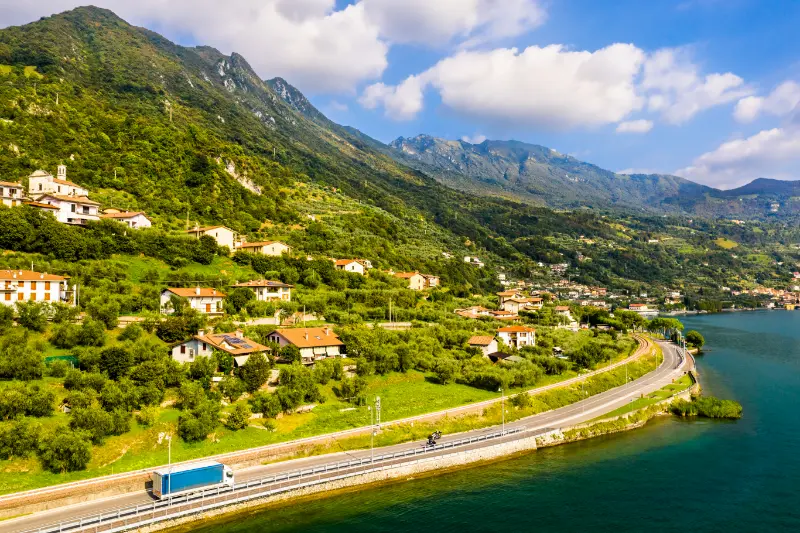
Iseo is the most practical first base on Lake Iseo because it combines a real historic centre with railway access, a ferry pier, restaurants and the Torbiere del Sebino reserve just south of town. It feels like a small lakeside town rather than a resort built solely around visitors.
The town itself deserves several hours even if you are using it primarily as a transport hub. A good day balances Piazza Garibaldi and the medieval street pattern with lakefront time, then adds either the wetlands or a ferry connection.
Our Lake Iseo Travel Guide is helpful if you want to see how Iseo Town Travel fits beside the main local sights and neighbourhoods.
| Best for | First-time Lake Iseo base |
|---|---|
| Rail access | Brescia–Iseo–Edolo line |
| Pier | A short walk from Piazza Garibaldi |
| Nature add-on | Torbiere del Sebino |
| Ideal stay | 1–3 nights as a regional base |
Piazza Garibaldi
Piazza Garibaldi is the social and architectural heart of Iseo, framed by historic buildings and cafés. The square anchors the street network and makes orientation easy for first-time visitors.
Visit in the morning for local activity and again in the evening when the day-trip pace subsides. Friday morning is traditionally associated with a major open-air market, so expect a different atmosphere and more activity then.
The medieval street pattern
Iseo retains a compact historic core of lanes, tower houses and small squares. The scale encourages slow wandering rather than a monument-to-monument route.
Leave navigation off for part of the walk. You are unlikely to get meaningfully lost, and the small detours are where the town feels most distinct from a generic waterfront resort.
Pieve di Sant’Andrea
The Pieve di Sant’Andrea is one of Iseo’s key religious monuments and provides historical depth beyond the lakeside promenade. Its presence helps explain the town’s medieval importance and long settlement history.
Check access respectfully around services. Even when the interior is unavailable, the surrounding streets are worth including in a historic-centre loop.
The lakefront
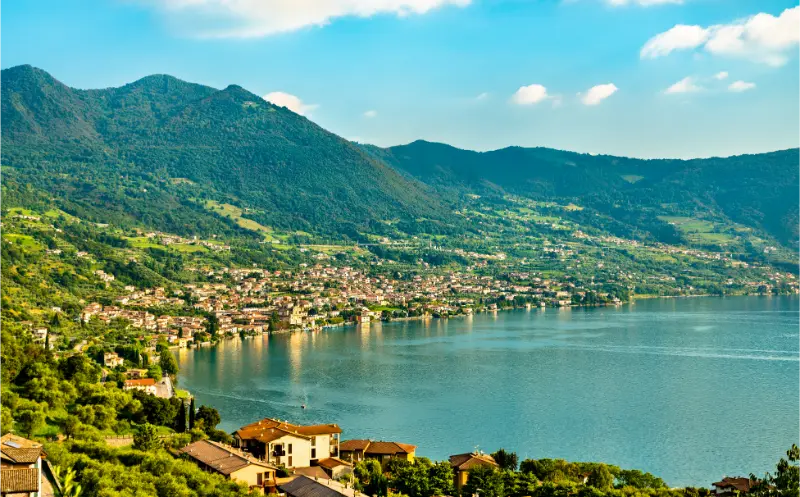
Iseo’s promenade gives easy views toward Monte Isola and the mountains beyond. It is less dramatic than some cliff-backed lake villages but more usable for everyday strolling, cafés and evening time.
Use the waterfront as a pause between structured visits. The lake is most enjoyable when you stop measuring sightseeing productivity and allow time simply to sit near the water.
The ferry pier
The pier lies just outside the main square and connects Iseo with other lake destinations according to seasonal schedules. This makes the town a convenient base for travellers who do not want to move hotels.
Check individual port-to-port journeys because not every route operates with the same frequency all year. For Monte Isola, Sulzano usually offers the simplest short crossing, so a train-plus-ferry combination can be faster than waiting for a direct boat from Iseo.
Torbiere del Sebino
South of Iseo, the Torbiere del Sebino reserve protects wetlands, ponds and bird habitat between the lake and Franciacorta. Boardwalks and paths create a completely different experience from the built waterfront.
Bring appropriate footwear and avoid the hottest part of the day in summer. Birdlife and light can be better early or late, and a quiet visit depends on respecting the reserve rather than treating it as a picnic park.
San Pietro in Lamosa
Near the Torbiere, the monastery of San Pietro in Lamosa adds architectural and historical interest to a nature-focused excursion. The combination of wetlands and monastic heritage is one of the most distinctive short outings from Iseo.
Check opening information separately from the reserve because access to religious or cultural buildings can be more limited than the outdoor paths.
Train connections
Iseo’s station is only a short walk from the centre and serves the Brescia–Iseo–Edolo corridor. This makes Brescia an easy arrival point and allows day trips north toward Sulzano, Marone, Pisogne and Val Camonica.
For a car-free stay, choose accommodation based on walking distance to both station and lake rather than just a lake view. Ten saved minutes on every transfer adds up over several days.
Franciacorta from Iseo
The wine hills begin immediately south of the lake, making Iseo a logical base for a cellar visit or vineyard day. The challenge is last-mile transport, since individual wineries are scattered across rural roads.
Reserve tastings and organise a taxi, transfer or guided tour if you plan to drink. Do not assume that being geographically close means you can easily walk between wineries.
How long to stay
One night is enough to enjoy the town and make a short ferry trip. Two or three nights are better if you want Monte Isola, Franciacorta and another lake town without changing accommodation.
Iseo is especially useful for first-time visitors who value transport simplicity. Travellers seeking a more dramatic mountain setting may prefer Lovere or the upper lake.
Where to stay
For accommodation, compare locations as carefully as prices: a slightly cheaper room can cost time if it leaves you dependent on infrequent transport.
Tours and activities
If you want a guided visit in Lake Iseo, compare the exact meeting point, group size, language, inclusions and cancellation terms before booking. A guided activity is most useful when it adds access, historical context or transport that would otherwise be difficult to arrange independently.
Continue planning
Use these related My Italy Experience guides to build the rest of the trip without repeating the same planning work:
- Lake Iseo travel guide
- Monte Isola travel guide
- Franciacorta wine travel guide
- Lake Iseo ferry guide
Check the lake timetable, not just the map
For Iseo Town Travel Guide, transport planning should begin with the actual date. Lake Iseo navigation changes by season, and the east-shore railway and west-shore bus network do not operate as one integrated urban system. A route that looks like a short hop across the water may be simple in July and awkward in November.
Search the official ferry journey planner before deciding the order of towns. Then check the train or bus connection that reaches the chosen port. This avoids the common mistake of designing a beautiful circular route that cannot be completed on the day you travel.
Weather changes the best version of the day
Lake weather influences more than photographs. Strong wind or storms can affect navigation, summer heat changes the comfort of exposed waterfront walks, and low cloud can make a summit or panorama less rewarding. Spring and early autumn usually provide the most comfortable walking conditions, while summer offers the broadest tourism services.
Keep one land-based alternative. The eastern railway makes Iseo, Sulzano, Marone and Pisogne useful fallbacks if a planned boat connection becomes inconvenient. A flexible lake itinerary is stronger than one whose success depends on a chain of perfect ferry connections.
Car-free travel is genuinely possible
Lake Iseo is one of the more manageable Italian lakes without a car, especially on the eastern shore. The Brescia–Iseo–Edolo railway links a useful sequence of towns, and short ferry crossings connect Monte Isola. A car becomes most helpful for dispersed Franciacorta wineries, the western shore and rural accommodation.
If travelling without a car, choose your base for station and pier access rather than for the most dramatic photograph. A ten-minute flat walk to transport can save hours over a three-day stay. If you do have a car, verify parking and do not assume waterfront historic centres allow easy door-to-door access.
Swimming, boating and outdoor safety
The lake is a real recreational environment, not a controlled resort pool. Swimming access, boat traffic, water temperature and local restrictions vary by location and season. Use designated or locally accepted swimming areas, follow posted rules and avoid assuming every attractive waterfront edge is safe for entering the water.
For rented boats, kayaks or guided water activities, check weather, safety equipment and operator rules. If the forecast is unstable, a town, museum, winery or wetland walk is a better use of the day than forcing an activity onto the water.
Families and slower travellers
The lake suits mixed-age groups when the itinerary is simplified. A ferry ride, one village and a waterfront lunch can be more enjoyable than trying to combine five ports. Monte Isola in particular rewards shorter walking segments with bus assistance rather than a full-island endurance challenge.
Older travellers or anyone with limited mobility should pay attention to slopes in Lovere and Monte Isola, steps in historic buildings and the distance between transport stops and accommodation. Choose routes by effort, not merely by kilometres.
Build the trip around contrasts
A focused article on Iseo town travel guide should help you choose experiences that feel different from one another. Lake Iseo is strongest when a water journey is balanced with a historic town, a mountain or wetland walk, or a Franciacorta food-and-wine experience.
Avoid collecting villages that offer the same waterfront rhythm. One carefully chosen cultural town plus Monte Isola and one nature or wine day usually provides more variety than stopping for forty minutes in every settlement around the shore.
Useful official sources
Final planning advice
Choose Iseo if you want the easiest car-free introduction to the lake. Spend real time in the historic centre, add the Torbiere for nature, and use the station and pier as tools rather than reasons to rush through. Its strength is balance: town, water, rail and wine country all meet here.
Last updated: October 17, 2026