

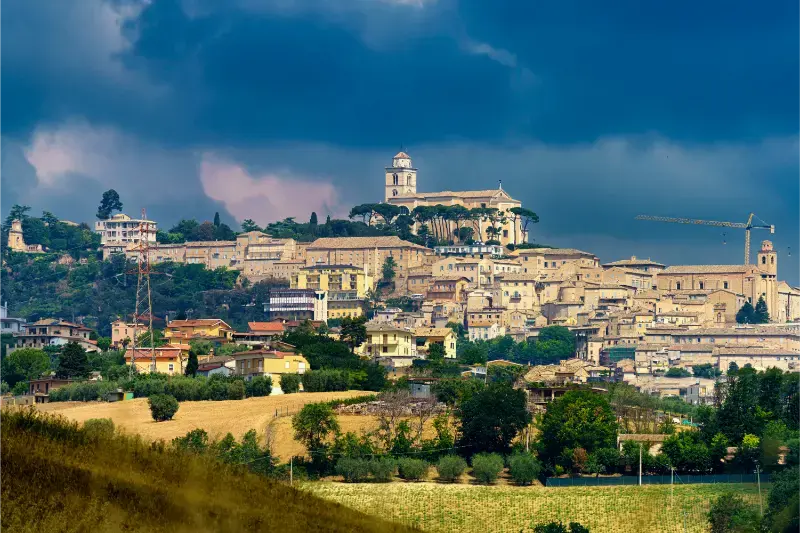
Loreto is one of Italy’s significant pilgrimage destinations, yet it also rewards visitors interested in Renaissance architecture, sacred art and the relationship between a hilltop town and the Adriatic landscape. Its monumental basilica was built around the Santa Casa, the Holy House venerated in Catholic tradition as connected with the life of Mary at Nazareth. Whether you approach as a pilgrim or as a curious cultural traveler, the key to a respectful visit is understanding that the complex is an active sanctuary, not simply a museum. Plan around services, allow time for the basilica’s art and square, and avoid treating religious tradition as an uncontested archaeological fact.
In this guide
- Understand the tradition of the Santa Casa
- Experience the basilica as a working place of worship
- Explore Piazza della Madonna and the sanctuary setting
- Look beyond the Holy House to the artistic heritage
- Walk the historic streets after the main sanctuary visit
- Plan for major feast days and pilgrimage crowds
- Reach Loreto by road or train without confusing the final approach
- Combine Loreto with Recanati or the Conero coast wisely
- Eat, sleep and respect the atmosphere of the town
- Practical information
- Frequently asked questions
Understand the tradition of the Santa Casa
At the heart of the sanctuary stands the Santa Casa. The sanctuary’s own explanation presents the tradition that the house associated with Mary was transported from the Holy Land to the area of Loreto in the late thirteenth century. Visitors should distinguish this religious tradition and its devotional significance from historical conclusions that can be established by archaeology alone. Making that distinction does not diminish the site’s importance; rather, it respects the different questions a pilgrim and a historian may bring to the same monument.
For travel beyond Loreto Travel, consult our Marche travel guide; it explains how to choose a base and link nearby destinations.
The Holy House is surrounded by an elaborate marble enclosure that reflects later centuries of artistic patronage. Before entering the devotional area, observe posted instructions on silence, photography and circulation. During busy pilgrimage periods there may be queues and staff directing visitors. The room is not appropriate for an extended private photo session while others are praying. A thoughtful visit considers why the sanctuary drew travelers for centuries and how the surrounding basilica, streets and hospitality structures developed around that movement of people.
Experience the basilica as a working place of worship
The Basilica della Santa Casa is architecturally impressive, but the visitor experience differs from that of a secular gallery. Liturgical celebrations, special religious dates and organized pilgrimages take precedence over ordinary sightseeing. Check the sanctuary’s official calendar if you want to attend Mass or plan a quiet cultural visit outside particularly busy periods. Different areas can have different rules, and a building being open does not mean every chapel or collection is accessible for tourism at every moment.
Look at the scale of the church, its chapels and decorative program without rushing directly to the central devotional focus. Details from different periods tell a layered story of changing tastes and commissions. The basilica is not an empty historical shell: candles, prayers and visitors moving with personal intentions are part of the atmosphere. Speak quietly, dress appropriately and let religious activities proceed without interruption. If you are traveling with children, explain these expectations before entering; even non-religious families can find the visit meaningful when framed as an encounter with living heritage.
Explore Piazza della Madonna and the sanctuary setting
Piazza della Madonna is much more than the space in front of a church. Its monumental urban composition shows how the pilgrimage site became the center of a larger town. The fountain, surrounding facades and open approach to the basilica create a ceremonial space that can feel very different depending on whether it is filled with organized groups or relatively quiet. Take time to look back from several points in the square. The relationship between the basilica and public space is one of Loreto’s most memorable architectural features.
The square can become crowded during major religious occasions and summer travel periods. If you seek a reflective atmosphere, consider an early visit on a day without a large scheduled event; if witnessing a pilgrimage is your goal, prepare for queues and a very different pace. Be considerate around processions and entrances. Wheelchair users and anyone with mobility concerns should check the sanctuary’s designated routes and nearby parking because approaching the square from the wrong side of the hill can introduce unnecessary gradients and steps.
Look beyond the Holy House to the artistic heritage
The sanctuary’s long history attracted substantial artistic patronage, giving Loreto value for travelers fascinated by Renaissance and later art. Rather than attempting to attribute every painting or chapel from memory, consult the site’s official guide and focus on the works and spaces actually open during your visit. The marble decoration associated with the Santa Casa enclosure is especially significant as an example of sacred architecture built around a smaller revered space. Looking carefully at this relationship is more illuminating than viewing the complex only from a distance.
Some of Loreto’s cultural holdings may be presented in museum spaces connected to the sanctuary, depending on arrangements and exhibitions. Check the current museum opening information and ticketing separately from access to the basilica. A church’s open doors do not guarantee that its treasury or museum is open. Travelers with strong art interests can allocate several hours, while a short pilgrimage stop may focus on the Holy House and prayer. Both are valid approaches, provided you plan honestly around how the site is used.
Walk the historic streets after the main sanctuary visit
Loreto’s identity extends into the streets around the basilica, where shops, cafés and accommodations developed to serve generations of visitors. Some businesses emphasize devotional items, while others supply the ordinary needs of residents and travelers. Rather than dismissing the town as a commercial setting for the sanctuary, look at how the pilgrimage economy has shaped its public spaces. Walk beyond the central square on permitted streets and you may find quieter corners and views toward the coastline and surrounding hills.
Not every historic-looking lane is a convenient shortcut, particularly when the town is busy or a procession changes pedestrian flow. Keep your route flexible and respect barriers. If you want to buy religious objects or local crafts, compare quality and prices without assuming everything on display was made locally. A break for coffee or lunch can also help if you are visiting with a multigenerational group. The most enjoyable visit is rarely the fastest possible movement from parking lot to devotional chamber and straight back again.
Plan for major feast days and pilgrimage crowds
Loreto receives visitors year-round, but the experience changes considerably around religious feast days and large group pilgrimages. Transport, accommodation availability, pedestrian circulation and entry rules may all be affected. The official sanctuary website is the appropriate source for current liturgy and pilgrimage notices. Travel articles often repeat a single opening schedule as though it applied every day, a risky simplification for an active international sanctuary. Confirm whether a special event will change the part of the complex you hope to see.
If your goal is a quiet architectural visit, a weekday outside major celebrations may be more suitable, though no date is guaranteed to be empty. If you are arriving with a faith group, coordinate the visit directly with the sanctuary rather than treating it like a general tourist reservation. Visitors with children or limited stamina should prepare for waiting, weather exposure in the square and the possibility that some indoor spaces are temporarily crowded. A thoughtful schedule allows room for the unexpected instead of turning every delay into a source of stress.
Reach Loreto by road or train without confusing the final approach
Loreto is situated inland above the Adriatic rail corridor. Depending on your route, rail travel may be practical, but you must check the exact connection from the station to the elevated sanctuary district. Do not assume a station name means you arrive immediately in the square. Local buses, taxis, slopes and walking distances deserve advance attention. If your trip includes Porto Recanati or Ancona, look for current connections and consider whether a half-day Loreto excursion fits your arrival or departure timetable.
Drivers should aim for signed legal parking and follow pedestrian directions to the sanctuary. Avoid entering restricted streets on instructions from an automated map. On busy pilgrimage days, follow temporary traffic arrangements rather than the parking plan you saw months earlier. Travelers with limited mobility should ask about accessible approaches and the drop-off procedure through official visitor services. Loreto is relatively compact once you reach the central zone, but choosing the wrong starting point can complicate an otherwise easy visit.
Combine Loreto with Recanati or the Conero coast wisely
Recanati is an especially natural cultural pairing for Loreto, offering the literary world of Giacomo Leopardi as a counterpoint to religious and artistic heritage. With a car, the two can make a rewarding day if you check sanctuary schedules and Casa Leopardi tour times. Without a car, the sequence depends on local buses and should not be improvised from a tourist map. It is better to do one meaningful interior visit in each town than to reserve multiple time slots that are vulnerable to traffic or missed connections.
The Conero coast and Porto Recanati provide different options for travelers also seeking sea air, but a beach afternoon should be treated as a separate logistical leg. Scenic beaches may have access restrictions, parking limitations or seasonal facilities. Choose one coastal stop rather than trying to see every viewpoint. If you are staying along the beach, Loreto can be the inland cultural excursion of the trip; if you are visiting primarily for pilgrimage, there is no need to squeeze a coastal tour into the same day.
Eat, sleep and respect the atmosphere of the town
Accommodation near the sanctuary suits pilgrims and travelers who value early or evening access to the central square. Rooms farther away may be easier for drivers, but always check the real walking route and parking arrangement. Accessibility, elevator availability and quiet hours are important in buildings adapted from older structures. If you are part of a large group, ask about arrangements and dining capacity in advance. A family that wants a beach holiday may be happier sleeping on the coast and visiting Loreto for a dedicated morning.
Food options range from simple meals for travelers to restaurants serving regional Marche dishes. Seek out local pasta, seasonal vegetables and wines without assuming that a restaurant in a pilgrim town must provide a specifically religious or ceremonial menu. After lunch, return to the square for one final look rather than immediately leaving. Loreto’s significance comes from centuries of belief and travel expressed through buildings, rituals and ordinary urban life. Experiencing those layers with consideration is the best way to appreciate the sanctuary, whatever your own beliefs.
Practical information
| Primary site | Basilica della Santa Casa |
|---|---|
| Type | Active religious sanctuary and cultural landmark |
| Visit time | Half-day or longer for art and services |
| Check | Official liturgy and pilgrimage calendar |
Continue planning your Marche trip
To build a wider trip without repeating the same route, compare our Marche travel guide, the Marche highlights guide, the seven-day Marche road trip, the Conero coast guide. These are published guides already present in this database.
For accommodation, compare the exact location, legal parking access, cancellation conditions and distance to the sights before booking. Compare accommodation on Booking.com.
Frequently asked questions
What is the Santa Casa?
The Holy House revered in Catholic tradition as associated with Mary; the sanctuary explains the tradition and its history.
Can nonreligious visitors enter?
The basilica welcomes respectful visitors, subject to worship and site regulations.
Is the entire sanctuary a museum?
No. It is an active place of worship and separate museum areas may have their own access rules.
Can I combine Loreto and Recanati?
Yes, provided you check transport and timed visits.
Is the basilica next to the train station?
No. Verify the final approach to Loreto’s elevated central area.
Official sources and current visitor information
Last updated: October 17, 2026