
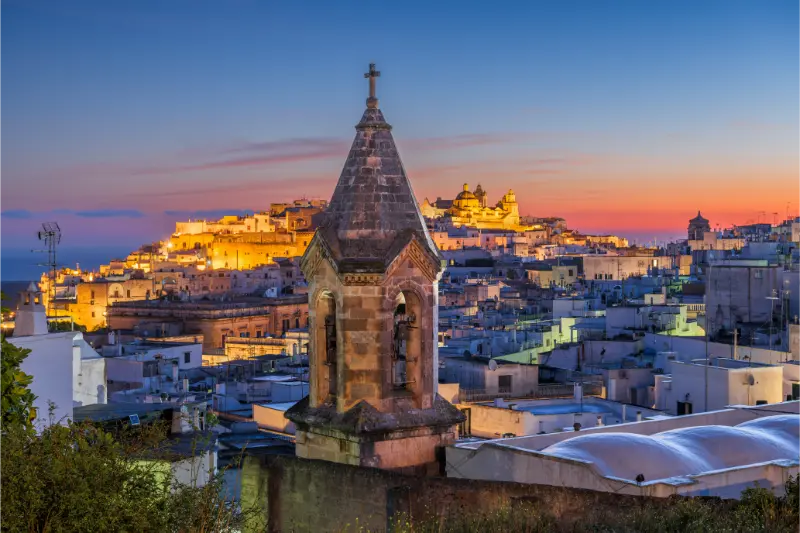
Ostuni is one of Puglia’s most photogenic hill towns, but the view from outside the walls explains only half its appeal. Inside the White City, steep lanes, arches, tiny terraces and pale limestone create a compact urban maze above an enormous plain of olive trees leading toward the Adriatic.
The town works as a half-day stop, an evening destination or a multi-night base. The right choice depends on whether your Puglia trip is focused on hill towns, beaches or masserie; Ostuni sits in a useful position between the Valle d’Itria and the coast.
To see where Ostuni Travel fits into a wider Puglia itinerary, use our Puglia travel guide for transport, bases and possible neighbouring stops.
This article is designed around decisions rather than a generic list: how long to stay, what deserves priority, where transport changes the experience, which combinations are realistic and what commonly wastes time on a first trip.
Quick planning summary
| Best for | Travellers who want to combine historic towns, food, coastline and countryside without turning the trip into a race. |
|---|---|
| Minimum time | One focused day for a single destination; several nights for a regional base or a multi-stop route. |
| Car | Useful for rural Puglia and beach-hopping, but not necessary for every city; train-based trips work well along parts of the Adriatic corridor. |
| Best months | Late April–June and September–October for the easiest balance of weather, daylight and crowds. |
| Planning rule | Choose bases by geography, not only by hotel price; Puglia is long, and unnecessary backtracking quickly consumes a day. |
What to see and do
The White City lanes
The historic centre is intentionally disorienting. Whitewashed walls, stairs and narrow passages wrap around the hill rather than following a simple grid. The pleasure is in wandering, but a loose uphill route toward the cathedral prevents you from spending the entire visit at the lower commercial streets.
Start early for cooler temperatures or visit in late afternoon and stay through dinner. Midday light makes the white architecture dramatic but can also be harsh and hot in summer.
Cathedral and upper town
The cathedral marks the high point of the old centre and gives the visit a destination beyond simply photographing white walls. Its façade and the surrounding piazza create one of the strongest architectural moments in Ostuni.

From here, explore the smaller lanes rather than descending by the exact route you used to climb. The upper town is where you are most likely to find quieter corners even on busy days.
Piazza della Libertà
The lower main square is the social transition between the modern town and the climb into the historic centre. It is useful for orientation, cafés and an evening meeting point.
Do not spend the entire visit here. The square makes more sense after you have walked the old town and want a slower aperitivo before dinner.
Olive-grove viewpoints
Ostuni’s position above the plain is what makes the city visually distinctive. Look for terraces and roadside viewpoints that show the transition from white hill town to ancient olive groves and the Adriatic beyond.
This landscape is a reason to consider staying in a masseria outside town. The trade-off is obvious: more atmosphere and parking, but a car becomes essential for dinner and evening visits.
Ostuni coast
The sea is close enough to combine with the town, but the beaches are not directly below the old centre. Coastal areas such as Villanova and the wider Marina di Ostuni require transport planning.
Do not book a central Ostuni hotel assuming you can casually walk to the beach. Treat town and coast as two separate zones connected by car, taxi or seasonal transport.
How to plan the visit
How much time? Three to four hours is enough for the historic centre. A full day allows a coastal stop. Two or three nights work well if Ostuni is your base for Valle d’Itria and the Adriatic.
Protect the first two hours of the day for the place or experience that matters most. Puglia becomes much easier when the hottest or busiest part of the day is used for lunch, a beach, a pool or an indoor stop rather than for crossing a famous town at peak crowd level.
If you are travelling in July or August, treat parking as part of the itinerary. Arriving twenty minutes earlier is usually better than building a schedule that assumes you can drive to the front door of every historic centre or beach.
Getting there and getting around
Ostuni’s railway station is outside the hill town, so a train arrival still requires a local transfer. Drivers should follow signed parking areas below the historic centre rather than trying to climb into restricted or narrow streets.
Car, train or a mix?
Puglia is one of the Italian regions where a mixed strategy often works best. Trains are excellent for selected Adriatic towns and remove parking stress; a car is far more useful for masserie, inland villages, remote beaches and routes that cross the countryside.
Do not keep a rental car simply because you already paid for it. If several days are concentrated in rail-connected towns, returning or delaying the car can reduce parking fees and make the trip calmer. Conversely, do not force public transport onto a rural itinerary where it creates long waits or impossible connections.
Parking and ZTL strategy
Historic centres across Puglia frequently have restricted traffic, narrow lanes or pedestrian areas. Follow official signs to peripheral parking and walk the final section. Accommodation inside a ZTL should provide exact arrival instructions; never assume a hotel booking automatically authorises your number plate.
Where to stay
Stay inside or just below the old town for evening atmosphere; choose a masseria for rural calm and a pool; choose the coast if beach time matters more than hill-town evenings. There is no single best Ostuni base for every itinerary.
Before booking, check the real travel time to your first morning stop, whether parking is included, whether dinner is available in rural properties and how luggage reaches the room. In Puglia, a beautiful location that adds forty minutes each way can become expensive in time over several days.
A realistic itinerary
Morning
Historic centre climb, cathedral and upper-town lanes.
Lunch
Town restaurant or countryside masseria depending on your next stop.
Afternoon
Olive-grove drive and beach time on the Ostuni coast.
Evening
Return to the White City for aperitivo and dinner after day-trip crowds thin.
Food and local character
Use Ostuni for vegetable-rich Puglian cooking, orecchiette, cheeses, olive oil and grilled or roasted dishes as well as seafood. An agriturismo or masseria dinner can be particularly worthwhile if you are staying outside town and do not want to drive back after wine.
Leave room for unplanned food stops. Bakeries, small caseifici, vegetable dishes, olive oil and seasonal specials can be more memorable than chasing a list of famous restaurants. If a specific tasting or masseria dinner matters, reserve it; otherwise keep at least one meal each day flexible.
Best time to visit
April to June
Late spring is one of the easiest periods for sightseeing. Daylight is long, countryside is green and walking temperatures are generally kinder than midsummer. The sea warms progressively, so beach-focused travellers may prefer late May or June.
July and August
Expect heat, busy coastal parking and higher accommodation demand. Start towns early, protect midday and reserve the experiences where capacity matters. The reward is lively evenings and reliable beach weather, but a schedule that looks reasonable in April can feel exhausting in August.
September and October
September is excellent for combining sea and towns, while October is stronger for food, countryside and walking. Ferry, beach-club and seasonal service patterns may reduce later in autumn, so verify practical details rather than assuming summer frequency.
Winter
Cities and larger towns remain rewarding, but beach destinations become quiet and some seasonal businesses close. Winter suits food, architecture and local life more than a classic coastal holiday.
Worth knowing before you go
The white façades create intense reflected light, so summer photography and walking are often more comfortable at the edges of the day. Sunglasses, water and shoes with grip sound trivial, but polished stone and stairs can make a hot midday visit surprisingly tiring.
On a road trip, Ostuni is a useful point to reassess the route. From here you can continue south toward Brindisi and Lecce, turn inland toward Ceglie Messapica and the Valle d’Itria, or move back toward Monopoli. That makes it a better strategic base than its small historic centre might suggest.
Families and accessibility
The main challenge is steep walking, stairs and summer heat. Families with strollers should expect to carry them at points. A split day with a pool or beach break can work better than several continuous hours in the old town.
Accessibility varies sharply between modern waterfronts, stone historic centres, beaches and rural properties. Check the exact attraction rather than the destination as a whole. Old-town stairs, polished stone, cobbles and steep lanes can matter more than distance.
Mistakes to avoid
- Assuming Ostuni station is in the historic centre.
- Trying to drive into the White City.
- Booking a countryside stay without a car.
- Treating Ostuni as only a photo stop and missing the olive-grove landscape.
The common pattern behind these mistakes is trying to make the itinerary look efficient on a map instead of efficient on the ground. Build in parking, meals, heat and the simple pleasure of not moving every hour.
Key decisions that improve the trip
Old town or masseria?
An old-town stay gives immediate evening atmosphere and eliminates the drive home after dinner, but parking and luggage can be awkward. A masseria gives space, pool time and countryside character but makes a car essential. The right choice depends on how many evenings you want to spend inside Ostuni itself.
Is Ostuni a beach base?
It can be, but not in the walk-out-the-door sense. The coast lies several kilometres away and different beach areas have different access and parking. If your trip is 70 percent beach, a coastal property may be more convenient; if it is mixed culture and sea, Ostuni is a strong compromise.
Ostuni or Alberobello?
Alberobello is more architecturally unique; Ostuni feels more like a classic hill town and has a stronger evening restaurant scene. On a first Puglia trip, both are worth fitting into the same central-region route rather than choosing one based solely on social media appeal.
Best time of day
Early morning works for photography and comfortable climbing. Late afternoon into evening gives warmer light and more atmosphere. Midday is the least forgiving in summer, so use it for lunch, a masseria or the coast.
On-the-ground strategy
Save key addresses, parking points and opening information offline before leaving your accommodation. Mobile coverage is usually fine in towns, but rural roads and crowded events are not the moment to discover that a map or booking confirmation is unavailable.
Carry water, sun protection and a light layer for evenings or boat trips. Beach shoes are useful on rocky or pebbly coves. If you are driving, keep valuables out of sight and avoid loading or unloading luggage in exposed parking areas more than necessary.
Allow a margin before the final train, flight, boat or long drive of the day. Puglia rewards flexibility: a thirty-minute buffer often has more value than one extra viewpoint squeezed into an already full schedule.
Useful related guides
Continue planning with Monopoli, Alberobello.
Official information to check before travel
Opening hours, road access, seasonal services and local rules can change. Before travelling, check the relevant Puglia destination information and verify any attraction, beach service or transport connection that is essential to your day.
Last updated: October 17, 2026
Leave a Reply