
Padua is one of the most rewarding easy trips in Veneto because its headline masterpiece comes with a real city around it. Giotto’s Scrovegni Chapel alone justifies the journey, but the University of Padua, Basilica of Saint Anthony, lively market squares, Prato della Valle and historic Botanical Garden turn a single reservation into a full day or an excellent overnight stop.
At a glance
| Best for | Padua travel guide |
|---|---|
| Planning style | Book the most important timed entry first, then leave room for walking and local discoveries. |
| Useful base | Historic centre or a transport-connected neighbourhood, depending on your itinerary. |
| Good to know | Opening hours, fares and access rules can change; verify official sources close to travel. |
Why Padua is worth more than a station change
Padua combines a major university city, pilgrimage destination, medieval art centre and everyday market town in a compact historic core. It is less visually theatrical than Venice and less internationally branded than Verona, which often means visitors can move through ordinary cafés, arcades and markets without feeling that every block exists for tourism.
You can place Padua Travel in a more complete itinerary with the Venice Travel Guide, which also covers practical arrival details.
A day trip from Venice is easy by direct train, but an overnight stay gives you the city in the evening and makes timed reservations at the Scrovegni Chapel easier to arrange. Padua also works as a practical base for travellers exploring the wider Veneto by rail.
Scrovegni Chapel: reserve before anything else
Giotto’s fresco cycle in the Cappella degli Scrovegni is Padua’s essential reservation. Entry is controlled to protect the paintings, and advance booking is compulsory. The current standard Museums + Scrovegni ticket is €15 plus the booking fee, though special evening formats and combined products can differ.
Choose the chapel time first, then build your day around it. The visit itself is carefully managed and relatively brief, but the artistic impact is enormous: Giotto’s narrative clarity, emotional figures and spatial imagination make the cycle a turning point in Western painting.
Eremitani and the museum context
The chapel sits within a wider museum complex, and the nearby Church of the Eremitani adds another important art-historical layer. Wartime destruction damaged famous frescoes, making the surviving and reconstructed material a powerful reminder that heritage conservation is not abstract.
Do not schedule your chapel entry so tightly that you have no time for the surrounding collections. The point of Padua is not one masterpiece isolated from the city that produced it.
Basilica of Saint Anthony
The Basilica di Sant’Antonio is one of the world’s major Catholic pilgrimage sites and remains an active place of worship. Its architecture combines Romanesque, Gothic and Byzantine influences, while the interior includes Donatello’s work and the saint’s tomb area. Visitors should dress and behave for a religious setting.
The piazza outside contains Donatello’s equestrian monument to Gattamelata, a landmark of Renaissance sculpture. Even secular travellers benefit from understanding that the basilica is not simply another museum stop: pilgrims may have travelled enormous distances to be there.
Prato della Valle and the southern centre
Prato della Valle is one of Europe’s largest urban squares, an elliptical open space ringed by water and statues. It is a useful decompression point after enclosed frescoes and churches, and it connects naturally with the route toward the Botanical Garden.
Markets and events can change the atmosphere completely. Rather than photographing the square and leaving, walk its perimeter and notice how residents actually use it.
Orto Botanico: science history in a living garden
Padua’s Botanical Garden was founded in 1545 and is UNESCO-listed as the world’s oldest university botanical garden that has remained in its original location. It links Renaissance scientific history with contemporary biodiversity displays and is a refreshing counterpoint to art-heavy sightseeing.
The standard full ticket is currently €10. Opening patterns vary by season and the garden is normally closed on Mondays except certain holidays, so verify the official schedule for your date.
Palazzo Bo and university Padua
The University of Padua, founded in 1222, is central to the city’s identity. Palazzo Bo is associated with figures including Galileo, and guided visits reveal historic rooms, the anatomical theatre and the development of one of Europe’s great universities.
Reservations and visit formats can change with academic activity. Check the university’s official visitor information rather than assuming you can wander into all spaces independently.
Markets, aperitivo and what to eat
Piazza delle Erbe and Piazza della Frutta are still tied to market life, while the arcaded streets around them are excellent for aperitivo. Padua is one of the places where the spritz feels embedded in everyday Veneto social life rather than invented for visitors.
Look for regional pasta, risotto, baccalà preparations and seasonal market produce. Coffee bars and bakeries make it easy to structure a day around small stops instead of a long formal lunch between timed entries.
Padua from Venice: day trip or overnight?
For a day trip, take an early train, reserve the Scrovegni Chapel in advance, then continue through the market squares, Palazzo Bo area, Basilica of Saint Anthony, Prato della Valle and Botanical Garden as time allows. Do not reserve the chapel late in the day if missing it would be the trip’s main disappointment.
For an overnight stay, compare current Padua hotel rates and consider the corridor between the station and historic centre for convenience. Padua also links naturally with Verona and Venice; our Venice guide and Verona guide can help build a Veneto rail itinerary.
How the Scrovegni booking system affects your day
Because access is timed and conservation controls are strict, the chapel should be treated like a train you do not want to miss. Reach the museum complex early enough to complete ticket procedures and follow the staff’s entry sequence. Do not schedule arrival in Padua at the exact time printed on the chapel ticket.
The controlled microclimate is part of why the frescoes survive, so visitor procedures are not bureaucratic theatre. Build a buffer, then use any spare time in the adjacent museum or Eremitani area.
Palazzo della Ragione and the market heart
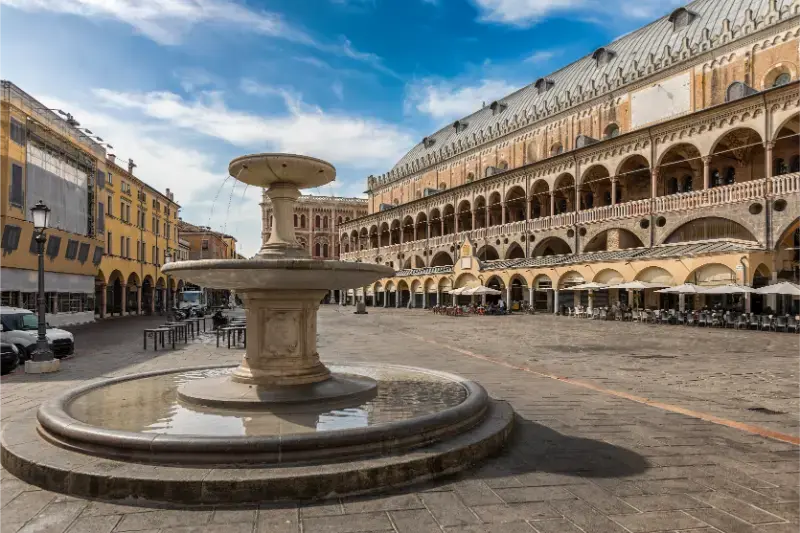
Between Piazza delle Erbe and Piazza della Frutta stands Palazzo della Ragione, the enormous medieval civic hall that once housed courts and commercial functions. Its upper hall is one of Padua’s defining interiors, while the covered market below keeps the building connected with everyday food life.
This area is ideal around lunch or aperitivo. It shows a side of Padua that contrasts with the solemnity of the basilica and the controlled experience of the Scrovegni Chapel.
Padua with children
Families often find Padua easier than Venice because streets are broader, there are fewer bridge obstacles and Prato della Valle gives children space. The Botanical Garden works well with school-age children interested in plants and science, while the market squares provide easy food breaks.
The Scrovegni Chapel can be meaningful for older children if you explain the frescoes as a visual story rather than an art-history lecture. For a broader Italian family trip, see our Italy with kids guide.
A two-day Padua plan
With an overnight stay, use the first day for the Scrovegni complex, market squares, Palazzo Bo and an evening aperitivo. On the second, visit Saint Anthony, Prato della Valle and the Botanical Garden, then add another church or museum according to interest. This pacing avoids placing every major interior in one continuous sequence.
Padua can then connect naturally by train to Venice, Vicenza or Verona. For travellers who prefer fewer hotel changes, it is also a reasonable base for regional day trips, especially when Venice accommodation is unusually expensive.
Is Padua better as a day trip from Venice or a stop between cities?
Both work. A day trip is ideal when you have a stable Venice base and want one change of pace without moving luggage. Padua’s station is close enough to the centre to make this efficient. An overnight stay becomes attractive when Scrovegni availability is awkward, when you want evening life or when Padua is part of a rail route toward Verona or Bologna.
The decision should come down to hotel changes. If your wider trip already involves many one-night stays, keep Venice as the base. If you value slower evenings and lower accommodation pressure, give Padua a night of its own.
Useful official sources
Tours and activities
If you prefer a guided visit, compare the meeting point, group size, duration, cancellation rules and exactly which admissions are included before booking. A tour is most valuable when the guide adds context or solves a difficult reservation, not simply because a listing uses the phrase “skip the line”.
Where to stay
For this trip, Compare hotels in Padua. Check the exact location on a map, recent reviews, cancellation terms and the route from your arrival point before choosing a non-refundable rate.
Final planning advice
Keep one part of the day deliberately unscheduled. Veneto’s historic cities are at their best when there is time for a market, café, church, canal, riverside walk or neighbourhood that was not on the original checklist. Use official websites for last-minute operational details, then use your itinerary as a framework rather than a race.
Last updated: October 17, 2026