

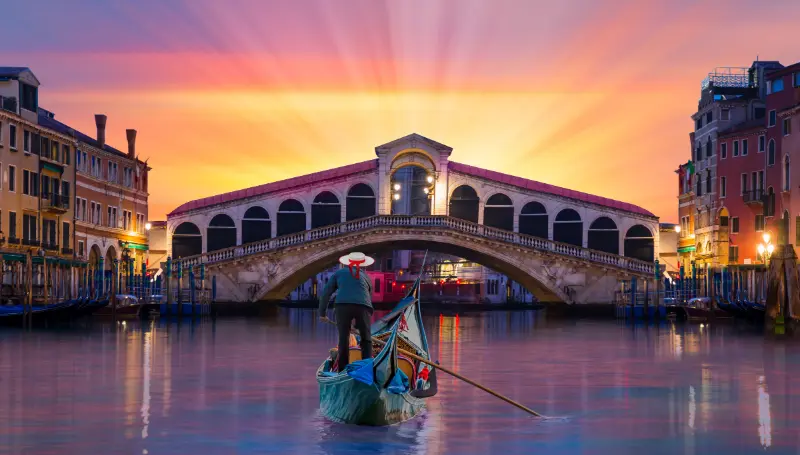
Rialto is worth more than a five-minute photo stop on Venice’s most famous bridge. The bridge, market, Grand Canal traffic and lanes of San Polo form one of the city’s oldest commercial landscapes. The challenge is timing: arrive at the wrong hour and you experience a compressed corridor of tour groups; arrive early and you see boats unloading, market stalls working and the Grand Canal before the day reaches full intensity.
At a glance
| Best for | Rialto Bridge, markets, Grand Canal views and San Polo |
|---|---|
| Allow | 2–4 hours for the area; longer if adding Frari and San Rocco |
| Best time | Early morning for the market and quieter bridge views |
| Good to know | The fish market is not open every day; check current market information |
Why Rialto matters
Rialto was Venice’s commercial core long before it became a global photo icon. The location sits at a strategic bend of the Grand Canal and historically concentrated trade, finance, food distribution and ferry crossings. That history explains why the market is not a decorative add-on: it is part of the same urban system as the bridge. Understanding that relationship makes the area more interesting than simply crossing from San Marco to San Polo.
If this is your first trip, begin with our Venice travel guide and use Rialto as one anchor rather than the whole day. Venice works better when headline sights are balanced with quieter neighbourhood walking.
The best time to visit Rialto Bridge
For photographs and breathing room, early morning is the clearest choice. Before the main day-trip flow arrives, you can stop on the bridge without blocking pedestrian movement and watch service boats working the canal. Late evening is another strong option, especially after dinner, when shops begin to close and the bridge becomes less transactional.
Midday is not “wrong,” but it is usually the least comfortable period. The bridge is a major pedestrian connection, not a viewing platform designed for long stops. Keep bags close, avoid forming a group in the middle of the steps and move to the side before taking photos.
Rialto Market: what is actually open
Venezia Unica currently lists the Rialto fruit and vegetable market in Casaria/Campo de la Pescheria from Monday to Saturday, generally 07:00–20:00, with Sunday closed. The fish market in Campo de le Becarie is listed Tuesday to Saturday, generally 07:00–14:00, with Sunday and Monday closed. These are working markets, so the most atmospheric visit is earlier rather than near closing.
Market operations can be affected by maintenance, holidays and local decisions. In August 2026 the city published temporary stall relocations connected with canopy works, a useful reminder to verify current conditions close to travel rather than relying on a years-old blog schedule.
How to behave at a working food market
Treat the market as a place of business. Do not block customers while composing long photo sessions, touch produce without permission or photograph vendors at close range without asking. Buying fruit, cheese or another permitted takeaway is a better way to engage than turning every stall into a backdrop.
If you want to understand Venetian food beyond the market, pair this morning with our Venice cicchetti and bacari guide. It explains how small snacks fit into local drinking culture and why a bacaro crawl should be slower and more selective than social media sometimes suggests.
What to see around the bridge
On the San Polo side, the market lanes lead naturally toward Campo San Polo, the Frari and the Scuola Grande di San Rocco. On the San Marco side, walking south eventually brings you toward Piazza San Marco, but resist the most direct shopping street if crowds are heavy. Parallel lanes often provide a calmer route and a better sense of scale.
The bridge also works as a transport reference point. If you plan to use boats repeatedly, read the vaporetto guide before buying passes. A Grand Canal ride can complement the bridge view rather than duplicating it.
Rialto by vaporetto or on foot?
Most visitors will reach Rialto on foot at least once because the bridge sits between major sightseeing zones. Vaporetto stops nearby are useful when arriving from the station, Piazzale Roma or distant parts of the city. Boats can also save tired legs after a long museum day, but walking remains essential for understanding San Polo.
Do not judge distance by kilometres alone. Venice walking times change with bridge crossings, luggage, crowds and wrong turns. If you have a timed entry at St Mark’s Basilica or the Doge’s Palace, build a buffer rather than assuming a map estimate is exact.
Best nearby churches and art
The Frari is one of the strongest reasons to continue deeper into San Polo. Its scale, Gothic architecture and major artworks give a completely different experience from the glitter of San Marco. Nearby, the Scuola Grande di San Rocco is renowned for its Tintoretto cycle and can easily become the artistic highlight of a day.
A sensible sequence is market first, then Frari and San Rocco, followed by lunch or cicchetti. This keeps you from crossing back and forth through the same congested lanes and leaves the late afternoon free for Dorsoduro or Cannaregio.
Eating near Rialto without defaulting to the obvious
The immediate bridge approaches contain many businesses aimed at very high visitor turnover. That does not make every restaurant poor, but location alone is not evidence of quality. Read recent menus and reviews, compare prices before sitting down and walk several streets away if a terrace seems to sell only the view.
For seafood, remember that “fresh” is not a magic word and menus should still make sense seasonally. A short list of dishes and visible local clientele can be useful signals, while aggressive street solicitation is a reason to keep walking.
Rialto with children and limited mobility
Children often enjoy the market and boat traffic more than another formal interior. Keep them close on the bridge because pedestrian traffic can be dense, and schedule a quieter campo afterward. Families can connect Rialto with ideas in our Venice with kids guide.
The bridge itself has steps, so wheelchair users and travellers who cannot manage stairs should plan alternative routes and accessible transport information in advance. Venice accessibility varies by bridge and seasonal ramp installation; do not assume the shortest map route is the easiest.
Common Rialto mistakes
The most common mistake is arriving at noon, taking one bridge photo and concluding that Rialto is only a crowd. Another is visiting the market on a day when the fish section is closed. A third is trying to combine Rialto, San Marco, Murano and a gondola in one compressed day.
If your schedule is that tight, simplify it using the priorities in our first-time Venice guide. The city rewards fewer anchors and more walking time.
A practical half-day route
Start around 07:30–08:30 at the market, then cross or photograph the bridge before the busiest period. Walk through San Polo toward the Frari and Scuola Grande di San Rocco. Stop for a late-morning coffee or early lunch, then continue toward Dorsoduro across the Accademia side or return by vaporetto.
This route gives you commerce, major art, residential lanes and water views in one compact area. It also leaves San Marco for a separate early or late time slot when its atmosphere is easier to appreciate.
Practical planning notes that save time
Build the day around geography rather than around a list copied from several different itineraries. In Venice and Veneto, a route that looks short can become slow because of bridges, boat waiting times, restricted traffic zones, mountain roads or seasonal transport. Put the hardest reservation or most weather-dependent activity first, then keep secondary stops movable. This simple rule reduces missed tickets and makes it easier to respond when a museum closes a room, a vaporetto is crowded, a lift stops for wind or a road journey takes longer than the map predicted.
Check the official source again 24–48 hours before the visit. Opening days, ticket rules, event closures and transport timetables are operational information rather than permanent facts. Save the relevant official page on your phone and take a screenshot of any ticket QR code that may need to work without a reliable connection. If you are moving between cities, keep the address of your accommodation and the name of the nearest stop available offline as well.
Budget and booking strategy
Do not pre-book every hour simply because booking is possible. Reserve the attractions or activities that genuinely sell out, then leave meals, walks and secondary churches flexible. Compare the total cost of city passes with the admissions you will actually use, and include transport only when it solves a real problem. A pass that saves a few euros but forces you into extra attractions is not saving time or money.
For accommodation, compare the final price including local taxes, breakfast, cancellation conditions and transport to the places you care about. In Venice, the cheapest room can become inconvenient if it requires several bridges with luggage; in the Veneto countryside or mountains, a remote property can create daily driving. Location should reduce friction in your itinerary, not just look attractive on the booking page.
Tours and activities
A guided food or market walk can be worthwhile when the guide explains ingredients, seasonality and neighbourhood history rather than simply moving a group through several tasting counters. Check whether tastings are included, how many stops are promised and whether the tour enters the market while stalls are actually operating.
Where to stay
Rialto is central but busy. If you want to stay nearby, compare accommodation around Rialto and San Polo; then compare bridge crossings, vaporetto stops and the walking route from your arrival point before booking. For quieter evenings, also compare Cannaregio and Dorsoduro in our where to stay in Venice guide.
Useful official sources
Final planning advice
Use Rialto early, not as a midday obstacle course. The bridge is most satisfying when you connect it to the market, San Polo and the working life of the Grand Canal. Check market days before you go, keep timed attractions elsewhere to a minimum and give yourself permission to leave the main pedestrian stream.