

Piacenza Travel Guide is designed to help you plan a realistic visit rather than simply collect a list of attractions. Piacenza is a compact Emilian city at the western edge of Emilia-Romagna, close to Lombardy and positioned between the Po plain and the first Apennine valleys. It is quieter than Bologna or Parma, but that is part of the appeal: the historic centre is easy to walk, major monuments sit close together, and the province opens quickly into vineyards, castles and river landscapes.
This guide focuses on what is genuinely useful on the ground: how long to allow, which sights deserve priority, how to combine them without excessive driving, where food fits into the day and which details should be rechecked shortly before travel. Piacenza province is compact on a map but divided by rivers and valleys, so good sequencing matters more than trying to maximise the number of stops.
| Best for | first-time visitors, art, architecture, food and an easy Emilia-Romagna city break |
|---|---|
| Allow | 1–2 days |
| Good base | Piacenza city centre |
| Region | Emilia-Romagna, Italy |
Why this place or route is worth your time
Founded as the Roman colony of Placentia in 218 BC, Piacenza developed at a strategic crossing point on routes linking the Po Valley with Liguria and central Italy. Medieval churches, Renaissance palaces and the long Farnese presence all left visible layers in the city. The best way to understand Piacenza is not to chase a huge checklist, but to connect Piazza Cavalli, the cathedral area, Sant’Antonino and Palazzo Farnese with time for a traditional meal and a slow walk through the streets between them.
The advantage of travelling here is the balance between major sights and breathing space. Even the best-known locations in Piacenza province usually feel more manageable than Italy’s headline art cities. That makes it easier to spend time with architecture, landscape and food instead of constantly queueing or crossing a large urban area. The trade-off is that many provincial attractions use seasonal schedules, guided departures or reservation systems. A little advance planning therefore has a much bigger payoff here than in a city filled with all-day museums.
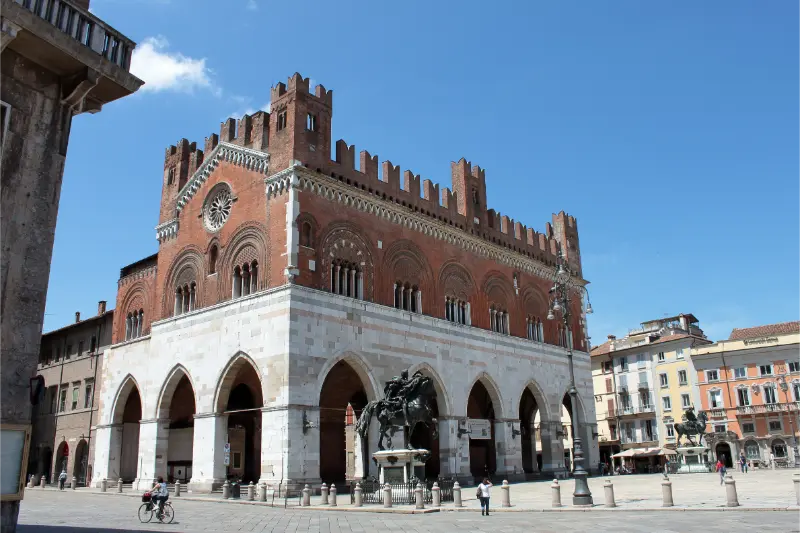
Piazza Cavalli and Palazzo Gotico
Piazza Cavalli has been the political and commercial heart of Piacenza since the Middle Ages. The square is dominated by the brick-and-marble Palazzo Gotico, begun in the thirteenth century, and by two bronze equestrian statues of the Farnese dukes made by Francesco Mochi. It is the natural orientation point for a first visit and one of the best places to appreciate how restrained and elegant Piacenza feels compared with larger tourist cities.
Give this stop enough time to notice context as well as the headline feature. In smaller Italian towns, the relationship between a church, square, castle, river or hillside often explains more than a quick interior visit. If an attraction is unexpectedly closed, the surrounding streets and landscape can still make the stop worthwhile, so keep the route flexible rather than building the entire day around a single photograph.
Palazzo Farnese and the Civic Museums
For a closer look at this side of the destination, read our Palazzo Farnese Piacenza Guide.
Palazzo Farnese is the city’s largest historic complex and the place to allow the most museum time. The unfinished sixteenth-century palace was developed for the Farnese family and today houses civic collections ranging from archaeology and paintings to carriages and Risorgimento material. Particularly notable are the Etruscan Liver and a tondo attributed to Botticelli. The building itself, with its immense scale and internal courtyard, is part of the experience.
Give this stop enough time to notice context as well as the headline feature. In smaller Italian towns, the relationship between a church, square, castle, river or hillside often explains more than a quick interior visit. If an attraction is unexpectedly closed, the surrounding streets and landscape can still make the stop worthwhile, so keep the route flexible rather than building the entire day around a single photograph.
Piacenza Cathedral
For a closer look at this side of the destination, read our Piacenza Cathedral and Sant’Antonino Guide.
The Romanesque cathedral, dedicated to Santa Maria Assunta and Santa Giustina, was built mainly between 1122 and 1233. Its façade, carved portals and powerful interior give a very different atmosphere from the more ornate later churches nearby. Inside, look for the medieval guild panels and the seventeenth-century fresco cycle in the dome and presbytery.
Give this stop enough time to notice context as well as the headline feature. In smaller Italian towns, the relationship between a church, square, castle, river or hillside often explains more than a quick interior visit. If an attraction is unexpectedly closed, the surrounding streets and landscape can still make the stop worthwhile, so keep the route flexible rather than building the entire day around a single photograph.
Basilica of Sant’Antonino
Sant’Antonino is one of Piacenza’s most historically important churches. Its origins go back to Late Antiquity, although the building has been reconstructed and altered many times. The pointed Gothic entrance known as the Porta del Paradiso faces a street once associated with the Via Francigena, while the basilica’s history is tied to the negotiations that preceded the Peace of Constance.
Give this stop enough time to notice context as well as the headline feature. In smaller Italian towns, the relationship between a church, square, castle, river or hillside often explains more than a quick interior visit. If an attraction is unexpectedly closed, the surrounding streets and landscape can still make the stop worthwhile, so keep the route flexible rather than building the entire day around a single photograph.
Food and evening atmosphere
To explore local dishes and food stops in more detail, use our Piacenza Province 3-Day Road Trip.
Piacenza is also a food destination. The province is especially known for Coppa Piacentina DOP, Pancetta Piacentina DOP and Salame Piacentino DOP, along with pisarei e fasö, anolini and tortelli con la coda. A first visit works best when lunch or dinner is treated as part of the itinerary rather than squeezed between monuments.
Give this stop enough time to notice context as well as the headline feature. In smaller Italian towns, the relationship between a church, square, castle, river or hillside often explains more than a quick interior visit. If an attraction is unexpectedly closed, the surrounding streets and landscape can still make the stop worthwhile, so keep the route flexible rather than building the entire day around a single photograph.
2026 opening information, tickets and what to verify
At Palazzo Farnese the current published schedule is Monday closed, Tuesday–Friday 10:00–13:00 and 15:00–18:00, Saturday and Sunday 10:00–18:00; the standard full-collection ticket is listed at €10. Religious buildings use worship schedules, so access can change during services.
Opening hours and prices can change for exhibitions, religious services, private events, maintenance or winter schedules. Check the official source again shortly before departure, especially when a guided tour has a fixed start time. Search-engine panels and older travel blogs can lag behind seasonal changes. If a ticket is essential to the day, protect that booking first and keep meals, viewpoints and outdoor walks as the flexible parts of the itinerary.
How to get there and move around
Piacenza city is well connected by rail on the Milan–Bologna corridor, and the historic centre is walkable once you arrive. For the province, a car becomes much more useful because castles, archaeological sites, wineries and mountain valleys are spread across rural areas with limited public transport. On a road trip, measure travel by realistic driving time rather than straight-line distance. Roads through Val Trebbia, Val Nure, Val Tidone and Val d’Arda can be winding, and a short distance may include village traffic or mountain sections.
Parking is generally easiest when you arrive earlier in the day. In medieval villages, avoid expecting to drive directly to the main square: access restrictions and steep historic lanes often mean leaving the car below or outside the old centre. Pack light for village visits and wear footwear suitable for cobbles, slopes and uneven fortress floors.
Best time to visit
For a more detailed plan, our Val Trebbia Road Trip develops this part of the journey step by step.
Spring and early autumn are the most versatile periods because temperatures are comfortable for city walking, vineyards are attractive and many seasonal castles are operating. Summer works well for mountain valleys and evening events but can be hot in exposed historic centres. Autumn is especially rewarding for food, wine and forest colour. Winter can be atmospheric in the city and larger villages, although smaller attractions may reduce hours and mountain conditions require more caution.
Food: how to make it part of the itinerary
To explore local dishes and food stops in more detail, use our Piacenza Wine Guide.
Piacenza is a province where food should be planned as an experience rather than treated as refuelling. The three DOP salumi — Coppa Piacentina, Pancetta Piacentina and Salame Piacentino — are an obvious starting point. Pisarei e fasö, anolini and tortelli con la coda add local identity to a meal, while Gutturnio, Ortrugo and Malvasia connect the city with the surrounding hills. If you are driving, keep wine tasting modest and consider an overnight stay for a fuller winery experience.
Lunch reservations are useful on weekends in small villages because a popular trattoria may be busier than the surrounding streets suggest. In mountain areas and tiny borghi, restaurant opening days can be as important as museum opening days. A simple rule works well: book the one meal you care most about, then leave the other food stops flexible.
A realistic itinerary structure
Start with the sight that has the strictest opening or guided-tour time. Use late morning for the main cultural visit, then stop for lunch in the same town or valley rather than driving thirty minutes solely for a restaurant. In the afternoon, choose one geographically logical second experience: a village, short nature walk, winery, museum or viewpoint. Leave at least one unbooked hour. That margin absorbs parking delays, a tour running long or a meal you decide not to rush.
For travellers staying in Piacenza, check the return route before dinner if the day takes you deep into the valleys. Rural roads are straightforward in daylight but can feel slower in fog, rain or darkness. Download the destination and key parking point for offline use when heading into the Apennines, where mobile coverage can be less consistent.
Where to stay
If choosing a base is the next step, our Where to Stay in Piacenza compares the options in more detail.
Piacenza city centre is the most logical starting point for this itinerary, but the right choice depends on the wider trip. A central Piacenza hotel suits rail travel and evening restaurants; a countryside stay suits drivers focusing on castles or wineries; Bobbio or another valley town can reduce backtracking on a mountain itinerary. Compare the total movement of the trip, not only the nightly room price.
If your route depends on weather or a seasonal attraction, a refundable rate can be worth the small premium. Also check parking terms: “parking nearby” in a medieval village can mean a public lot several hundred metres away, which is fine for most travellers but relevant with heavy luggage or limited mobility.
Families and accessibility
Families can enjoy this area because distances are manageable and castles, bridges and open landscapes give children visual variety. The main limitation is physical access: historic centres may have cobbles and steep lanes, towers use stairs, and some castles developed around defensive terrain rather than modern accessibility standards. If step-free access is essential, contact the attraction directly before booking and ask about the exact route, not only whether the site is described as “accessible.”
Common planning mistakes
The most common mistake is overloading the day. Two castles with fixed guided departures, a full lunch, a winery and a mountain village rarely fit comfortably once real driving and parking are included. A second mistake is assuming that a small town can be visited at any hour: museums, churches and restaurants may close in the middle of the day or operate seasonally. Finally, do not use scenic river or mountain photographs as evidence that a particular access point will be suitable after rain, flooding, snow or road works.
Tours and organised experiences
An organised tour can be useful when the value lies in interpretation, producer access or not having to drive after a tasting. Compare inclusions carefully: transport, guide language, entry fees and the amount of tasting matter more than a generic “food tour” or “castle tour” label. For independent travellers, organised experiences work best as one anchor in the day rather than as a replacement for exploring the town or valley itself.
Official information to check before you go
Continue planning Piacenza and Emilia-Romagna
Final advice
A successful trip in Piacenza province is usually built around one clear priority and a small number of supporting stops. Decide whether the day is mainly about art, a castle, food, wine, archaeology or landscape, then let the other elements strengthen that theme. The region rewards travellers who leave enough time for a square, a conversation over lunch or an unplanned viewpoint. Those slower moments are often what distinguish a real provincial itinerary from a checklist assembled from search results.
Last updated: October 17, 2026
Leave a Reply