
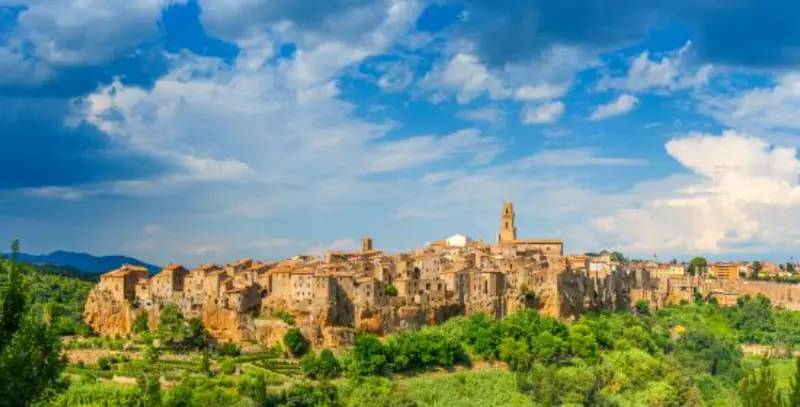
Pitigliano, Sovana and Sorano form one of southern Tuscany’s most distinctive small-road landscapes. Towns rise directly from tufa cliffs, Etruscan tombs sit in wooded valleys, and ancient sunken paths known as Vie Cave cut between high rock walls. This is not a region to rush between photo stops: the roads are slow, parking sits outside historic cores and the best experiences often involve walking.
At a glance
| Ideal time | 2 days; 3 if hiking the Vie Cave and adding thermal stops |
|---|---|
| Best for | Tufa villages, Etruscan archaeology, hiking, road trips |
| Car needed? | Strongly recommended |
| Best base | Pitigliano for atmosphere; Sorano/Sovana for a quieter stay |
| Official planning | Visit Tuscany / official visitor information |
Why Tufa Towns deserves time in your Tuscany itinerary
Use Pitigliano as the visual anchor, Sovana for archaeology and a gentler village scale, and Sorano for fortifications and dramatic topography. The three places are close enough to combine, but each has a different reason to stop. Two nights transform the route from a driving exercise into a coherent trip.
If Pitigliano, Sovana and Sorano is part of a longer route through Tuscany, our Tuscany travel guide is a useful starting point for choosing the next stop.
The practical advantage is that you can shape the visit around your own travel style. Art-focused travellers can give more time to churches and museums; food travellers can protect a long lunch; families can reduce the number of interiors; road trippers can use the destination as an anchor rather than as one more pin on the map. The goal is not to see everything. It is to leave with a clear sense of place.
Pitigliano and its cliff-edge profile
The classic view of Pitigliano shows buildings apparently growing from the tufa ridge. Stop only at designated pull-offs and viewpoints; roadside photography on narrow approaches can be dangerous. Once inside, explore the lanes, aqueduct, palace area and overlooks rather than treating the town as an exterior panorama.
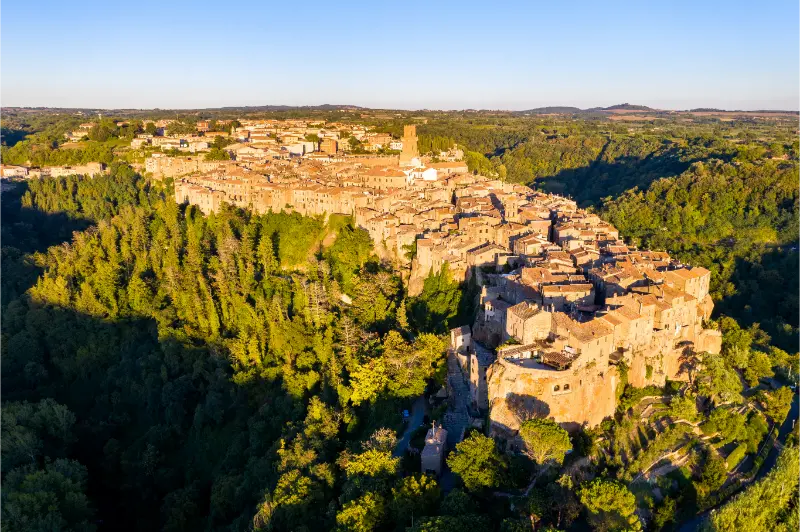
The vertical setting means stairs and uneven surfaces are part of the day. Travellers with limited mobility should research parking and accessible routes before arrival.
The Jewish quarter
Pitigliano’s long Jewish history is central to its identity and explains the nickname “Little Jerusalem.” The synagogue and associated spaces offer a more meaningful visit when approached as cultural history rather than a novelty.
Check current opening times and respect the religious character of the site. Food traditions linked to the community are also part of the story, but avoid reducing that history to one specialty or souvenir.
Sovana and Etruscan archaeology
Sovana is smaller and quieter, with a compact historic centre and important Etruscan necropolises nearby. The archaeological landscape is spread out enough that proper shoes, water and time matter more than in a city museum.
Choose a limited number of tombs and paths, especially in hot weather. The value comes from seeing how burial spaces relate to rock, vegetation and ancient routes, not from reaching every signed feature.
Vie Cave
The Vie Cave are deeply cut paths in the tufa, some bordered by strikingly high rock walls. Their atmosphere depends on shade, moisture and isolation, which also means conditions can change after rain or maintenance work.
Use current local information before hiking, avoid entering closed sections and do not treat slippery surfaces lightly. A short safe section is better than forcing a longer route because an old blog described it as easy.
Sorano and the fortress landscape
Sorano climbs through a maze of stone lanes beneath defensive structures and offers a different spatial experience from Pitigliano. Its fortress and cliffside setting make it worth several hours rather than a drive-through.
Use Sorano to slow the trip after a more crowded Pitigliano morning. Staying nearby also positions you well for thermal areas or a second day of archaeological walks.
How long should you stay?
2 days; 3 if hiking the vie cave and adding thermal stops is the useful starting point, but the right answer depends on what comes before and after. If you are moving hotels every night, add less; if this is one of only two bases in Tuscany, stay longer. Travel time, parking, check-in and meals consume more of a day than first-time itineraries usually allow.
A rushed schedule also makes weather and closures more damaging. With margin, a late museum opening or a slow lunch is simply part of the trip. Without margin, it forces you to abandon the next stop. Build one “optional” item into every day so the itinerary can contract without feeling like a failure.
Getting there and moving around
A car is the practical choice. Roads are scenic, narrow and slower than map distances suggest. Park outside historic centres, keep fuel above empty before rural loops and download offline maps. If you plan thermal bathing or hiking in the same day, carry a separate bag for wet gear and shoes.
Before driving anywhere in Tuscany, review our driving in Italy guide, especially ZTL rules, parking signs and rural-road timing. If you are travelling without a car, compare the plan with our Italy without a car guide and simplify the number of same-day stops rather than replacing every drive with a complicated chain of buses.
Where to stay
Pitigliano for atmosphere; Sorano/Sovana for a quieter stay. The best accommodation is the one that reduces the most annoying part of your itinerary: parking if you have a car, station access if you rely on public transport, or evening driving if food and wine matter. A beautiful countryside property can be a poor choice when every dinner requires a dark 25-minute drive.
Compare current accommodation options on Booking.com. Check parking, air conditioning, stairs, breakfast times and the exact distance from the historic centre rather than relying only on the property’s marketing description.
What and where to eat
Southern Maremma food is robust and seasonal: acquacotta, handmade pasta, wild boar, mushrooms, local cheeses and olive oil appear often, while Pitigliano adds Jewish-influenced traditions to the regional mix. Rural restaurants may keep specific lunch and dinner windows, so do not assume you can eat anywhere at 4 p.m.
Reserve only the meals that genuinely matter to you. Leaving one lunch flexible makes a road trip more resilient, while booking every dinner can turn a relaxed region into a sequence of deadlines. In small towns, however, restaurant capacity may be limited on weekends or outside high season, so ask your accommodation whether advance reservations are sensible.
A realistic first-day itinerary
Day one: Pitigliano, Jewish quarter and one easy viewpoint walk. Day two: Sovana, selected Etruscan sites and one Vie Cave section, then Sorano for late afternoon. With a third day, add a thermal stop such as Saturnia or Bagni San Filippo depending on your onward route.
Protect at least one unstructured hour. It can become a café stop, a shop visit, a longer museum, a rest in the hotel or simply time lost to parking without damaging the rest of the day. This buffer is one of the simplest ways to make a Tuscany itinerary feel independent rather than tour-like.
Best time to visit
Spring and autumn are ideal for walking. Summer works if you start hikes early and carry enough water; exposed villages can be hot even when the Vie Cave feel cool. After heavy rain, verify trail conditions. Winter is atmospheric but daylight is short and rural schedules are reduced.
For the wider seasonal picture, use our guide to the best time to visit Italy. Always check attraction hours close to your date: church access, museums, ferries, trails and small businesses can change seasonally, and a timetable copied from an old article is not a reliable planning tool.
How to avoid turning the visit into a checklist
Choose one “must-do,” two “would-like” stops and let everything else remain optional. This is particularly important in Tuscany because the distance between towns looks short on a map while parking, hillside walking and meals expand the real day. If you have already seen three churches and a museum before lunch, the best next stop may be a bench with a view.
Crowd strategy is usually simple: start earlier than day-trip groups, stay later than they do, or sleep in the destination. You do not need to discover a “secret” viewpoint to have a quieter experience; you often just need to be in a famous place at a less compressed time.
Families, accessibility and slower travel
For families, alternate cultural stops with movement and food. One castle, tower, beach, short trail or open square can reset the day after a museum. Do not assume a stroller will be comfortable on medieval paving, steep lanes or natural paths; a carrier may be more practical for smaller children in some destinations.
Travellers with limited mobility should investigate gradients, stairs, parking and accessible entrances attraction by attraction. Historic Tuscany is not uniformly accessible, but a visit can often be redesigned around viewpoints, lower-town routes, taxis and selected museums. Asking a hotel about the actual number of steps is more useful than relying on a general “central location” description.
How to connect this stop with the rest of Tuscany
Useful next reads are our Maremma guide, our Tuscany thermal-springs guide, our Val d’Orcia guide and our Tuscany travel guide. Build clusters geographically: pair places that share the same road or rail corridor and avoid crossing Florence or Siena repeatedly just to keep a hotel booking.
If this is your first trip to the region, step back occasionally and compare the route with the larger Tuscany travel guide. A strong itinerary normally includes contrast—at least one art city, one smaller town and one landscape or coast experience—rather than ten versions of the same hill-town day.
What to book in advance
Book only capacity-limited experiences that matter: a specific museum slot, winery tour, ferry with a vehicle, guided cave, concert, spa entry or restaurant during a major event. For everything else, preserve flexibility. Before paying a third-party seller, compare the offer with the official visitor page linked above and read cancellation terms.
Our broader guide to booking Italy attractions explains how to distinguish official tickets, timed-entry requirements and convenience products. Save confirmations offline because mobile reception can be unreliable in rural or mountain areas.
Practical planning notes that make a real difference
Carry water, a small amount of cash, a charged phone and footwear suitable for stone or uneven ground. In summer, move exposed walks to the morning; in shoulder seasons, carry a light waterproof layer. Do not let a sunny forecast in Florence convince you that an island, mountain valley or elevated hill town will feel identical.
Use offline maps but follow local signs when they disagree with navigation. ZTL cameras, market closures, ferry lanes and temporary road works are local realities that an app may not understand in real time. On rural roads, never stop around a blind bend for a photograph and never block farm access.
Finally, leave space for local information. A hotel owner, museum desk or tourist office may know that a path is muddy, a road is closed, a church has a special opening or a festival is changing parking that day. Good independent travel is not rigid self-sufficiency; it is the ability to update the plan when better information appears.
Final thoughts
Tufa Towns earns its place in a Tuscany itinerary when you let its strongest qualities determine the pace. Plan transport first, choose a small number of meaningful experiences, eat locally and leave enough margin for the landscape or street life that cannot be reserved. That approach produces a richer day than trying to prove how many Tuscan names you can fit on one route.
Last updated: October 17, 2026