
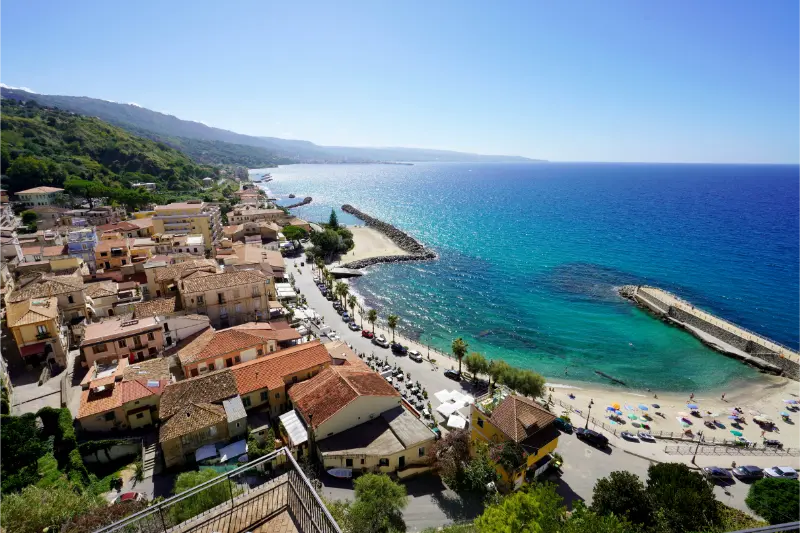
Pizzo is the kind of Calabrian town that becomes more enjoyable the longer you stay past the obvious postcard moment. A square hangs above the Tyrrhenian coast, narrow streets spill down toward the sea, a castle recalls the region’s turbulent history, and a church carved into coastal rock offers a genuinely unusual visit. Then there is tartufo di Pizzo, the famous ice-cream dessert that attracts travelers who may otherwise have driven straight from Lamezia toward Tropea.
Come for the gelato if you like, but give Pizzo time for its setting and history. This guide covers the old town, Murat Castle, Piedigrotta, beach options, and practical logistics. It explains why Pizzo works as a half-day stop or overnight base near the Costa degli Dei, and why a tight connection between two sights can be more awkward than it looks on a simple map.
For a broader Calabria itinerary, see the Calabria travel guide before deciding which destinations to combine with Pizzo, Calabria.
At a glance
| Signature dessert | Tartufo di Pizzo gelato |
|---|---|
| Key historic landmark | Murat Castle |
| Unusual cultural visit | Rock-carved Piedigrotta church |
| Plan around | Historic center and Piedigrotta are separate stops |
On this page
- Begin at Pizzo's cliff-top square
- Murat Castle and the story behind its name
- Piedigrotta: the remarkable rock-carved church
- Tartufo di Pizzo: what you're actually ordering
- Down toward the water: beaches and lower Pizzo
- A walking itinerary for half a day
- Where Pizzo fits in a Calabria itinerary
- Arriving by train, car, or from the airport
- Where to stay and how long to spend
- Local food and a slower rhythm
- Practical cautions before you visit
- FAQ
Begin at Pizzo’s cliff-top square
The central piazza is one of Pizzo’s pleasures. From this elevated setting, you can move between cafés, old lanes, and outlooks over the Tyrrhenian Sea. It is a town where sitting for a little while is part of sightseeing. Resist the temptation to order a tartufo and immediately depart: walk away from the busiest corner, follow an old lane that interests you, and notice the layers of residential and commercial life. Pizzo feels more complete when you see people going about ordinary business rather than only the visitors circulating through cafés.

The elevation brings beautiful views but also gradients and steps connecting the upper center with lower areas. If traveling with someone who finds climbs difficult, plan an accessible segment around the center rather than a route that depends on multiple steep shortcuts. A relaxed visit can include the square, the castle exterior or interior, and a meal without needing to descend to every waterfront corner.
Murat Castle and the story behind its name
The castle in Pizzo is frequently known as the Castello Murat because Joachim Murat, Napoleon’s brother-in-law and former king of Naples, was imprisoned and executed here in 1815. The event gives the fortress an important place in the history of the Napoleonic period in southern Italy. Visiting can be an opportunity to understand that history beyond a simplified anecdote, although exhibits and visitor routes should be checked before arrival.
The castle is a compact urban landmark, not an all-day palace experience. Combine it with a walk through the surrounding streets and viewpoints, and allow time to consider the political world that made Pizzo part of larger European events. If the interior is closed for a private event, restoration, or another reason, do not let that spoil the entire day; the town and its coastal landscape still have plenty to offer. Look for up-to-date information from local cultural authorities.
Piedigrotta: the remarkable rock-carved church
The Chiesetta di Piedigrotta is probably Pizzo’s most unusual sight. It stands in a coastal rock setting, with sculpted religious figures and spaces carved from the stone. The effect is different from an ordinary church interior: its atmosphere comes from the meeting of devotional work and the natural material. Visit with curiosity about the place’s history and the people who shaped it, rather than seeing it as a backdrop for whimsical photographs. Respect any signs regulating movement and photography.
Piedigrotta is not simply on the main square. It requires a separate approach in the coastal area, and access can involve stairs or uneven surfaces. Check opening hours and the route before leaving the center, especially if you are traveling without a car or with limited mobility. Do not assume a taxi can deliver you to the last step of the entrance. On a hot summer day, choose morning or a more comfortable hour for the walk, and bring water.
Tartufo di Pizzo: what you’re actually ordering
The famous tartufo is a molded gelato dessert associated with Pizzo, often presented as a rich chocolate-and-hazelnut combination with a soft chocolate center. Variations exist, and vendors may offer additional flavors, but the classic is worth trying at least once. It is a pleasurable local tradition rather than a race to find a single universal winner. Compare atmosphere and craftsmanship; the busiest café is not necessarily the only excellent one.
If you have nut, milk, or other allergies, ask carefully about ingredients and cross-contact. Frozen desserts can contain ingredients that are not obvious from their appearance. For everyone else, give yourself time to enjoy it sitting down. In a place whose identity is tied to an ice-cream specialty, the small ritual of eating slowly in the piazza is arguably part of the destination’s character.
Down toward the water: beaches and lower Pizzo
Pizzo’s shoreline offers a different perspective from the elevated old town. Depending on where you go, you may find stretches for swimming, small harbor scenes, and views back toward the buildings above. Do not imagine that every beach is instantly reachable from a cliff-top accommodation. Check actual access routes, whether facilities operate on your travel dates, and where parking is permitted. In summer, the heat of a return climb matters as much as the distance on the map.
For a swimming-oriented stay, investigate your chosen accommodation’s shoreline access separately from its proximity to the central square. Some travelers will prefer a property closer to a beach and visit the old town later in the day. Others are happiest in the center, enjoying cafés and restaurants without using the car at night. Both are legitimate ways to experience Pizzo; the mistake is assuming one location provides effortless access to both.
A walking itinerary for half a day
Start with the old center and its viewpoints, then visit Murat Castle if open. Take time for lunch or tartufo in the square. Use the remainder of the visit either for Piedigrotta or for a relaxed descent toward the shore, depending on access, weather, and personal interests. Piedigrotta is distinctive enough that travelers interested in religious art may wish to prioritize it over a lengthy lunch, but the stop should be planned rather than added as an afterthought.
If you have a full day, there is room for both the rock-hewn church and the waterfront, with an unhurried return to the center for evening atmosphere. In peak summer, separate the more exposed walking segments with shade and refreshment. On a rainy day, prioritize whichever indoor attraction is currently open and avoid slippery steps to coastal sites. A well-paced town day can be refreshing after repeated days on crowded beaches.
Where Pizzo fits in a Calabria itinerary
Pizzo lies along the broader Costa degli Dei route and is convenient for people arriving through Lamezia Terme, especially when the following days are around Tropea or Ricadi. It can make a good first night after a late arrival or last stop before departing. If you are driving from Reggio or Scilla toward Lamezia, Pizzo is an attractive cultural pause, but still allow enough time for airport logistics if you have a flight the same day.
The distance to Tropea is manageable for a separate day trip, yet parking and traffic can change the effort. Do not assume you can casually add Pizzo, Capo Vaticano, and several beaches to one afternoon. If your trip is only four days long and focuses on the Costa degli Dei, Pizzo merits its own half-day. With a week, it can break up beach time and supply a stronger sense of local town life.
Arriving by train, car, or from the airport
The wider area has railway services, but always verify which station is relevant and how you will reach Pizzo’s historic center or a coastal hotel. The route from a station to a cliff-top town may require a local transfer. Do not book accommodation based on the existence of a rail symbol without comparing actual walking conditions and luggage needs. Trenitalia’s regional planning resources are the starting point for connections.
By car, look for suitable public or hotel parking rather than steering into narrow historic-center lanes. If the hotel promises parking, ask whether it is guaranteed and how far it lies from reception. Travelers arriving at Lamezia airport should compare the complete transfer journey, especially after evening flights when local transport may be limited. A short drive on paper can become an awkward arrival if no driver or pickup option is arranged.
Where to stay and how long to spend
An overnight stay is worthwhile if you enjoy atmospheric old towns and prefer not to rush. A centrally located guesthouse can offer easy evening dining, though the usual caveats about steps and vehicle restrictions apply. A beach-focused hotel may offer easier swimming but require transport to the historic center. Choose according to which part of Pizzo you want to experience most frequently. For families, room configuration, shade, and practical access matter more than a romantic photo from a rooftop.
One night plus a relaxed morning is enough to see the main sights, while two nights create space for a beach day and a longer outing. If your main vacation is in Tropea, you can visit Pizzo as a day trip without changing hotels. Staying in Pizzo solely to commute to distant south-coast attractions every day would be less efficient; match the base to the activities you’re actually prioritizing.
Local food and a slower rhythm
Tartufo is the famous treat, but use the town to explore Calabrian cooking more broadly. Seafood, vegetables, pasta, and preserved ingredients feature in regional kitchens; the exact menu depends on season and restaurant. Order what is being prepared well locally rather than expecting every café and trattoria to offer the same fixed collection of classics. If you dislike spicy food, ask about peppers and hot condiments without assuming every Calabrian dish is fiery.
A market or bakery visit can be a rewarding part of the day and a useful alternative to a large restaurant lunch. In the evening, the town’s elevated position can make the changing light especially attractive. Give yourself time to wander again after eating. The character of Pizzo lies partly in how the square, alleys, and waterfront respond to different hours rather than in the raw number of sights available.
Practical cautions before you visit
Check attraction hours directly, especially Piedigrotta and the castle, because schedules can change for maintenance or local events. Wear shoes suited to stone steps and coastal routes. Bring water and sun protection in summer, and do not leave bags unattended while swimming. Historic streets may be noisy on busy evenings; read recent accommodation reviews for information specific to your building.
Travelers with mobility needs should ask for step-free alternatives and realistic distances between sights. “Close” in Pizzo may mean a short horizontal separation with a substantial change in elevation. Visitors with children should consider a simple combination—one monument, a manageable walk, and gelato—rather than an exhausting sequence of hillside climbs.
FAQ
Is Pizzo worth visiting if I stay in Tropea?
Yes. Its castle, rock-carved Piedigrotta church, elevated old town, and tartufo dessert make it a distinctive cultural day trip rather than another version of the same beach resort.
How much time do I need in Pizzo?
A half-day can cover the main center and one attraction. A full day allows the castle, Piedigrotta, food, and some waterfront time without rushing.
Is Piedigrotta in the historic center?
No. It is a separate coastal site requiring its own route. Check opening, access conditions, and how to reach it before setting out.
Can I visit Pizzo without renting a car?
Potentially, with a planned rail and local-transfer combination. Confirm the station, last-mile transport, and accommodation access rather than assuming everything is walkable with luggage.
Is tartufo gelato suitable for someone with allergies?
It depends on the ingredients and preparation; the classic commonly includes dairy and nuts. Ask the specific vendor about allergens and cross-contact rather than relying on the dessert’s name.
Continue planning your Italy trip
- Tropea, Calabria: Old Town, Beaches and Visit Tips
- Calabria Travel Guide: Where to Go, Stay and How to Plan
- Best Things to Do in Calabria: Coast, Culture and Nature
- Driving in Italy: ZTLs, Tolls, Parking and Rental Cars Explained
Official resources and current information
Schedules, access restrictions and services can change. Use these official sources shortly before traveling rather than treating old prices or timetables as fixed.
Last updated: October 17, 2026