

Rimini’s beach is not one private strip: it is a long public shoreline organised into hundreds of numbered bathing establishments. You can enter the sand without paying and rent an umbrella or lounger only if you want the services of a bagno. Understanding that system, the different beach districts and the 2026 smoke-free rules makes the coast far easier to use, especially for first-time visitors.
| Beach length | About 15 km |
|---|---|
| Bathing establishments | Around 250 |
| Entry to sand | Free; pay for rented services |
| Best first-time area | Marina Centro |
| 2026 rule | Beaches are smoke-free |
How the bagno system works
Rimini has roughly 250 bathing establishments along about 15 kilometres of beach. Each bagno manages a section with umbrellas, loungers and varying extras such as showers, changing rooms, sports courts, children’s play areas, bars or restaurants. Numbers help you navigate the long coastline and are even marked prominently for emergency identification.
You do not pay an entrance fee merely to walk onto the beach. Charges apply when you rent equipment or use paid services. Ask for the daily or multi-day price before settling in, and check whether your hotel already has an agreement with a specific bagno.
Free access and free-beach areas
Even where organised establishments dominate, access to the shoreline remains possible. If you prefer not to rent equipment, ask the tourist office or your hotel for the nearest free-beach section and current local rules. Space can be limited in peak summer, so arrive earlier for a comfortable spot.
Bring your own shade only where permitted and do not block access routes. The practical value of a bagno becomes clearer with children or a full beach day because toilets, showers and secure storage can matter more than the lounger itself.
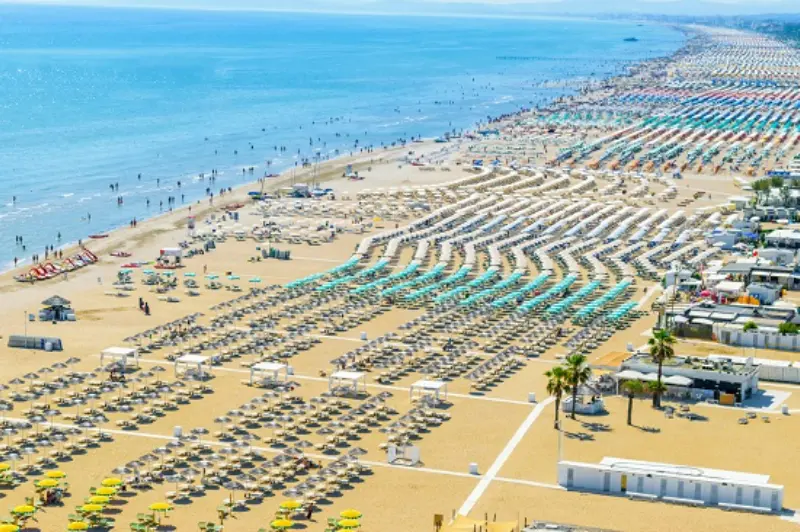
Marina Centro beach
Marina Centro is the classic first-time section: central, lively and close to the Grand Hotel, seafront promenade and many restaurants. It works well for travellers who want to alternate beach time with the historic centre and evening dining without relying heavily on a car.
It is also one of the busiest parts of the coast. If your ideal beach means quiet sand and fewer people, consider districts farther north or south rather than expecting central Rimini to feel secluded in August.
Southern beaches
Bellariva, Marebello, Rivazzurra and Miramare extend the resort south toward Riccione. These districts are strongly oriented toward family holidays, with hotels, beach services and entertainment concentrated close together. Shallow water and fine sand are important reasons the area remains popular with children.
The farther south you stay, the more you should think about transport to the historic centre. Local buses make the trip manageable, but daily museum visits may become less convenient than from Marina Centro.
Northern beaches
Rivabella, Viserba, Viserbella and Torre Pedrera offer long stretches of sand north of central Rimini. They can feel more residential and are often attractive to families or repeat visitors who care less about nightlife in Marina Centro.
These areas are still part of Rimini’s urban coast, not remote nature beaches. Choose them for a different resort rhythm and potentially better value, not for wilderness.
2026 smoke-free rules
Rimini Turismo states that in 2026 the beaches have become entirely smoke-free, with many establishments creating designated smoking areas. The rule builds on earlier shoreline restrictions and is part of the city’s environmental and health policies.
If you smoke, ask the bagno where the designated area is instead of assuming an umbrella provides a private exception. If smoke-free sand is important to you, the policy is a meaningful practical improvement compared with older travel descriptions.
Families and child safety
The beach’s gentle slope and shallow water make it particularly popular with families. Many establishments provide playgrounds, baby-changing facilities and identity bracelets for children. Lifeguard cooperation along the numbered beach system is designed to help reunite lost children quickly.
Even with organised services, standard water safety still matters. Follow flag warnings, supervise children directly and do not confuse shallow water with risk-free water, especially on windy or rough days.
Dogs on Rimini beaches
Many beach establishments accept dogs, but access conditions vary. Vaccination documentation, leashes and sometimes muzzles may be required, while water access is restricted to authorised areas and times. Check the specific bagno before arriving with a dog.
A generic “pet-friendly hotel” does not guarantee that the nearest beach allows your dog into the sea. Coordinate hotel and beach policies before booking a summer stay.
Parco del Mare and cycling
The redesigned seafront is now part of the beach experience. Parco del Mare adds walking, cycling, green areas and fitness spaces parallel to the sand, making it easy to spend time outside a rented umbrella. Early morning is particularly pleasant for cycling or a long walk before temperatures rise.
Use a bicycle for north-south movement when conditions are comfortable, but respect pedestrian zones and local bike rules. In peak evening hours, walking may be less stressful than trying to move quickly through crowds.
Best beach season
July and August have the fullest services, warmest atmosphere and greatest demand. June and September can provide excellent beach days with fewer crowds, though weather and water temperature are less predictable. Spring is better for walking and cycling than for a guaranteed swimming holiday.
If beach weather fails, Rimini has enough museums, Roman sites and Fellini attractions to save the day. This is one of its advantages over a resort with little beyond the seafront.
Where to stay
For a beach-first trip, compare hotels by the exact bagno or beach district they use. Marina Centro balances the beach with city access, while southern districts often provide stronger family packages.
Tours and activities
A guided activity is most useful when it adds context, removes transport friction or bundles several sights into a coherent route. Compare the exact meeting point, duration, language, inclusions and cancellation terms rather than choosing only by headline price.
Continue planning
These related My Italy Experience guides make it easier to connect this article with the rest of the trip without repeating the same planning work.
Useful official sources
Final planning advice
Decide whether you want services or simplicity, choose the beach district that matches your hotel and daily routine, and use the 2026 smoke-free rules and numbered bagno system to your advantage. Rimini’s beach is easiest when you understand how organised it is.
What to bring
Even with a fully serviced bagno, bring sunscreen, a reusable water bottle, a light cover-up and footwear for hot surfaces. Families should add a simple plan for identifying the beach number and hotel contact details. If you use a free beach, shade and water become more important because services may be limited.
Beach etiquette
Do not spread personal equipment into rented spaces, use showers as if they were private bathrooms or leave valuables unattended. Keep pathways clear, follow lifeguard instructions and respect quiet or family areas. The highly organised beach system works because visitors treat the bagno as shared infrastructure rather than an extension of the hotel room.
Sunrise and evening beach time
Rimini beach is not only a midday activity. Sunrise is one of the quietest moments on the Adriatic and works well for walkers and photographers, while the evening brings a social promenade and cooler temperatures. If you are sensitive to heat, split beach time into morning and late afternoon rather than spending the entire central part of the day under an umbrella.
Before you leave
Before finalising a trip around Rimini beach guide, check the exact opening day, first and last transport, weather, reservation rules and the walking distance from your accommodation. Save official confirmations offline, allow a realistic meal break, and keep one alternative for rain or unexpected closures. Also check whether a city pass, combined ticket or hotel package actually covers the experiences you intend to use; paying for unused inclusions rarely improves a short trip. Leave at least thirty minutes of unscheduled time between major activities so small delays do not cascade through the day.
Practical pacing
A good Rimini beach guide plan should also leave room for the ordinary parts of travel: finding breakfast, using a restroom, collecting luggage, waiting for a bus and changing plans when a place is busier than expected. Build the route in geographical order, avoid back-to-back reservations in different districts, and decide in advance which attraction you would drop if the day runs late. That keeps the itinerary useful in real conditions rather than only on paper.
Booking checklist
For Rimini beach guide, compare the final cost rather than the headline price. Accommodation taxes, parking, beach service, museum passes, transfers and cancellation terms can matter as much as the room or ticket itself. Read recent reviews for the season in which you are travelling, confirm any benefit promised by the property or provider in writing, and keep the confirmation accessible offline. If the plan depends on one essential service such as late transport, step-free access or an included beach place, verify that detail directly before the free-cancellation deadline. Keep a screenshot of the final terms so you can check them quickly during the trip.