
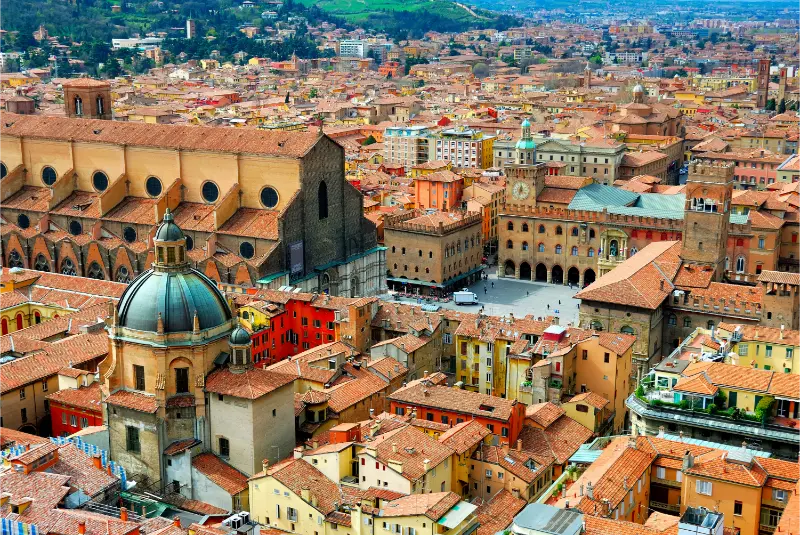
Bologna’s Sanctuary of the Madonna di San Luca is both a major religious site and one of the city’s most rewarding walks. The classic approach follows the long portico from Porta Saragozza and the Arco del Meloncello to Colle della Guardia, turning the journey itself into the main experience rather than simply a transfer to a church on a hill.
At a glance
| Best for | Views, architecture, walking and a half-day outside the dense historic centre |
|---|---|
| Classic route | Porta Saragozza to San Luca under the portico |
| Portico length | About 3.5 km from Porta Saragozza, traditionally counted as 666 arches |
| Allow | 3–4 hours for a relaxed walk, visit and return |
| Useful alternative | Public transport or San Luca Express when walking uphill is not suitable |
Why San Luca is different from an ordinary church visit
The sanctuary sits above Bologna on Colle della Guardia, but what gives the visit its identity is the covered approach. Bologna Welcome describes the portico from Porta Saragozza as roughly 3.5 km long and traditionally made up of 666 arches. The route passes through the elegant Arco del Meloncello before climbing more decisively toward the church. This makes San Luca one of the clearest examples of how Bologna’s porticoes function as urban infrastructure as well as architecture.
Before adding San Luca Bologna to your plans, explore our Bologna Travel Guide for nearby attractions and a realistic sightseeing route.
The walk is not technically difficult, but it is a real uphill outing. The final section has sustained gradients, so comfortable shoes matter more than sightseeing style. Travellers who have already spent a full morning standing in museums often enjoy San Luca more on a separate afternoon, when there is no pressure to hurry back for another timed attraction.
The classic walk from the historic centre
A good starting point is Piazza Maggiore or the western edge of the centre, continuing along Via Saragozza toward Porta Saragozza. The first part is urban and almost level. After the gate, the covered route becomes increasingly distinctive, culminating at the Arco del Meloncello, where the portico crosses the road with a sweeping eighteenth-century curve.
From Meloncello the climb becomes the physical part of the experience. The sequence of arches creates a strong rhythm and provides shade or shelter, but summer heat can still be substantial. Carry water, especially in July and August. In cooler months, the covered structure makes the walk possible even when the weather is changeable, although wet stone can be slippery.
What to see at the sanctuary
The church is associated with the icon of the Madonna di San Luca and remains an active place of worship. Dress and behaviour should reflect that function even if your main interest is architecture or the panorama. The forecourt and terraces give wide views over Bologna and the surrounding hills, and the contrast with the dense medieval centre is one of the main rewards of the climb.
Do not treat the summit as a quick photo stop. Sit for a few minutes, look back over the line of the portico and notice how the city changes scale from above. If a panoramic terrace or special access is available on the day of your visit, check the current conditions locally because opening arrangements can vary.
Alternatives if you do not want to walk uphill
You do not have to complete the full climb on foot. Local buses can reduce the amount of walking, and the tourist San Luca Express is a straightforward option for visitors who want a scenic transfer rather than a workout. Bologna Welcome lists the service among the ways to reach the sanctuary, and seasonal timetables should be checked before departure.
A useful compromise is to travel uphill and walk downhill. Descending still lets you experience the architecture of the portico and the Meloncello section without the same physical effort. Families with small children, travellers with limited time and anyone visiting in strong summer heat may find this balance much more enjoyable.
When to go and how to avoid a rushed visit
Early morning is calm and comfortable in warm weather, while late afternoon often gives softer light over Bologna. Weekends can be busy because the route is popular with residents as well as visitors. If your priority is photography, avoid structuring the outing around a tight lunch reservation in the centre; the walk naturally takes longer than expected because the view changes constantly.
In poor weather the portico provides unusual protection, but thunderstorms and strong wind are still reasons to reconsider a hilltop excursion. The route is urban rather than remote, yet it should be planned as a proper walk rather than as a short extension of Piazza Maggiore.
A practical half-day plan
Start after breakfast in the centre, walk through Via Saragozza and reach Porta Saragozza before the streets become busy. Continue to Meloncello, pause there to appreciate the engineering of the crossing, then climb to the sanctuary. Allow time inside the church and for the viewpoints before choosing whether to return on foot or by transport.
Back in the centre, this outing pairs well with a slower food-focused evening rather than another major museum. The change of pace is useful: Bologna is compact, and alternating dense cultural visits with outdoor walks makes a two- or three-day stay feel much less repetitive.
Common planning mistakes
The most common mistake is underestimating the climb because the route is paved and covered. Another is assuming that every part of the sanctuary complex follows the same opening schedule. Religious services, special events and maintenance can affect access, so check the official tourism or sanctuary information close to your visit.
It is also easy to forget that San Luca is part of a broader UNESCO-porticoes story. If the architecture interests you, combine the outing with central stretches around the Pavaglione, Via Zamboni or Piazza Santo Stefano on another day rather than trying to walk every major portico in one continuous session.
How this fits into a Bologna trip
Use this guide together with our Bologna porticoes UNESCO guide. our two-day Bologna itinerary. our Bologna food guide. Keeping each part of the trip in its own time block makes Bologna much easier to enjoy than trying to turn the historic centre into one long checklist.
Extra planning for walkers
If you are training for the climb or travelling with mixed fitness levels, agree on a turnaround plan before starting. The route has frequent visual landmarks, so splitting the group briefly is easier than forcing everyone to maintain the same pace. In summer, a light snack and refillable water bottle are more useful than carrying heavy sightseeing gear.
Cyclists should remember that the road climb and pedestrian portico are different experiences. The road can be steep and traffic-aware riding is essential; casual visitors should not assume that a city rental bike automatically makes San Luca easier than walking.
Route details worth knowing
The portico changes character as it leaves the flatter city streets. Before Meloncello, the route still feels part of urban Bologna; after the monumental crossing, the repeated arches begin to frame trees, slopes and glimpses back toward the city. That transition is one reason walking at least part of the route is worth the effort even if you eventually use transport.
If you start from Piazza Maggiore, the full outing is longer than the famous 3.5 km portico figure suggests because you still need to reach Porta Saragozza. For planning, think in terms of a half-day rather than a single attraction. This also leaves enough time for bathroom stops, photographs and a drink before or after the climb.
Visitors with knee problems often find the descent more uncomfortable than the ascent. In that case, walking uphill and returning by transport can be better than the more obvious reverse plan. Conversely, travellers who dislike sustained climbing may prefer transport to the top and a controlled walk down, stopping whenever the gradient becomes tiring.
The portico is not a wilderness trail, so you remain close to the city, yet the upper section can feel exposed to heat and changing weather. A hat, water and footwear with decent grip are sensible in summer. In winter, layers matter because the hilltop can feel cooler and windier than the streets around Piazza Maggiore.
Religious festivals and Marian processions can affect both atmosphere and access. These events are part of San Luca’s identity, not an inconvenience to be worked around. If your dates coincide with a major celebration, decide whether you want to experience the devotional side of the sanctuary or prefer a quieter visit on another day.
For photographers, the best images are not necessarily from the summit. Meloncello, the repeating arches and the changing perspective along the climb often produce more distinctive photographs than a wide city panorama. Morning and late-afternoon light also reduces the harsh contrast that can make the covered portico difficult to photograph at midday.
Final practical checks
Before finalising a day around San Luca Bologna guide, recheck the official opening page, any temporary access notices and local transport on the morning of the visit. Bologna changes less dramatically than a seasonal resort, but exhibitions, religious services, road works and public events can still alter the most efficient route.
Keep at least one unbooked hour in the day. The historic centre rewards spontaneous detours under a portico, into a food shop or through a quiet piazza, and an itinerary with no margin usually makes a compact city feel more stressful rather than more complete.
If you are travelling in a group, agree which parts are essential before leaving the hotel. Bologna is easy to split for an hour because central landmarks are close together, so one person can visit a specialist collection while another chooses a café or market without losing the rest of the day.
Last updated: October 17, 2026
Leave a Reply