
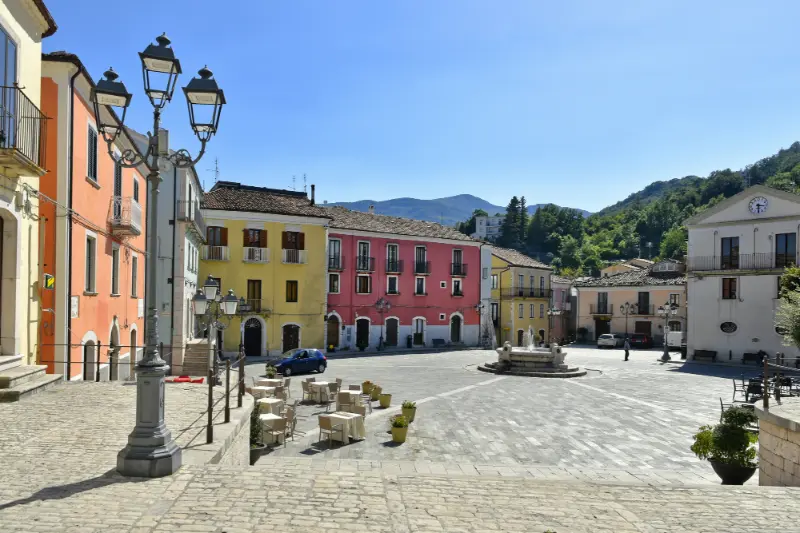
Sepino's Roman town is one of the most useful archaeological visits for understanding how an ancient settlement worked. At Altilia-Saepinum, streets, gates and public buildings can be read together rather than as a series of unrelated ruins. Give the site a focused morning, then decide whether to visit the modern village of Sepino for lunch and a street walk.
Access requires particular attention during the current works. The park's 2026 notices describe temporary free admission, the closure of the Porta Tammaro entrance and an alternative approach from Porta Terravecchia. Follow the latest instructions for your date instead of relying on an old gate pin. This Sepino and Saepinum guide explains those arrangements, a practical way to explore the town and the distinction between Altilia, modern Sepino and the earlier upland site of Terravecchia.
Our Molise travel guide places Sepino and Saepinum in the context of the wider region, including travel times and alternative bases.
Three places that are easy to confuse
Altilia is the locality containing the Roman town of Saepinum, on the lower ground. Modern Sepino is a separate village. Terravecchia refers to an earlier fortified upland settlement, while Porta Terravecchia is also the name of a gate at the Roman town. These names are related historically, but they do not describe a single entrance or an interchangeable sightseeing route.
For a first visit, make Altilia-Saepinum your main destination. Save the park's current arrival information and address, then add modern Sepino only if you have time and suitable transport. The earlier upland settlement is a separate outdoor outing and should use its own route and condition checks.

This distinction is particularly important when reserving a guide. Ask where the tour meets and which site it covers. A visit to the Roman streets does not automatically include a climb to the earlier settlement or a walk through the modern village. Clear names and meeting points prevent a short archaeological morning from becoming a confusing drive between places you did not intend to visit.
Current entry arrangements during the works
The park announced free admission from March 1, 2026 as a temporary measure while some areas are closed for accessibility works. Its May notice directs visitors away from the Porta Tammaro entrance to the parking and information point at Porta Terravecchia. A later notice describes a route outside the walls leading toward Porta Bojano, where visitors enter the Roman town.
These are arrangements associated with ongoing work, so check the latest park notice shortly before travel. Free admission does not mean every area is available or that a guided service is included. Ask the information point which parts can be visited that day and obtain whatever entry document the current system requires.
The park lists its address as Contrada Altilia 1, SP82, and telephone +39 0874 790207. Use those details to clarify the approach if navigation and local signs appear inconsistent. Follow the signed visitor route and site staff's instructions; an older guide's suggestion to enter through a different gate does not override an active restriction.
Begin with the town plan, not individual photo stops
Before walking far, look at the overall plan and identify the main streets and central public area. Understanding that structure makes low walls and fragments easier to interpret. You do not need to locate every room before you begin, but knowing where the principal street leads gives the visit a useful direction.
As you move, compare the streets with the buildings beside them. Ask where a person would have entered, where people gathered and how an ordinary journey through town might have worked. Those questions make the site approachable even without detailed architectural knowledge. A family can use them to turn the visit into a short exploration rather than a lecture about dates.
The setting includes later rural use around the ancient remains. Notice that relationship from permitted areas, without treating houses, gardens or working land as part of unrestricted public access. Saepinum's appeal includes the survival of an ancient town within a living landscape, but the site's visitor rules still define where you may walk.
The streets, forum and basilica
The main street axes help organize the Roman layout, with the forum and basilica providing a public focus. Start by seeing their relationship rather than trying to identify isolated fragments in the wrong order. The basilica's role was civic and commercial; the word does not mean it began as the type of church travelers may know from later Italian towns.
Where the present route allows, stand back and look at the space as a whole. Columns or surviving bases become easier to understand when you consider the outline of the building and its position beside the public square. A guide can explain what is known from excavation and what is reconstructed through interpretation.
Do not climb on masonry or step across barriers to obtain a clearer view. Small archaeological features can be damaged by ordinary foot traffic, and a temporary route may avoid an area for reasons not obvious from outside. The permitted viewpoints are enough for a meaningful visit when you take time to understand the plan and use the site's interpretation.
Gates, walls and the theater
The gates and walls give a scale to the town that you cannot get from the central buildings alone. The current external visitor route is also an opportunity to look at the defended outline before entering the street system. Ask which stretches are available rather than expecting to complete an unrestricted circuit around the entire perimeter.
The theater adds another kind of public space. Compare its shape and arrangement with the civic center, then consider why the town needed different places for gathering. The site is more rewarding when those areas are connected through their functions, rather than treated as four attractive ruins to photograph separately.
Choose one or two details to examine closely, such as a doorway, a carved element or the surviving relationship between a street and a building entrance. You do not have to understand every fragment to enjoy the visit. If a feature is inaccessible during works, ask whether the park's digital material explains it, and keep the physical route to the spaces currently open.
Museum areas and guided explanations
The park includes a Museum of the City and Territory, but ongoing works can affect the availability of particular spaces. Ask about current museum access when checking the entrance. A general site opening does not establish that every gallery or building inside is operating normally.
A guide is particularly worthwhile if you want to understand the town's development and the use of its buildings. Confirm the language, duration, meeting point and fee before reserving. The current temporary free-admission arrangement concerns the park's entry; a professional guided explanation may still have a separate charge.
If you prefer an independent visit, use the map, panels and official digital material to select a route. Allow pauses for reading rather than walking rapidly from gate to theater and back. A few well-understood areas produce a stronger visit than a large number of features seen without context, especially when the layout is unfamiliar.
How long to allow and a comfortable route
Allow roughly two to three hours as a planning estimate for an interested first visit, including orientation and the main open areas. A guided visit may use a different duration, and substantial archaeology enthusiasts can spend longer. Do not schedule lunch so tightly that a temporary detour forces you to leave halfway through the route.
Begin at the currently indicated information point, follow the permitted approach and use the main street to orient yourself. Put the central public buildings and theater into the order suggested by the available route. Keep the return clear, including any extra walk outside the walls needed to reach your parked car.
With younger children, shorten the visit to a few areas and bring a snack for an appropriate break afterward. Ask them to find evidence of entrances, movement or public gathering rather than expecting them to absorb a full historical chronology. In summer, an early start and a limited route can be more enjoyable than an extended midday circuit.
Visiting the modern village of Sepino
Modern Sepino makes a useful second stop when you want lunch and a different kind of town walk. Check the actual transfer from Altilia, and park where local signs permit rather than following navigation into the tightest streets. The village is an addition to the archaeological visit, not the same place seen from another gate.
Choose a short route through its public streets and investigate a church interior only when access is available. After several hours among ruins, a meal and a relaxed village loop may be enough. There is no need to add the earlier upland settlement just because its name appears in the history of Saepinum.
For lunch, confirm the kitchen's hours and reserve when your day depends on a particular restaurant. A smaller village can have fewer options during quieter periods or on a venue's rest day. Carry a simple backup snack and water, but choose a proper meal if you want to give the afternoon a slower pace.
Getting here and choosing an overnight base
Campobasso is a practical base for a dedicated Sepino day, with the return allowing you to sleep in the same accommodation. A local rural stay can also work when countryside and village time are priorities. Ask about meals, parking and the actual access road before choosing a property simply because it is listed under Sepino.
Public transport requires checking the final connection to Altilia and its current visitor entrance. A service to the modern village is not automatically a service to the park. Confirm both the outward and return, including the walk remaining from the stop. If they do not fit a meaningful visit, arrange a transfer or an organized excursion whose itinerary is clear.
Drivers should follow the park's current arrival instructions, particularly during works. Save the contact number and avoid leaving visible luggage in the car while sightseeing. If this is a stop between hotels, ask whether one property can store your bags or schedule the visit before checking out. Archaeology is easier to enjoy when the practical arrival details are settled.
Surfaces, weather and a sensible budget
Ancient paving, grass and changes of level need footwear with grip. Request the actual available route if you use a wheelchair or stroller; future accessibility improvements do not establish today's surface conditions. The works may change the approach, so a description of a previous visitor's route is only background information.
Spring and fall suit a longer outdoor visit when the weather allows. In summer, carry water and sun protection and avoid expecting shade at every stop. Winter calls for current opening confirmation and a shorter route if conditions are poor. Rain can change the feel of both grass and paving, even when the park remains open.
Budget for transport, lunch and any reserved guide, then check the entry arrangements in force on your date. The temporary 2026 concession should be described as temporary, not as a promise of permanent free access. With a clear arrival, a town plan and time to read the remains, Sepino provides a substantial archaeological day without requiring a complicated regional circuit.
Plan at a glance
| Stop or choice | Why choose it | Before you go |
|---|---|---|
| Altilia-Saepinum | Roman town on lower ground | Main first-visit destination |
| Current works | Temporary route and availability changes | Read the park’s latest notices |
| Modern Sepino | Village and lunch stop | Separate transfer from Altilia |
| Upland Terravecchia | Earlier fortified settlement | Separate outdoor route, not the Roman gate |
Location map
Use this map for orientation in the region and its visiting areas. Check actual road connections, site entrances and official trail information before planning a journey or walk.
Open the location in Google Maps
Frequently asked questions
Is admission permanently free?
No. The park announced temporary free entry from March 2026 during accessibility works. Check the arrangement in force on your travel date.
Which entrance should I use?
The 2026 notices describe an approach from Porta Terravecchia during Porta Tammaro works. Follow the park’s latest instructions and local signs.
Is Porta Terravecchia the upland settlement?
No. A gate at the Roman town shares the name. The earlier upland settlement is a different destination.
Where to stay
More Molise ideas
- Molise Travel Guide: Towns, Archaeology, Coast and a Practical First Trip
- Seven Days in Molise: A Practical Road Trip from Ancient Towns to the Coast
- Campobasso Travel Guide: Castle Hill, Samnite Museum and the Misteri
- Pietrabbondante Guide: Samnite Sanctuary, Theater and How to Visit
Visitor information
- Park website and current visitor information
- Temporary free admission from March 2026
- Porta Tammaro closure and alternative approach
- Current route outside the walls
- Ministry site history and Terravecchia distinction
Last updated: October 17, 2026