
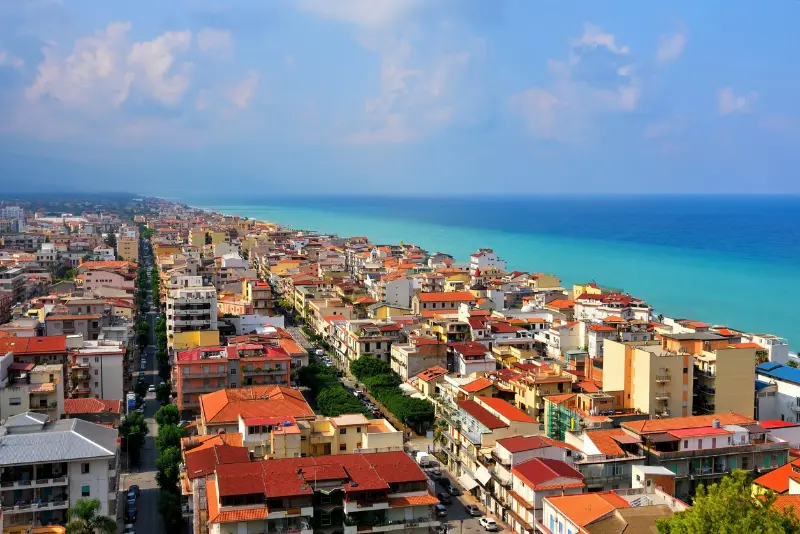
Siniscola is where the Baronie compress mountains and sea into one territory. Monte Albo rises behind the town, while La Caletta, Santa Lucia and Capo Comino open onto long beaches, dunes and fishing traditions along the east coast.
Italia.it highlights Siniscola’s position between Monte Albo and the sea, with archaeological remains in the surrounding countryside and easy access to La Caletta. Capo Comino adds high white dunes, junipers, an old lighthouse and clear shallow water. This guide focuses on what gives the destination its identity, how long it deserves and how to fit it into a realistic Sardinia route.
Extend a visit to Siniscola and Capo Comino with the suggestions in our Sardinia travel guide, which covers regional transport and where to base yourself.
Quick planning summary
| Best for | beaches, dunes, fishing-village atmosphere, mountain scenery and travellers who want both sea and Baronie culture |
|---|---|
| Time needed | Two or three nights let you combine Siniscola, La Caletta, Santa Lucia and Capo Comino without turning the coast into a driving checklist. |
| Car | Recommended because the territory stretches from Monte Albo to several coastal settlements and beaches. |
| Main planning rule | Use Siniscola as a regional territory rather than choosing only Capo Comino. Give one day to coast, one to village/mountain or archaeology and leave enough time for Santa Lucia’s slower fishing-village atmosphere. |
What makes this place feel different
The defining image is contrast: pale dunes and blue water in front, the long limestone mass of Monte Albo behind. Few east-coast bases make the sea-and-mountain relationship so obvious.
Santa Lucia provides another contrast. It remains visually and culturally connected to fishing, giving the coast a lived-in feeling that large resort developments often lack.
Is it worth adding to your Sardinia trip?
Yes, especially for beaches, dunes, fishing-village atmosphere, mountain scenery and travellers who want both sea and Baronie culture. Use Siniscola as a regional territory rather than choosing only Capo Comino. Give one day to coast, one to village/mountain or archaeology and leave enough time for Santa Lucia’s slower fishing-village atmosphere.
The key is geographic fit. Sardinia is large enough that a beautiful destination can still be the wrong choice if it forces hours of repeated driving. Add this place when it strengthens the regional story of the trip.

What to see and experience
Siniscola town
The inland centre offers churches, everyday services and a base for understanding the Baronie beyond the seafront.
Give this stop enough time to feel distinct from the next one. Check current access, parking, opening hours, protected-area rules or weather-sensitive conditions close to travel.
La Caletta
A marina and sandy beach provide practical sea access and boat-oriented services.
Give this stop enough time to feel distinct from the next one. Check current access, parking, opening hours, protected-area rules or weather-sensitive conditions close to travel.
Santa Lucia
A former fishing village with pine-backed coast and a slower atmosphere than larger resorts.
Give this stop enough time to feel distinct from the next one. Check current access, parking, opening hours, protected-area rules or weather-sensitive conditions close to travel.
Capo Comino
Wide white sand, high dunes, junipers and shallow water make this one of the area’s defining beaches.
Give this stop enough time to feel distinct from the next one. Check current access, parking, opening hours, protected-area rules or weather-sensitive conditions close to travel.
Old lighthouse and Isola Rossa
The coastal landmark and offshore red-porphyry islet add visual interest at Capo Comino.
Give this stop enough time to feel distinct from the next one. Check current access, parking, opening hours, protected-area rules or weather-sensitive conditions close to travel.
Monte Albo
The limestone mountain massif behind Siniscola offers a completely different outdoor environment and hiking possibilities.
Give this stop enough time to feel distinct from the next one. Check current access, parking, opening hours, protected-area rules or weather-sensitive conditions close to travel.
Prehistoric heritage
Nuraghi, giants’ tombs, caves and ancient settlement traces show long human occupation of the territory.
Give this stop enough time to feel distinct from the next one. Check current access, parking, opening hours, protected-area rules or weather-sensitive conditions close to travel.
Pompìa
The distinctive local citrus fruit is linked with Siniscola food traditions and gives the area a rare culinary specialty.
Give this stop enough time to feel distinct from the next one. Check current access, parking, opening hours, protected-area rules or weather-sensitive conditions close to travel.
How to plan the visit without rushing
Use the first half of the day for the experience that would make the visit worthwhile on its own. Then let lunch create a real pause before one lighter afternoon stop. Sardinia rewards depth more than a list of completed names.
In summer, archaeological sites, exposed viewpoints and village climbs are better earlier or later. Midday is more comfortable for lunch, water activities, museums or shaded streets.
If the destination depends on wind or sea conditions, keep one nearby land-based alternative. The backup should stay in the same region so it does not create a new long transfer.
Getting there and getting around
Drive between town and coastal settlements. Distances are short enough to stay in one base, so avoid changing accommodation simply to move from La Caletta to Capo Comino.
Driving and parking
Map distance is not enough. Coastal bends, mountain gradients, narrow village approaches and parking searches all add time. Avoid placing a timed booking immediately after the longest drive of the day.
When to stop moving
Once you have reached the main village, beach or harbour cluster, park and experience it on foot whenever possible. Repeated short drives often consume more holiday time than one slightly longer walk.
Where to stay around Siniscola & Capo Comino
La Caletta for marina services and evening convenience; Santa Lucia for quiet atmosphere; Siniscola for local life and easier inland access.
Before booking, check parking, stairs, evening restaurants, the final access road and the first activity planned for the following morning. A strategically placed room can improve every day of the stay.
A realistic itinerary
Morning / Day 1
Use the first morning for Capo Comino before peak heat and parking pressure.
Midday / Day 2
Move to Santa Lucia for lunch or a slower afternoon walk.
Afternoon / Day 3
Use the second day for Siniscola, archaeology or Monte Albo according to weather and fitness.
Evening / Extra time
Keep La Caletta as an easy evening or boat-service base rather than another full driving destination.
Food and local character
Try sa suppa Siniscolesa and sweets made with pompìa in addition to seafood and broader Sardinian dishes.
Regional food is one of the simplest ways to make each base feel different. Keep at least one meal slow enough to understand local products rather than eating only where parking happens to be easiest.
Best time to visit
April to June
Spring and early summer are excellent for road trips, archaeology and walking. Temperatures are easier and landscapes often remain greener than in peak summer.
July and August
Peak summer delivers the strongest beach and excursion schedule but also the highest parking pressure, heat and accommodation demand. Early starts become part of the itinerary.
September and October
Early autumn is outstanding for combining sea, inland culture and food. The weather is usually easier for village and archaeological days.
Winter
Cities, villages and heritage sites can be rewarding with few visitors, while seasonal coastal services and mountain conditions require more checking.
Costs, reservations and what deserves your budget
Spend on the defining experience: a guided archaeological site, boat day, well-located accommodation or safe mountain activity. Save by reducing hotel changes and unnecessary rental-car days.
Anything with regulated access, limited parking, guided entry or small-boat capacity should be checked early for peak season. Ordinary town walking and flexible meals are better left open.
Families and accessibility
Capo Comino’s shallow water and La Caletta services can be family-friendly, while dunes and mountain trails need more supervision.
Serviced beaches are easier than dunes and mountain terrain; check exact parking and boardwalk conditions.
With children or mobility needs, fewer bases and exact last-mile research usually improve the trip more than squeezing in another destination.
Common mistakes to avoid
- Seeing only Capo Comino.
- Skipping Santa Lucia.
- Trying a serious Monte Albo hike after a full beach day.
- Ignoring local food traditions.
- Moving hotels between nearby coastal hamlets.
What I would do with an extra half-day
I would stay at least two nights because this is one of those regions where a coast-only plan leaves half the story untouched. A mountain or archaeological half-day makes the next beach feel more distinctive rather than repetitive.
Capo Comino is best treated gently. Dune vegetation is fragile, and the beauty depends on the landscape remaining intact. Use established access, carry out what you bring in and avoid turning the dune system into a shortcut.
Santa Lucia is ideal for the slower meal or evening of the stay. Fishing-village identity and pine-backed coast provide the kind of atmosphere that disappears if every hour is spent driving to another named beach.
How to fit this into a wider Sardinia route
For seven days, two bases are usually enough. Ten days can support two or three. Add this destination when it creates a logical progression instead of another out-and-back drive.
On transfer days, use one substantial stop only. Reach the next hotel before dinner whenever possible so the evening remains part of the holiday rather than another travel task.
What to protect if the schedule slips
Keep the experience unique to this destination. Remove the optional second beach, additional village or extra viewpoint first. If necessary, move the key attraction to the next morning instead of rushing it.
What to verify shortly before travel
Recheck opening hours, parking systems, beach access, guided-tour arrangements, wildfire restrictions, ferry or boat schedules and wind forecasts. Save the essential confirmation offline.
Why slower usually feels more beautiful
The most memorable part of a Sardinia day is often unplanned: softer evening light, an unexpectedly good local meal, a quiet church, wildlife at a lagoon or a beach that becomes calmer after the crowd leaves.
Leaving room for those moments is not inefficient. It is the difference between seeing a destination and experiencing it.
How I would combine it with nearby places
The best combination is the one that keeps the route moving in one direction. Pair this destination with the nearest regional cluster already on the itinerary rather than using it as an out-and-back excursion from a distant base.
That usually means one meaningful neighbouring stop, not three. A coherent day with one main destination, lunch and one complementary place will feel fuller than a longer checklist connected by repeated parking and driving.
What I would leave unplanned
I would leave at least one late-afternoon block open. Wind can change a beach, heat can slow an archaeological visit and a local meal can run longer than expected. The open block lets the day adapt without turning every delay into a problem.
Use that time for the place that is working best on the day: a second swim, a village walk, a viewpoint, a museum or simply an earlier dinner. Flexibility is especially valuable in Sardinia because weather and light can change the character of a destination quickly.
A final accommodation check
Before confirming the hotel, map the exact first activity of the following morning. If reaching it requires another long drive, difficult parking or an early ferry, a slightly different base may improve the whole stay more than a better room or sea view.
Also check dinner logistics. A remote property is wonderful when you want silence and are happy to eat there; it becomes inconvenient when every evening requires driving twenty minutes on dark rural roads.
Related Sardinia guides
Posada — useful for extending the route with content already public by this article’s publication date.
Orosei — useful for extending the route with content already public by this article’s publication date.
Gulf of Orosei — useful for extending the route with content already public by this article’s publication date.
Official information to verify before travel
Access, transport and seasonal rules can change. Check the official or primary information source close to your travel date.
Last updated: October 17, 2026
Leave a Reply