
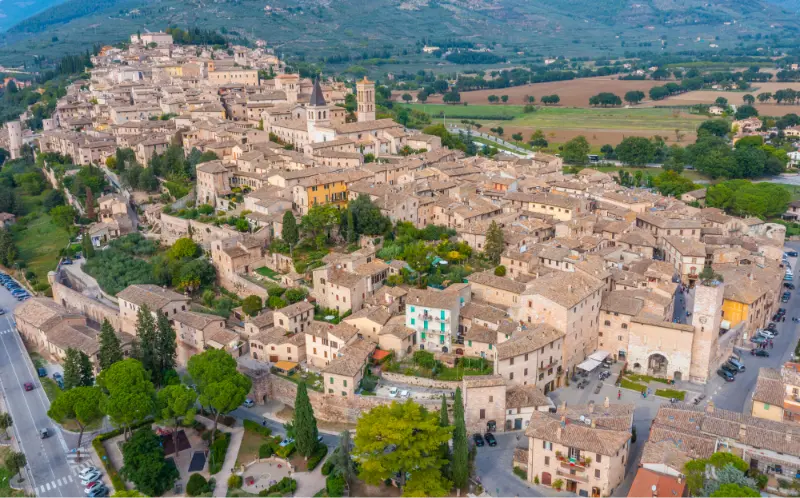
Spello is often described as a “flower village”, but that label undersells it. The compact hill town preserves Roman gates and walls, a major Pinturicchio fresco cycle, an important Roman villa with almost 500 square metres uncovered and a sequence of stone lanes that opens repeatedly toward the Umbrian Valley. Flowers enrich the setting; they are not the whole reason to come.
A first visit needs four to six hours. That is long enough to walk from Porta Consolare through the historic centre, see the Baglioni Chapel, continue to the upper viewpoints and add the Villa of Mosaics without reducing the town to a 45-minute photo stop.
| Best for | Roman heritage, Renaissance art, flowers, photography and slow village walking |
|---|---|
| Allow | 4–6 hours; one night for a quieter experience |
| Major paid site | Villa of Mosaics |
| Walking challenge | Steady uphill streets and stone surfaces |
| Easy pairing | Assisi, but only if you give each place real time |
Enter through Porta Consolare
Porta Consolare is the most satisfying place to begin because it immediately establishes Spello’s Roman layer. From here the town rises gradually through narrow streets toward its medieval and Renaissance core. Starting lower down also gives your visit a clear direction instead of random loops.
If you have parked outside the walls, confirm which gate is closest. Spello is small enough to cross on foot but steep enough that unnecessary backtracking becomes tiring in summer.
Santa Maria Maggiore and the Baglioni Chapel
The Baglioni Chapel inside Santa Maria Maggiore is one of the main reasons art lovers should take Spello seriously. Pinturicchio decorated the chapel around 1500–1501 with richly coloured scenes, and the experience is more intimate than seeing a single panel in a large national museum.
Check current access and any ticket arrangement before travel because church use and conservation requirements can affect visiting. Dress and behave for an active religious building rather than a purely secular gallery.

Roman Spello beyond the famous gate
Spello’s Roman heritage includes walls, Porta Venere, the Towers of Propertius and archaeological remains beyond the centre. The regional tourism route emphasises that the town’s later walls incorporated sections of the Roman circuit, so ancient and medieval fabric are intertwined.
Do not try to photograph every fragment. A better plan is Porta Consolare on arrival, Porta Venere later, then the Villa of Mosaics as the interpretive anchor for Roman domestic life.
Villa of Mosaics: why it is worth leaving the lanes
The Villa of Mosaics was discovered in 2005 during construction works and has revealed around twenty rooms, ten with polychrome mosaic floors. Official regional tourism describes nearly 500 square metres of excavated area, making this far more than a minor local display.
Multimedia interpretation helps visitors understand rooms whose walls no longer survive. The villa sits just outside the historic walls, so schedule it deliberately rather than hoping to “pass by” on the main medieval walk.
Flowers and the Infiorata: visit beyond the cliché
Spello’s decorated balconies are beautiful, but the town’s flower culture reaches a peak during the Infiorata associated with Corpus Christi, when elaborate floral carpets transform streets. If you travel specifically for the event, expect crowds, access changes and a very different experience from an ordinary weekday.
Outside festival time, look for lived-in details rather than expecting every lane to be in permanent competition condition. Seasonal weather affects displays, and respecting private doorways matters more than recreating social-media photos.
Upper-town viewpoints and the right pace
Continue uphill beyond Piazza della Repubblica toward the higher lanes and viewpoints. The reward is not one official “best panorama” but repeated views across olive-covered slopes and the Umbrian Valley. These sections also become quieter than the lower tourist spine.
Build short stops into the climb. Spello’s appeal is exactly the small-scale transition between stone, flowers, churches and landscape; rushing to the top removes that rhythm.
Spello versus Assisi: how to combine them
The two towns are close and linked by rail, but they serve different experiences. Assisi is larger, more monumental and shaped by pilgrimage; Spello is smaller, more intimate and especially strong for Roman remains, Renaissance painting and slow street exploration.
If you have a full day and move efficiently, combining them is possible. If you care about art or photography, give Spello at least half a day and avoid treating it as an hour-long detour after Assisi.
How to plan the visit without overloading the day
Start low at Porta Consolare, climb through the central churches and Roman gates, take a lunch break, then visit the Villa of Mosaics as you descend or return toward parking. This keeps the steepest walking before the day’s final museum stop.
If the Villa of Mosaics is closed on your chosen day—some tourism products note Tuesday closure—replace it with a longer upper-town walk rather than rearranging the entire trip at the last minute. Always verify current hours directly.
Common mistakes to avoid
- Calling Spello only a flower village and skipping its Roman heritage.
- Trying to combine Spello and Assisi in a rushed morning.
- Driving into narrow central streets instead of using edge parking.
- Assuming every church art site follows museum-style hours.
- Visiting the Villa of Mosaics only if you “happen to pass it”.
When to go
Spring is excellent for flowers, green landscapes and comfortable walking. The Infiorata period is extraordinary but far busier. Autumn brings softer light, food culture and fewer floral displays but a calmer town.
Summer can be hot on the exposed climbs, so visit early or late. Winter is quiet and atmospheric, but verify reduced attraction hours.
Getting there and moving around
Spello has a railway station below the historic centre, making it practical without a car. The final approach to the old town still involves walking uphill.
Drivers should use signed parking outside the narrow core. Once parked, the town is best explored entirely on foot.
Tours and bookable experiences
A guided Spello visit is most useful when it combines Roman remains with the Baglioni Chapel and explains how the ancient and medieval street plans overlap. If booking from Assisi, check how much actual time is spent in Spello rather than in transfers.
Where to stay
One night in Spello is ideal for travellers who value quiet streets and photography. The village changes noticeably after day visitors leave, especially outside festival periods.
If you are using public transport for a wider trip, Assisi or Perugia can provide more connections; stay in Spello because you want the village atmosphere, not because it is the most connected base.
Official sources and last checks
Opening hours, ticket prices, transport services and temporary access rules can change. Check the official source shortly before travel.
A better way to prioritise your time
The most useful way to plan Spello Travel Guide is to rank experiences by how difficult they are to replace. A timed museum, a sacred-site schedule or a transport-dependent viewpoint should come before a generic coffee stop or shopping street. Build the day around the least flexible element, then keep nearby streets and viewpoints as movable pieces. This approach is especially important in Umbrian hill towns, where a short distance on a map can involve a climb, a bus connection or a parking transition.
If the day starts running late, remove the least distinctive stop rather than cutting every visit in half. Travellers often remember one properly understood church, museum or archaeological site more clearly than four monuments seen at speed. Keep at least thirty minutes of unassigned time for views, photographs, an unexpected open doorway or simply sitting in a square; that margin is part of good trip design, not wasted time.
Accessibility and comfort notes
Historic Umbria rewards walking but is not uniformly easy. Cobblestones, steep gradients, old staircases and limited vehicle access can matter more than total distance. Travellers with reduced mobility should check the exact entrance route to museums and churches rather than relying only on a general accessibility label. Mechanical lifts, escalators, taxis and lower-city parking can remove some climbs, but the final approach may still include uneven paving.
In warm weather, carry water and shift exposed climbs away from the hottest part of the day. In rain, stone paving can become slippery. Comfortable shoes with grip are more useful than formal footwear even in elegant historic centres, and a light layer is useful inside churches and climate-controlled museums.
How to improve a short visit
If you have less time than the full itinerary assumes, protect one experience that is unique to this destination and one flexible walk that helps you understand the setting. Drop secondary indoor stops before cutting the main sight to a rushed glance. This is especially useful in Umbria, where atmosphere, elevation and views are part of the visit and cannot be appreciated from a checklist.
Check the final admission time, not only the closing time, and allow a buffer for parking or public transport. A fifteen-minute delay in a hill town can easily become thirty once you add walking from the car park, finding an entrance and dealing with stairs. Planning that margin makes the day feel slower even when you see the same number of places.
Final planning advice
Spello is worth more time than its size suggests because three different stories—Roman town, Renaissance art and lived hill village—fit inside one walkable place.
Give it half a day at minimum. The visit becomes memorable when you stop treating flowers as the attraction and start using them as the visual thread connecting much deeper history.
Leave a Reply