
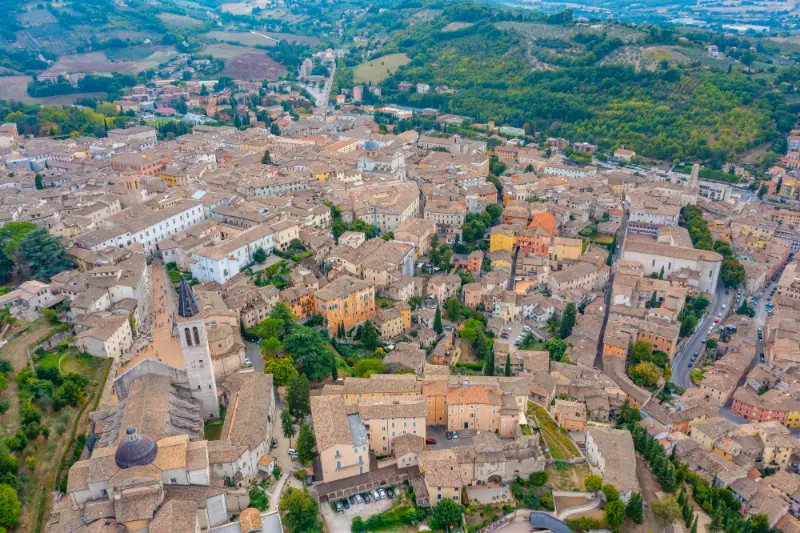
Spoleto is one of Umbria’s strongest art cities because it combines a real urban centre with Roman archaeology, a great cathedral square, a fortress and a dramatic mountain-edge landscape. It is large enough to justify a full day and varied enough that the visit never needs to become a sequence of similar churches.
The city is vertical, but escalators and mechanical connections help visitors move between parking areas, the historic centre and the Rocca. Understanding those access systems before arrival is the difference between a smooth day and an unnecessary climb carrying luggage.
Spoleto fills an important gap between the existing Assisi, Marmore Falls and Terni guides. It is also one of the best places to base yourself for a few days in the central-southern Valle Umbra.
Quick planning summary
| Ideal time | 1 full day; 2 nights for museums and nearby Valnerina |
|---|---|
| Best for | Duomo, Rocca, Roman remains, art, views and festivals |
| Car | Not needed in the centre; useful for wider Valnerina |
| Main challenge | Vertical city and parking strategy |
| Best approach | Use the mechanical access system and walk downhill through the centre |
Piazza del Duomo: give the square time before going inside
The descent into Piazza del Duomo is one of Spoleto’s great urban moments. The cathedral façade, bell tower and enclosed geometry of the square make the approach as important as the interior. Do not arrive, enter and leave without first seeing how the buildings frame the space.
Inside, the cathedral preserves major artistic layers, including frescoes by Filippo Lippi in the apse. Check service times and access before assuming every section is open continuously.
Rocca Albornoziana: the city’s strategic viewpoint
The Rocca dominates the hill above Spoleto and explains why the city’s position mattered militarily and politically. Today the fortress and its museum context are the natural upper anchor of the visit, with wide views over the city and valley.
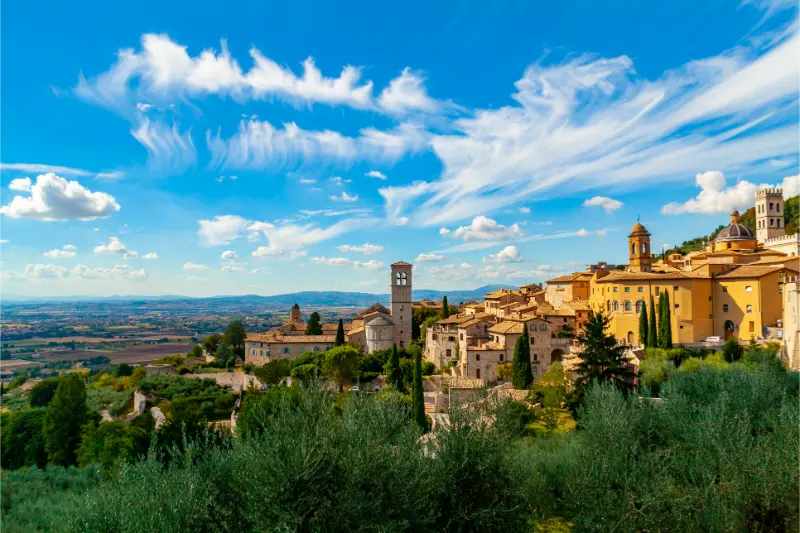
Reach the upper zone using the mechanical system when practical. Saving your legs for the fortress, bridge landscape and historic streets is smarter than proving you can climb every road from the station.
Ponte delle Torri and the mountain-edge landscape
The Ponte delle Torri is the structure that gives Spoleto its dramatic relationship with the ravine and Monteluco side. Access conditions have changed in different periods because of safety and restoration, so check the current status rather than assuming an old route description is valid.
Even when full crossing access is restricted, viewpoints around the Rocca and bridge remain central to understanding the city’s landscape. Treat the bridge as part of a walking environment, not only a single photo.
Roman theatre and Casa Romana
Spoleto’s Roman layer keeps the city from being read only as medieval. The Roman theatre area and Casa Romana show urban life from a much earlier period and provide useful contrast with the fortress and cathedral.
Choose one or both according to opening hours and your interest. On a one-day visit, it is better to see one Roman site properly than to rush through every ticketed interior.
Palazzo Collicola: contemporary art in a historic city
Palazzo Collicola adds a modern and contemporary layer that many visitors do not expect. This is especially valuable if you have already spent several days on medieval and Renaissance art elsewhere in Umbria.
The museum is a good midday or bad-weather choice. Its presence also makes Spoleto a better two-night base for art lovers than small villages where most interiors close early.
A realistic walking route through Spoleto
Start high using the escalator/mechanical access system, visit the Rocca and bridge viewpoints, then work downhill toward the Duomo. Continue through the central streets to your chosen Roman or art museum, ending near the lower access route rather than climbing back to the top unnecessarily.
This top-down structure uses the city’s vertical geography in your favour. If arriving by train, confirm the bus or pedestrian connection to the mechanical system rather than walking uphill with luggage.
Festival periods: when Spoleto changes character
The Festival dei Due Mondi and other cultural events can transform the city with performances, temporary venues and higher accommodation demand. For culture-focused travellers, this can be a highlight; for travellers seeking empty streets, it can feel like a different destination.
If your dates overlap a major festival, book rooms and restaurants early and check whether normal museum access or traffic patterns are affected.
Spoleto as a base for southern and central Umbria
Spoleto is well placed for the Valle Umbra and for moving toward the Valnerina, Marmore Falls and smaller villages. It also gives you restaurants and evening life that rural bases cannot always provide.
Use it when your itinerary includes at least two nearby days. If you plan only Assisi and Perugia, a more northern base reduces backtracking.
How to decide whether Spoleto belongs in your itinerary
Prioritise Spoleto if you want one Umbrian city that combines major art, Roman history, fortress architecture and landscape in a single day.
On a very short three-day first trip, Perugia, Assisi and Orvieto may come first. From five days onward, Spoleto becomes one of the strongest additions.
It is particularly valuable for travellers heading south toward Marmore Falls or Valnerina because it converts a long transfer into a worthwhile base.
A better daily rhythm
Start high, work downhill and schedule one indoor museum around the hottest or wettest part of the day.
Leave the evening flexible for Piazza del Duomo or dinner. The city is large enough that a slow final walk is more rewarding than adding a last-minute distant sight.
Final practical checklist before you go
Before leaving for Spoleto, recheck the exact opening hours or transport times that affect your day, save any timed tickets offline and note the address of the entrance you actually need. In Italy, the headline destination name and the practical access point are not always the same place, so a two-minute check before departure can prevent a long detour.
Carry water, comfortable shoes and a small weather layer even on a simple city day. If the itinerary includes archaeological ground, gardens, hills or old paving, footwear matters more than it does on a museum-only day. Keep one part of the schedule flexible so a delayed train, ferry, lunch or sudden change of weather does not force you to abandon the most important experience.
Finally, save the return connection before you start sightseeing. That is particularly useful on Sundays, public holidays and shoulder-season dates, when the last practical train, bus or boat may be earlier than expected. A good itinerary should finish with margin rather than with a sprint to the platform or pier.
How long to spend in Spoleto
One full day is the right first visit. Two nights are ideal if you want museums without rushing or a day trip toward Valnerina or Marmore Falls.
A half-day works only for the Duomo, Rocca/bridge viewpoint and a central walk. It is too short for the city’s Roman and modern-art layers.
Getting to and around Spoleto
Spoleto is served by regional and intercity rail connections, and the station sits below the historic centre. Local buses or taxis can save a substantial climb.
Drivers should use signed parking and the mechanical access system rather than attempting to enter restricted historic streets.
For Valnerina day trips a car becomes more useful, but you do not need to keep it moving inside Spoleto itself.
Where to stay in Spoleto
Stay in or near the historic centre for atmosphere and easy evening walking, provided you understand parking and luggage access.
Stay lower or near easier road access if the trip includes frequent driving. The best hotel is not necessarily the highest one in the old town.
Food and local flavours
Spoleto sits close to strong truffle, cured-meat and mountain-food traditions. Look for strangozzi, seasonal truffle sauces, legumes and local meats rather than limiting the meal to generic “Tuscan-style” menus.
Protect one proper lunch or dinner. The city has enough cultural content that eating only on the run makes the day unnecessarily exhausting.
Best time to visit
Spring
Spring is excellent for walking and the green Umbrian valley, with comfortable temperatures for the Rocca and bridge area.
Summer
Summer can be culturally exciting during festival periods but hot and busy. Book early and use the mechanical access routes.
Autumn
Autumn offers comfortable walking, truffle-season food and softer crowds, making it one of the best times for a city-plus-countryside stay.
Winter
Winter is quiet and atmospheric, but museum schedules and bridge access conditions should be checked carefully.
Families, accessibility and pace
Families benefit from the fortress, bridge landscape and mechanical lifts because the city offers more than church interiors. Keep one museum optional rather than compulsory.
For limited mobility, the vertical topography requires planning. Mechanical routes help significantly, but individual monuments may still involve stairs and uneven paving.
Budget and booking strategy
Spoleto can be visited largely on foot with selective museum tickets. The main avoidable costs come from poor parking choices or taxis used because the route was not planned.
During major festivals, accommodation prices can rise sharply. If you are not attending performances, compare nearby dates before paying the event premium.
Common mistakes to avoid
- Walking uphill from the station with luggage without checking local transport.
- Treating the Duomo as the only reason to visit.
- Assuming Ponte delle Torri access is unchanged from older guides.
- Adding too many Roman and art museums to one day.
- Driving into the old centre without a parking plan.
- Booking a festival weekend without realising accommodation and restaurant demand will be higher.
Spoleto is easiest when you use the city’s vertical infrastructure, start high and let the day flow downhill. Geography is the organising principle.
On-the-ground strategy for Spoleto
The most efficient way to experience Spoleto is to protect the first part of the day for the sight or area that matters most to you. Do not spend the best morning hour solving breakfast, parking and ticket questions that could have been settled the evening before. Save addresses, opening information and any reservation confirmation in one offline note, then begin with the one experience you would regret missing.
Build the middle of the day around geography rather than around a long attraction list. Group places that are naturally walkable or connected by the same transport corridor, and avoid crossing town simply because two highly ranked sights appear next to each other in a search result. A relaxed lunch is useful planning time: reassess energy, heat, weather and the return connection before committing to the afternoon.
Crowds are rarely distributed evenly. The busiest landmark may be dramatically calmer at opening time or late in the visit, while nearby streets can feel almost empty. If a queue becomes disproportionate to the value of the experience, use the alternative parts of the itinerary instead of sacrificing an hour only because the place is famous. That flexibility is one of the advantages of having more than one worthwhile stop planned.
Leave enough margin for the final transfer. Rural buses, island ferries, regional trains and mountain roads each fail in different ways, but the solution is similar: do not make the last practical connection depend on perfect timing. A fifteen- or thirty-minute buffer is often worth more than squeezing in one final viewpoint, shop or coffee stop.
Small details that make the visit easier
For Spoleto, keep the day deliberately simple: one major cultural priority, one secondary area and enough unscheduled time to move between them without rushing. Historic Italian destinations often look compact on a map but involve gradients, steps, cobbled surfaces, security queues or indirect public transport. Those small frictions are easier to enjoy when the timetable has breathing room.
If you are travelling with luggage, children or anyone with reduced mobility, decide where bags, toilets and rest stops fit into the route before the busiest part of the day. These details rarely appear in a list of attractions, yet they often determine whether the experience feels relaxed or exhausting. When in doubt, choose fewer stops and spend more time in each one.
Useful related guides
Combine Spoleto with Marmore Falls, Terni, Foligno or a slower Montefalco day.
Official information to check before travel
Opening hours, tickets, transport and temporary access rules can change. Before travelling, check Umbriatourism – Spoleto for the latest practical information.
Leave a Reply