
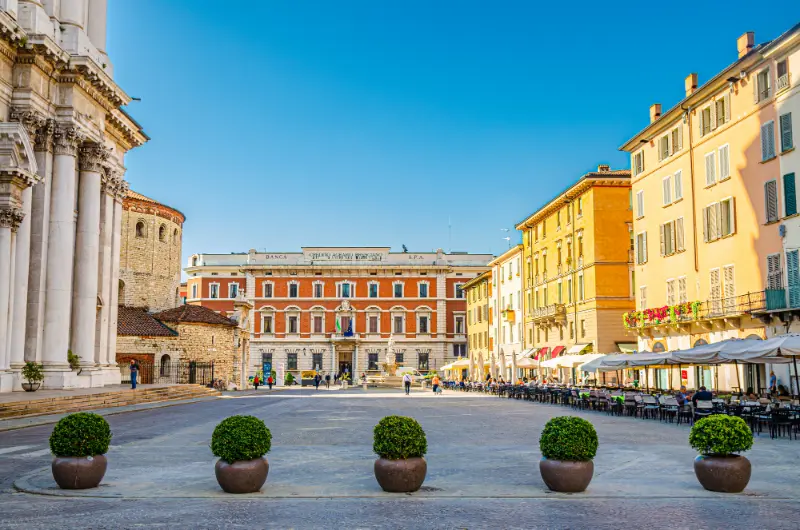
Where you stay in Brescia matters less than in a sprawling capital, but the right base can still save several kilometres of unnecessary walking. Most first-time visitors should choose between the historic centre and the station-to-centre corridor; longer stays can also work well around San Faustino or another metro station.
The best area depends on the trip structure. A traveller spending two museum-heavy days in the centre has different needs from someone using Brescia as a rail base for Lake Iseo and Lake Garda. The comparison below focuses on real trade-offs rather than naming one neighbourhood as universally best.
If you are still deciding how long to spend in the city, start with our Brescia travel guide for the main sights, transport and possible day trips.
| Best overall | Historic centre |
|---|---|
| Best for early trains | Station area |
| Best for nightlife and local feel | San Faustino / Carmine |
| Best for car-free regional trips | Centre or station |
| Best planning tool | Walking distance + metro access, not neighbourhood name alone |
Historic centre: best for a first visit
Staying around Piazza della Loggia, Piazza Paolo VI or the streets between them puts Brescia’s main sights within easy walking distance. Brixia, Santa Giulia, restaurants, cafés and the castle approach can all be reached without planning transport.
The trade-off is that the most central rooms can cost more, parking is less convenient and pedestrian or limited-traffic zones require attention if you arrive by car. For a one- or two-night cultural stay without a car, those disadvantages usually matter less than the saved time.
Station area: best for rail-heavy itineraries
Accommodation near Brescia railway station is practical if you have early departures, late arrivals or repeated day trips. Milan, Verona, Desenzano and other main-line destinations are easy from here, while the Brescia–Iseo–Edolo line opens Lake Iseo and Val Camonica.

The area is less atmospheric than the historic core, but the metro and a manageable walk connect it quickly to central sights. Check the exact street rather than booking solely on the phrase ‘near station’, because the experience changes significantly over a few blocks.
San Faustino and Carmine: character and evening energy
The San Faustino and Carmine area offers a livelier, more local-feeling base close to the northern side of the centre. Bars, casual food and evening activity can make it appealing to younger travellers or anyone who wants to return to a neighbourhood with life after museum hours.
Noise is the obvious trade-off. Read recent accommodation reviews for sound insulation and street-facing rooms, especially on weekends. The San Faustino metro station can make the area convenient even when your daily itinerary extends beyond the old centre.
Near a metro station outside the centre
Brescia’s metro makes some outer locations more practical than a map initially suggests. A hotel a few minutes from a station can provide lower rates, simpler parking or newer facilities while preserving fast access to the centre.
This strategy works best for repeat visitors, business travellers or families with a car. First-time tourists staying only one night usually gain more from being able to walk outside and immediately enter the historic centre.
Where to stay for Roman archaeology and museums
If Brixia and Santa Giulia are the main reasons for your trip, prioritise the east side of the historic centre or anywhere within an easy walk of Via dei Musei. That allows early starts, museum breaks and a return to the room without crossing the entire city.
Do not over-optimise by trying to sleep directly beside an entrance. Brescia is compact enough that a fifteen-minute walk can offer better dining and evening atmosphere without sacrificing convenience.
Where to stay for Lake Iseo day trips
For repeated trips to Iseo, the station area becomes especially attractive because the regional railway north starts from Brescia. A central hotel is still feasible, but every early excursion adds a walk or metro transfer before the train.
If Lake Iseo is the primary destination rather than a day trip, however, sleep on the lake instead. Brescia is a good base for one excursion, not a substitute for evening time in Iseo, Lovere or Monte Isola.
Where to stay with a car
Drivers should pay more attention to parking access and ZTL restrictions than to a hotel’s marketing description. Historic Italian centres often limit through traffic, and Brescia is no exception. A garage arrangement or peripheral hotel near the metro can be more relaxing than navigating narrow streets with luggage.
Confirm parking directly with the property before arrival. ‘Parking available’ can mean private garage, paid public facility or limited spaces that cannot be reserved, and those differences matter after a long drive.
Where to stay with children
Families often benefit from quieter streets, larger rooms and a simple route back after dinner. The central area remains practical because it reduces transport, but a serviced apartment or family room near the metro can offer more space for longer stays.
Consider the castle climb and museum schedule when choosing. A hotel that allows a midday rest can be more valuable than a slightly more stylish property that adds twenty minutes of walking each way.
How many nights
One night works for travellers arriving early and leaving the following afternoon, but two nights create a much better rhythm: a full city day without luggage pressure, plus time for dinner and an evening walk. Three or more nights make sense if Brescia becomes a base for nearby destinations.
Because Milan is only about 66 minutes away by direct regional train, some visitors are tempted to commute instead of staying. That is workable, but sleeping in Brescia gives you quieter morning and evening hours and avoids repeating the rail journey.
Booking strategy
Compare total trip cost rather than room rate alone. Add parking, metro use, taxi needs and the value of time. A room that is €20 cheaper but forces two taxi rides or an inconvenient early transfer is not actually cheaper.
Look at recent reviews for air-conditioning in summer, noise, lift access and breakfast timing. Those operational details often influence satisfaction more than a generic star rating.
Where to stay
For accommodation, compare locations as carefully as prices: a slightly cheaper room can cost time if it leaves you dependent on infrequent transport.
Continue planning
Use these related My Italy Experience guides to build the rest of the trip without repeating the same planning work:
Check live information before the day begins
Where to Stay in Brescia works best when the fixed plan is checked against live information. Brescia’s civic museums publish opening days, temporary closures and exhibition changes through Fondazione Brescia Musei, while Brescia Mobilità publishes current metro and bus information. The city is compact enough that a closure will not ruin the day, but discovering it at the door can waste the exact hour you had reserved for a major stop.
Build one flexible alternative into the plan. If a museum is closed, substitute a square, church, neighbourhood walk or the castle; if weather deteriorates, move an indoor attraction forward. This simple contingency keeps the itinerary useful without turning the article into a schedule that only works on one perfect date.
Season, heat and daylight
Brescia can be visited year-round, but the order of activities should change with the season. In summer, do the castle climb early or late and use museums through the hottest hours. In winter, prioritise outdoor viewpoints while daylight is strong, then move indoors. Spring and early autumn are the easiest periods for long walking days, though events can make accommodation busier.
Rain should change emphasis rather than cancel the trip. Santa Giulia, Brixia’s indoor components, the Pinacoteca and castle museums provide enough depth for a wet day. Carrying a compact umbrella and choosing footwear that handles smooth stone makes more difference than trying to predict a completely dry forecast.
Accessibility and realistic walking
Central Brescia is walkable, but ‘compact’ does not mean entirely flat or barrier-free. The castle requires an uphill approach, older churches may have steps, and long museum routes can be tiring even when individual distances look short. Travellers with limited mobility should check current accessibility information for the exact sites they plan to enter rather than assuming historic buildings offer identical access.
For everyone else, pace matters. A route containing Santa Giulia, the archaeological park, several churches and the castle can easily exceed the effort suggested by the map. Use the metro strategically, take a real lunch break and reduce the number of attractions before you reduce the time spent at the most important ones.
Using Brescia as part of a wider Lombardy trip
The city fits naturally between Milan, Bergamo, Lake Iseo and Lake Garda. Direct rail corridors make it possible to arrive from Milan, spend one or two nights, then continue east or north without backtracking. That makes Brescia especially useful for travellers building a car-free northern Italy itinerary.
Avoid treating the city only as a base, however. If every daylight hour is spent on excursions, you lose the Roman and museum experiences that justify sleeping here. A good rule is to reserve at least one full day for Brescia before using additional nights for Lake Iseo, Franciacorta or Garda.
Families and mixed-interest groups
Brescia works well for groups whose interests differ because the centre offers several types of experience close together. One person may care about archaeology, another about views, another about cafés and shopping. The castle, central squares and short walking distances allow those interests to overlap without splitting the group for an entire day.
With children, shorten museum blocks and add open-air time between them. Santa Giulia is substantial enough that adults should decide which sections matter most rather than expecting young visitors to absorb every room. The castle can then provide movement and views after a long indoor visit.
How to keep the visit from feeling generic
The purpose of a focused guide such as where to stay in Brescia is not to reproduce a universal Italy checklist. Notice what is specifically Brescian: the physical proximity of Roman Brixia and the Lombard monastery, the contrast between Piazza della Loggia and Piazza della Vittoria, the title Leonessa d’Italia, and the connection from the city to Franciacorta and the pre-Alpine valleys.
Choose at least one experience that could not simply be swapped with another Italian city. That may be the Winged Victory, Romanino and Moretto, a Brescian food specialty or the civic history of the castle. Those specific choices are what turn an efficient itinerary into a memorable one.
Useful official sources
Final planning advice
For most first-time visitors, the historic centre is the simplest choice; for travellers using trains intensively, the station area often wins on logistics. Choose the exact property by walking time, noise, parking and metro access rather than assuming one district label guarantees convenience.
Last updated: October 17, 2026