
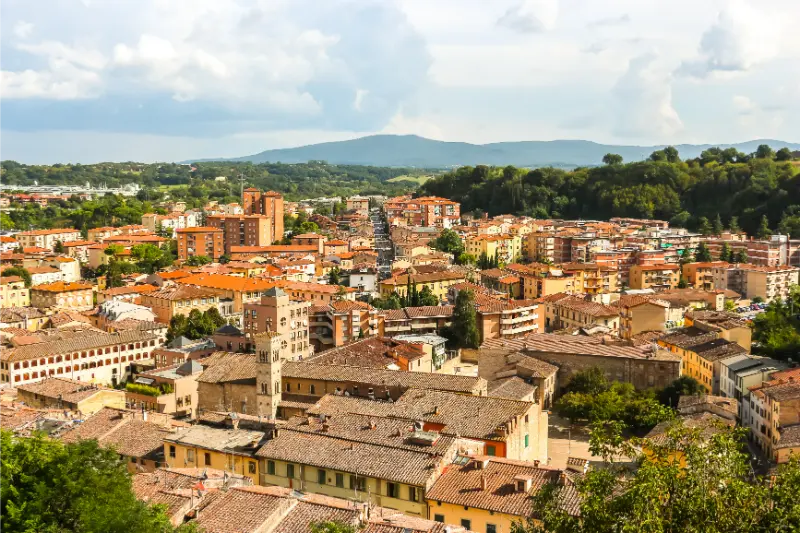
Colle di Val d’Elsa is often bypassed on the road between Siena and San Gimignano, yet it combines several things travellers usually seek separately: a medieval upper town, a working lower centre, a long crystal-making tradition and access to the Elsa river landscape. The town also sits on routes associated with the Via Francigena, giving it a natural place in slower central-Tuscany itineraries.
At a glance
| Ideal time | 1 full day; 2 nights if combining town, river walks and nearby hill towns |
|---|---|
| Best for | Crystal craft, medieval architecture, Via Francigena, nature walks and central location |
| Car needed? | Helpful but not essential for the town; useful for regional touring |
| Best base | Colle di Val d’Elsa for access to San Gimignano, Monteriggioni and Siena |
| Official planning | Visit Tuscany / official visitor information |
Why Colle di Val d’Elsa deserves time in your Tuscany itinerary
Split the visit in two. Use the first half for Colle Alta and its urban history, then move down toward craft, everyday streets or the Elsa river. The contrast is the point; treating only the upper town as “real Colle” misses why the destination works as more than another hilltop photo stop.
To see where Colle di Val d’Elsa Travel fits into a wider Tuscany itinerary, use our Tuscany travel guide for transport, bases and possible neighbouring stops.
The practical advantage is that you can shape the visit around your own travel style. Art-focused travellers can give more time to museums and historic buildings; food travellers can protect a long lunch; families can alternate culture with open space; road trippers can use the destination as an anchor rather than one more pin on a map. The goal is not to see everything. It is to leave with a clear sense of place and enough energy to enjoy the next day.
Colle Alta and the tower-house skyline
The oldest part of town stretches along a ridge with gates, narrow streets and surviving tower houses. The urban form reflects Colle’s position on historic travel routes and gives the upper town a distinctly vertical profile.
Walk the ridge before entering museums. Views and street geometry help explain how the settlement functioned defensively and commercially.
Crystal craftsmanship
Colle di Val d’Elsa has been associated with glass and crystal production for generations and is widely described as Italy’s crystal capital. Museums, shops and workshops preserve that identity even as industrial production has changed.
Look for information about how pieces are produced and finished instead of shopping only by appearance. If you buy glass, ask about packing and transport; fragile souvenirs create practical problems on flights and road trips.
Arnolfo di Cambio and artistic heritage
The medieval sculptor and architect Arnolfo di Cambio is traditionally associated with Colle, adding another layer to the town’s artistic story. Local museums and architecture place that connection in context.
Use Colle as a bridge between the major art cities and smaller centres: it helps show that Tuscan artistic history was not confined to Florence and Siena.
The Elsa River and Sentierelsa area
The river landscape below town can provide a striking natural contrast, with paths, vegetation and turquoise water in certain conditions. Access and trail status can vary after storms or maintenance.
Wear footwear suitable for uneven and potentially wet ground, respect closure signs and do not assume swimming is safe or permitted simply because social media shows people in the water.
Via Francigena connections
Historic pilgrimage routes through Valdelsa connect Colle with a larger network of towns and countryside. Even a short walk on a signed section changes the rhythm of the visit and reveals why this corridor mattered.
Plan return transport before starting a one-way walk. Summer heat and limited shade can make a modest distance feel much harder than the map suggests.
How long should you stay?
1 full day; 2 nights if combining town, river walks and nearby hill towns is the useful starting point, but the right answer depends on what comes before and after. If you are changing hotels every night, add less; if this is one of only two or three bases in Tuscany, stay longer. Parking, check-in, meals and slow roads consume more of a day than first-time itineraries usually allow.
Build one optional item into every day so the itinerary can contract without feeling like a failure. This matters in Tuscany because weather, museum access, beach traffic, mountain conditions and restaurant schedules can alter the pace. Margin is not wasted time: it is what allows an independent trip to adapt without becoming stressful.
Getting there and moving around
Buses connect Colle with surrounding towns, but schedules may be less frequent than visitors expect. A car simplifies combinations with Monteriggioni, San Gimignano and rural areas. Park outside restricted historic zones and treat the upper and lower parts as one town connected by local roads and pedestrian routes.
Before driving anywhere in Tuscany, review our driving in Italy guide, especially ZTL rules, parking signs and realistic rural-road timing. If you are travelling without a car, compare the plan with our Italy without a car guide and simplify the number of same-day stops instead of replacing every drive with a complicated bus chain.
Where to stay
Colle di Val d’Elsa for access to San Gimignano, Monteriggioni and Siena. The best accommodation is the one that removes the most annoying part of your itinerary: parking if you have a car, station access if you rely on public transport, or evening driving if food and wine matter. A beautiful rural property can be a poor fit when every dinner requires a dark mountain or country-road journey.
Compare current accommodation options on Booking.com. Check parking, air conditioning, stairs, breakfast times and the exact distance from the places you intend to visit rather than relying only on a property’s marketing description.
What and where to eat
The area shares central Tuscan staples such as pecorino, Cinta Senese products, soups, grilled meats and Chianti Colli Senesi wines. A market or deli lunch is useful on a day that also includes walking. If you are driving afterward, keep wine tasting separate from the road portion of the itinerary.
Reserve only the meals that genuinely matter. Leaving one lunch flexible makes a road trip more resilient, while booking every meal can turn a relaxed region into a sequence of deadlines. In small towns or event periods, however, restaurant capacity may be limited, so ask your accommodation whether advance reservations are sensible.
A realistic first-day itinerary
Morning: explore Colle Alta and one museum or crystal-related stop. Lunch in town. Afternoon: choose either the Elsa river area or a short Via Francigena walk. If you have a second day, add San Gimignano or Monteriggioni rather than trying to combine both with Colle before dinner.
Protect at least one unstructured hour. It can become a café stop, a longer museum, a swim, a rest in the hotel or simply time lost to parking without damaging the rest of the day. This buffer is one of the simplest ways to make a Tuscany itinerary feel independent rather than tour-like.
Best time to visit
Spring is excellent for river walks and green landscapes, while early autumn balances warm weather with easier hiking. Summer can be hot, especially on exposed walking routes. After heavy rain, river access may be less suitable, so keep an urban alternative.
For the wider seasonal picture, use our guide to the best time to visit Italy. Always check attraction hours and local conditions close to your date: churches, museums, ferries, trails, thermal sites and small businesses can change seasonally, and an old timetable should never be treated as current.
How to avoid turning the visit into a checklist
Choose one “must-do,” two “would-like” experiences and let everything else remain optional. Distances often look short on a map while parking, hillside walking, mountain roads and meals expand the real day. If you have already completed the core experience, a bench with a view or an early dinner can be a better use of time than another rushed attraction.
Crowd strategy is usually simple: start earlier than day-trip groups, stay later than they do, or sleep in the destination. You do not need to discover a secret viewpoint to have a quieter experience; you often just need to be in a famous place at a less compressed time and avoid building your entire day around social-media photo locations.
Families, accessibility and slower travel
For families, alternate cultural stops with movement, food and open space. A castle, river walk, beach, park or short trail can reset the day after a museum. Do not assume a stroller will be comfortable on medieval paving, quarry terrain, steep lanes or natural paths; a carrier may be more practical for smaller children in some destinations.
Travellers with limited mobility should investigate gradients, stairs, parking and accessible entrances attraction by attraction. Historic Tuscany is not uniformly accessible, but many visits can be redesigned around viewpoints, lower-town routes, taxis and selected museums. Asking a hotel about the actual number of steps is more useful than relying on a general “central location” description.
How to connect this stop with the rest of Tuscany
Useful next reads are our Certaldo guide, our San Gimignano guide, our Monteriggioni guide and our Siena guide. Build clusters geographically: pair places that share the same road or rail corridor and avoid crossing Florence, Siena or the Apennines repeatedly just to keep a hotel booking.
If this is your first trip to the region, compare the route with the larger Tuscany travel guide. A strong itinerary normally includes contrast—at least one art city, one smaller town and one landscape, mountain or coast experience—rather than ten variations of the same hill-town day.
What to book in advance
Book only capacity-limited experiences that matter: a specific museum slot, quarry tour, winery visit, ferry with a vehicle, guided cave, spa treatment, concert or restaurant during a major event. For everything else, preserve flexibility. Before paying a third-party seller, compare the offer with the official visitor page linked above and read cancellation terms.
Our broader guide to booking Italy attractions explains how to distinguish official tickets, timed-entry requirements and convenience products. Save confirmations offline because mobile reception can be unreliable in rural, coastal or mountain areas.
Practical planning notes that make a real difference
Carry water, a small amount of cash, a charged phone and footwear suitable for stone or uneven ground. In summer, move exposed walks to the morning; in shoulder seasons, carry a light waterproof layer. Do not let a sunny forecast in Florence convince you that a mountain ridge, exposed archaeological park or windy coast will feel identical.
Use offline maps but follow local signs when they disagree with navigation. ZTL cameras, market closures, ferry lanes, industrial access roads and temporary works are local realities that an app may not understand in real time. On rural or mountain roads, never stop around a blind bend for a photograph and never block farm, quarry or emergency access.
Finally, leave space for local information. A hotel owner, museum desk or tourist office may know that a path is muddy, a road is closed, a beach access has changed, a church has a special opening or a festival is affecting parking. Good independent travel is the ability to update the plan when better information appears.
If you are building a longer Tuscany itinerary
For a trip of one week or more, use this destination as part of a geographic block rather than an isolated day trip. Two or three nights in one area often produce more actual sightseeing time than changing hotel every evening. It also gives you a fallback day if rain, heat, traffic or a closure disrupts the original plan.
Think in travel zones: Florence and its close hills; Siena and central Tuscany; Val d’Orcia and Valdichiana; western Tuscany around Pisa and Lucca; the coast and islands; and mountain areas such as Garfagnana, Apuan Alps, Mugello or Casentino. Moving between zones every day creates unnecessary distance, while staying within one zone lets meals, viewpoints and spontaneous stops become part of the trip.
A longer stay also reduces dependence on perfect weather. Museums can move to rainy hours, walks can move to cool mornings and a beach day can shift when the sea is rough. Flexibility is not empty time; in Tuscany it is one of the most valuable parts of the itinerary.
Final thoughts
Colle di Val d’Elsa earns its place in a Tuscany itinerary when you let its strongest qualities determine the pace. Plan transport first, choose a small number of meaningful experiences, eat locally and leave enough margin for the landscape or street life that cannot be reserved. That approach produces a richer day than trying to prove how many Tuscan names you can fit on one route.
Last updated: October 17, 2026