
Barletta is one of northern Puglia’s strongest city breaks because it combines a substantial Swabian castle, Romanesque and Gothic architecture, a major art collection, an unusually memorable bronze colossus and a long Adriatic waterfront without the visitor pressure found in some of the region’s headline towns.
Barletta works best when you treat it as part of a wider Puglia route rather than an isolated pin on the map. This guide focuses on what is genuinely worth your time, how long to allow, where the practical friction appears and how to combine the destination intelligently with nearby places.
If Barletta Travel is part of a longer route through Puglia, our Puglia travel guide is a useful starting point for choosing the next stop.
Quick planning summary
| Best for | history lovers, travellers exploring the Barletta-Andria-Trani area, art-focused visitors and anyone who wants a northern-Puglia base with both culture and beach access |
|---|---|
| Minimum time | A full day is ideal; add a second day if you want Canne della Battaglia, beach time or a slower museum visit. |
| Car | Not needed for the historic centre; useful for Canne della Battaglia and wider BAT road trips. |
| Best seasons | April–June and September–October for comfortable sightseeing; summer for coast and evening atmosphere with earlier starts. |
| Main planning rule | Choose one major experience first, then add only nearby stops that do not create unnecessary driving. |
Is Barletta worth visiting?
Yes, if history lovers, travellers exploring the Barletta-Andria-Trani area, art-focused visitors and anyone who wants a northern-Puglia base with both culture and beach access. The destination has enough identity to justify its place in a Puglia itinerary, but the right amount of time matters. A full day is ideal; add a second day if you want Canne della Battaglia, beach time or a slower museum visit.
For a first trip to Puglia, the best strategy is not to collect every town. Choose places that add a different experience: a major monument, a local food tradition, a beach landscape, an archaeological site or a practical base. This destination earns its place when it contributes something distinct to the route rather than duplicating what you have already seen.
What to see and do
Barletta Castle
The massive castle beside the old town is the natural starting point. Its present form reflects successive Norman, Swabian, Angevin, Aragonese and Spanish phases, so the building works as a compact history lesson in how power shifted across southern Italy. The civic museum inside adds context, while the broad exterior and moat make the site visually impressive even before you enter.
Allow enough time to experience this stop rather than taking a quick photograph and moving on. If interior access, tickets, guided visits or protected-area rules matter to your day, verify the current arrangement shortly before travel because smaller Puglia attractions can change opening patterns by season.
Cathedral of Santa Maria Maggiore
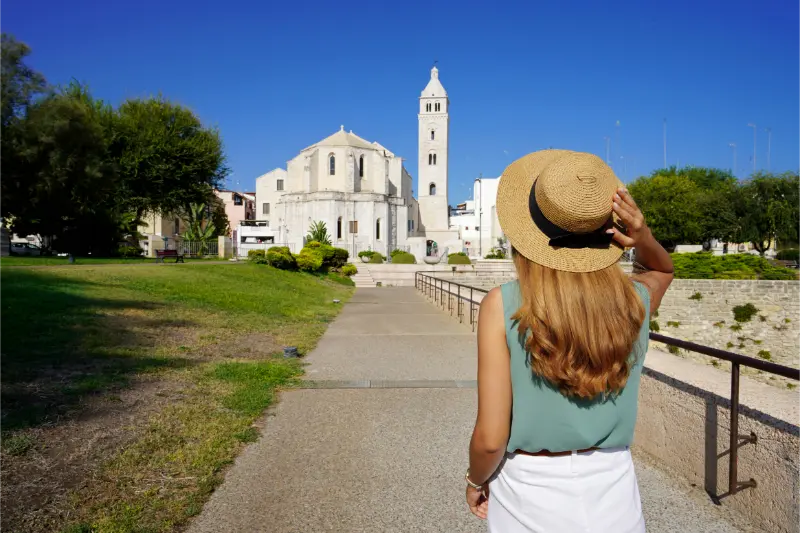
The cathedral stands close to the castle and shows the transition from Romanesque to Gothic architecture. Spend time around the exterior before going inside; the relationship between the cathedral, old streets and the nearby fortress is what makes this corner of Barletta especially coherent.
Allow enough time to experience this stop rather than taking a quick photograph and moving on. If interior access, tickets, guided visits or protected-area rules matter to your day, verify the current arrangement shortly before travel because smaller Puglia attractions can change opening patterns by season.
The Colossus of Barletta
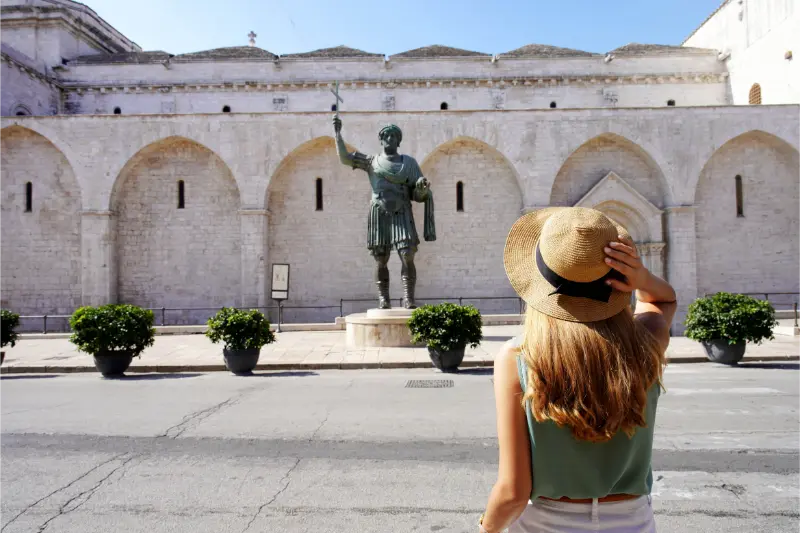
The giant late-antique bronze statue known locally as Eraclio is one of the city’s most distinctive sights. It is easy to see in a few minutes, but it is worth understanding why such a large ancient bronze survived and why it became a civic symbol rather than treating it as a simple photo stop.
Allow enough time to experience this stop rather than taking a quick photograph and moving on. If interior access, tickets, guided visits or protected-area rules matter to your day, verify the current arrangement shortly before travel because smaller Puglia attractions can change opening patterns by season.
Palazzo della Marra and the De Nittis Gallery
Giuseppe De Nittis was born in Barletta and became an important nineteenth-century painter associated with Parisian artistic circles. The collection in Palazzo della Marra gives the city a genuinely significant art stop and is one of the clearest reasons Barletta deserves more than a quick castle visit.
Allow enough time to experience this stop rather than taking a quick photograph and moving on. If interior access, tickets, guided visits or protected-area rules matter to your day, verify the current arrangement shortly before travel because smaller Puglia attractions can change opening patterns by season.
Cantina della Disfida and the Challenge story
The famous Challenge of Barletta in 1503 still shapes the city’s identity. The Cantina della Disfida and related sites are most interesting when experienced as part of the old-town walk rather than as isolated monuments.
Allow enough time to experience this stop rather than taking a quick photograph and moving on. If interior access, tickets, guided visits or protected-area rules matter to your day, verify the current arrangement shortly before travel because smaller Puglia attractions can change opening patterns by season.
Canne della Battaglia
Outside the city, the archaeological area of Cannae recalls Hannibal’s devastating victory over Rome in 216 BC. It changes the scale of a Barletta visit completely: instead of only medieval and early-modern history, you add one of antiquity’s most famous battlefields.
Allow enough time to experience this stop rather than taking a quick photograph and moving on. If interior access, tickets, guided visits or protected-area rules matter to your day, verify the current arrangement shortly before travel because smaller Puglia attractions can change opening patterns by season.
How to plan the visit
Start at the castle when museums open, continue to the cathedral and old-town streets, then reach the Colossus and Santo Sepolcro area. Use the middle of the day for lunch and Palazzo della Marra, leaving the waterfront for late afternoon. If Canne della Battaglia is essential, treat it as a separate half-day component rather than squeezing it between city monuments.
The most efficient Puglia days are built geographically. A short distance on the map can still mean a long transfer once parking, coastal traffic, limited-traffic zones and the walk from the car are included. Group neighbouring places and leave margin around lunch and late afternoon.
In July and August, move the most exposed sightseeing to the first part of the day. Churches, museums, caves and long lunches can occupy the hottest hours, while old towns and waterfronts become far more pleasant toward evening. In spring and autumn you can reverse that logic and use the whole day more flexibly.
Getting there and getting around
Barletta is well connected by rail along the Adriatic line, which makes it easy to combine with Trani, Bari or Foggia without a car. The historic centre is walkable from the station. A car becomes useful only for Canne della Battaglia, rural stops and a wider BAT itinerary.
Driving and parking
Do not follow navigation apps blindly into historic streets. Puglia has many ZTLs, pedestrian zones and narrow lanes where the legal or sensible route ends before the main square. Use signed public parking and walk the final section. In summer, the first reasonable legal space is often better than circling repeatedly for the closest one.
Without a car
A car-free visit works best when the destination sits on a useful rail or bus corridor and your plan stays focused on the town centre. Rural churches, beaches, wineries, caves and protected landscapes usually reduce flexibility. Check the final return service before dinner, especially on Sundays and outside peak season.
How much driving is too much?
A common Puglia mistake is adding a second or third town simply because it appears nearby. If the next stop requires another parking search, a new ZTL, a long walk and a rushed meal, it may add less value than staying where you are. One well-paced destination plus one complementary stop is usually stronger than four superficial visits.
Where to stay
Barletta works well as an overnight base if you want lower-key evenings than Bari while keeping strong rail connections. Stay near the old town for atmosphere, near the station for car-free day trips, or closer to the seafront if beach access matters more than monuments.
When comparing accommodation, check parking, stairs, air conditioning, breakfast hours, actual walking route and evening restaurant access. A romantic property in the deepest old town can be excellent for atmosphere but inconvenient with heavy luggage or a car. A masseria can offer space and quiet but may require driving for every dinner.
A realistic itinerary
Morning
Start with the attraction that is most sensitive to heat, opening times or crowds. A castle, archaeological site, cave or major church is usually easier before lunch. If the destination is coastal, a summer swim can also work first thing before parking pressure grows.
Lunch
Treat lunch as part of the destination rather than dead time. Choose one regional dish, local product or restaurant style that fits the place, and avoid reservations so tight that a delayed museum visit creates stress. In smaller towns, lunch hours can matter because some attractions and shops pause in the middle of the day.
Afternoon
Use the afternoon for the complementary side of the destination: a museum after an outdoor morning, countryside after a historic centre, or a waterfront after archaeology. This gives the day variety without a long transfer.
Evening
If you are staying overnight, leave something for after the day visitors depart. A harbour, main square or old-town loop often feels substantially different after sunset, and the evening is one of the main arguments for sleeping in smaller Puglia towns.
Food and local character
Look for seafood from the Adriatic, orecchiette and other regional pasta, focaccia, local vegetables and wines from the wider Castel del Monte area. Barletta is also a good place to slow down over an aperitivo after the museums rather than rushing immediately to the next town.
Season matters. Spring brings vegetables and lighter countryside cooking; summer shifts attention toward seafood, tomatoes, fruit and late dinners; autumn strengthens wine, mushrooms, baked dishes and harvest products. Ask what is local to the immediate area rather than assuming every famous Puglian speciality belongs equally to every town.
Best time to visit
April to June
This is one of the easiest periods for a culture-heavy itinerary. Temperatures are usually more comfortable for walking, countryside is greener and the coast is active without the full pressure of August. Late May and June can already feel summery.
July and August
Expect heat, higher accommodation prices near the coast and stronger parking pressure. Start earlier, reserve important dinners and protect the hottest hours. Inland towns can feel quiet in mid-afternoon and lively again after sunset.
September and October
Excellent for travellers combining food, towns and sea. The light is softer, driving is easier than in August and many coastal areas remain pleasant. Some beach services reduce operations later in the season, so check if a specific lido or boat service matters.
Winter
Winter is best for local atmosphere, food, architecture and events rather than beach travel. Opening hours can be shorter and weather more variable, but parking and accommodation are often much easier.
Visiting with children and accessibility
Families can handle the central sights well because the main historic area is relatively compact. The castle is usually the most immediately engaging monument for children, while the waterfront provides a useful break after churches and museums.
The old town has uneven paving in places, but Barletta is generally less physically demanding than many hill towns. Museum accessibility and lifts should still be checked individually, particularly if a specific gallery or castle level is essential.
For families, one major cultural stop plus outdoor time usually works better than a long list of churches and museums. Carry water, protect the hottest hours and choose accommodation with straightforward parking if you have strollers or substantial luggage.
Mistakes to avoid
The most common mistake is treating Barletta only as a stop on the way to Trani or Castel del Monte. Another is trying to add Canne della Battaglia without allowing for the extra transfer time.
Also avoid relying on old opening-hour information copied across travel sites. Smaller museums, churches and archaeological places can change schedules seasonally. Verify the one or two attractions that would genuinely disappoint you if closed.
Trying to see too much
Puglia rewards repetition of simple pleasures: another walk through the same square at a different hour, a longer lunch, a swim, a bakery stop or an evening passeggiata. If the day feels like a race between parking lots, remove a stop rather than driving faster.
Booking the wrong base
The cheapest room is not always the best value. A remote property can add driving to every meal, while a deep-old-town room can create parking and luggage problems. Choose the base according to how you will actually move each day.
Useful related guides
Trani Travel Guide — useful for building the next step of the itinerary without crossing the region unnecessarily.
Castel del Monte Travel Guide — useful for building the next step of the itinerary without crossing the region unnecessarily.
Puglia Travel Guide — useful for building the next step of the itinerary without crossing the region unnecessarily.
Official information to check before travel
Opening hours, access rules, parking, protected-area restrictions and seasonal services can change. Before travelling, check the official or primary destination information and verify any ticket, transport or attraction that is essential to your day.
Last updated: October 17, 2026
Leave a Reply