

Trani is one of Puglia’s easiest cities to love because its most important monument and its best evening walk are in the same place: the pale Romanesque cathedral rising directly beside the Adriatic.
The city is much more than a cathedral photo stop. The harbor, castle, old Jewish quarter, limestone streets and restaurants make Trani an excellent one-night pause between Bari and the Gargano, while the rail station keeps it practical for travellers without a car.
For a broader Puglia itinerary, see the Puglia travel guide before deciding which destinations to combine with Trani Travel.
This guide focuses on how long you actually need, when the cathedral looks best, whether to stay overnight, where a car is useful, and how to combine Trani with Castel del Monte without turning both places into rushed half-hour visits.
Quick planning summary
| Best for | Romanesque architecture, waterfront evenings, seafood and an easy northern-Puglia stop. |
|---|---|
| Minimum time | Half a day; one night if you want the harbor and cathedral at sunset and after dark. |
| Car | Not needed for central Trani; useful for Castel del Monte and inland day trips. |
| Best arrival | Mid-afternoon if staying overnight, so you catch both daylight and evening waterfront. |
| Best combination | Trani plus Castel del Monte with a car or organized excursion. |
What to see and do
Cathedral of San Nicola Pellegrino
The cathedral is Trani’s defining sight and one of the strongest examples of Apulian Romanesque architecture. Its pale local stone, tall campanile and position beside the sea create an unusually complete setting.
Do not arrive only at noon, photograph the facade and leave. Walk around the building from multiple angles and, if possible, return in late light. Interior access depends on religious functions, so check current times if the crypt or interior is important to you.
Swabian Castle
The castle sits only a short walk from the cathedral and creates a strong medieval pair. Its low, massive geometry contrasts with the cathedral’s verticality and helps explain Trani’s strategic coastal role.
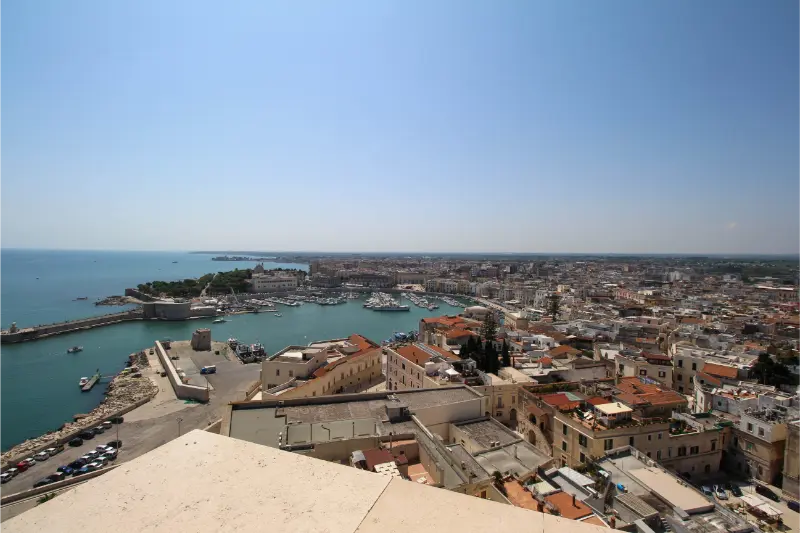
If your schedule is tight, decide in advance whether to visit the interior. The exterior setting and waterfront walk already add value, while an interior visit makes more sense for travellers particularly interested in Frederick II and medieval fortifications.
Harbor and evening passeggiata
Trani’s harbor is not simply scenery between sights; it is the social centre of the visit. Fishing boats, restaurants and the curved waterfront make it one of the best places in northern Puglia for an unstructured evening.
This is the main argument for staying overnight. Day visitors often leave just as the heat drops and the harbor becomes most pleasant. A slow dinner and second walk can be more memorable than adding another monument elsewhere.
Jewish quarter and historic lanes
The historic centre contains traces of Trani’s medieval Jewish community and a street network that deserves time beyond the cathedral axis. Look for the former synagogue/church heritage and the transition between residential lanes and the waterfront.
The area is compact, so there is no need to march through it. Use it as the link between cathedral, harbor and dinner rather than as a separate checklist attraction.
Villa Comunale and a quieter seafront
The public gardens and seafront give you a calmer side of Trani, useful after the monument cluster. Families in particular benefit from open space between church visits and meals.
If you have several hours, continue along the waterfront rather than immediately driving away. Trani’s strength is how comfortably the visit extends beyond its headline sight.
How to plan the visit
Half a day is enough for the cathedral, castle exterior, old centre and harbor. One night is better if Trani is on your route north or south because it transforms the waterfront from a sightseeing stop into an evening destination.
For a Castel del Monte combination, visit the castle in the morning and Trani in the afternoon/evening. Reversing that sequence can mean leaving Trani before its best atmosphere.
Protect the first part of the day for the place or experience that matters most. In Puglia, heat, parking and long lunches are real parts of travel time. A plan with breathing room normally delivers more than a longer list of stops.
Getting there and getting around
Trani is on the Adriatic rail corridor, making it easy from Bari and other coastal towns. The centre is walkable from the station. If you are travelling only along the coast, keeping a rental car here is optional rather than essential.
A car becomes useful for Castel del Monte and inland Alta Murgia. Park outside the narrowest historic lanes and walk toward the waterfront.
Car, public transport or a mix?
Use transport according to geography rather than ideology. Trains work very well for selected Adriatic cities, while rural valleys, beaches and national-park routes reward a car. If a vehicle spends several days parked while you explore on foot, consider whether you need it for that part of the trip.
Parking and ZTL strategy
Historic centres often restrict traffic or become unpleasant to drive through even when access is technically possible. Save a peripheral parking location before departure, follow official signage and ask accommodation for exact arrival instructions when a ZTL is involved.
Where to stay
Choose the historic centre or harbor for atmosphere, especially if you want dinner on foot. Station-side accommodation can be more practical for an early train but gives up some evening character.
Drivers should confirm parking before choosing a charming room in the oldest streets. A property a few minutes outside the core can be easier with luggage while remaining walkable to the cathedral.
Before booking, compare the accommodation with your actual first morning route. Parking, stairs, dinner options, station distance and the last kilometre of a rural access road can matter more than a small difference in nightly price.
A realistic itinerary
Morning
Cathedral and castle while interiors are open, then a slow loop through the historic centre.
Lunch
Seafood or a simple local lunch near, but not necessarily directly on, the most tourist-facing harbor edge.
Afternoon
Villa Comunale, café and free time; if combining with Castel del Monte, this is when you arrive in Trani.
Evening
Cathedral in softer light, harbor passeggiata and dinner. Stay until after dark if possible.
Food and local character
Seafood makes sense in Trani, but the city is also connected to the broader food traditions of northern Puglia. Look for simple fish, raw seafood from reputable establishments, local vegetables and regional wines rather than a generic “Italian” menu.
The harbor is attractive but not every waterfront table offers the same value. Read the menu first and walk one or two streets inland if you want a quieter meal.
Best time to visit
April to June
Excellent for architecture and walking, with long daylight and manageable temperatures. Coastal evenings are pleasant before the main summer rush.
July and August
Heat makes early monument visits valuable. Trani and other coastal cities come alive in the evening, while inland sites need sun protection and water.
September and October
A strong period for culture, food and road trips, with softer light and fewer peak-season crowds.
Winter
Major monuments and cities remain worthwhile, but opening patterns and weather should be checked. Inland hill sites can feel notably colder than the coast.
Worth knowing before you go
Check operational information close to travel rather than assuming opening hours, beach services, event access or transport frequencies remain fixed. Save important ticket QR codes and addresses offline, especially when a timed reservation or boat departure anchors the day.
Puglia rewards simple geography. Put stops in the same direction on the same day and avoid crossing the region merely to add one more famous name. The resulting itinerary usually costs less, feels calmer and gives you more time on foot.
Families and accessibility
Trani is an easy cultural stop with children because distances are short and the seafront provides open space. The cathedral and castle can be balanced with the harbor and gardens, avoiding the museum fatigue that can build on architecture-heavy road trips.
Accessibility varies by individual sight. Stone paving, old stairs, steep lanes, sand and rural paths can change the experience even when the destination appears compact on a map. Check the exact attraction and parking-to-entrance route if step-free access matters.
Mistakes to avoid
- Leaving immediately after photographing the cathedral.
- Driving into the oldest lanes when the centre is easy to explore on foot.
- Combining Trani and Castel del Monte in the wrong order and missing the waterfront evening.
- Assuming the closest harbor restaurant is automatically the best choice.
The pattern behind most of these mistakes is over-optimisation: trying to gain one more attraction while ignoring heat, parking, meals and transfer friction. Build the day around two or three priorities and leave secondary stops movable.
Key decisions that improve the trip
Is Trani worth an overnight stay?
Yes if it fits naturally between Bari and the Gargano or if you value evenings. It is one of the easiest one-night stops in Puglia because the station, old centre and waterfront are close.
Trani or Bari?
Bari is the larger transport and food hub; Trani is calmer and more visually concentrated. They complement rather than replace each other.
Can you visit Trani without a car?
Very easily. Rail access is one of its strengths. A car is useful only when you add Castel del Monte or inland destinations.
What would I skip?
Skip a hurried second coastal town on the same afternoon. Let Trani carry the evening instead.
On-the-ground strategy
Save parking points, accommodation directions and essential opening information before leaving Wi-Fi. Keep water, sun protection and a light layer in the car or day bag. Coastal wind and evening temperatures can change faster than the midday forecast suggests.
If driving, keep valuables out of sight and avoid loading luggage in exposed public parking longer than necessary. On a rail day, leave a margin before the final useful train; on a boat day, arrive early enough that parking does not become the reason you miss departure.
The final hour of a good Puglia day is often better spent over dinner or on a waterfront than squeezing in another town. Protect that flexibility.
Deeper planning notes
How to use Trani as a break in a longer Puglia road trip
Trani is especially effective between central Puglia and the Gargano. Instead of driving from Monopoli or Bari directly to Vieste, stop for a night in Trani, visit Castel del Monte on the way or next morning, and continue north rested. The city gives you a proper evening rather than a motorway transfer day, and the station also makes it useful for rail-based itineraries that later pick up a car.
The best light and timing around the cathedral
The cathedral is impressive at any hour, but the setting changes dramatically across the day. Morning is useful for a quieter interior visit; late afternoon gives warmer stone and a livelier waterfront; blue hour makes the silhouette against the sea particularly strong. If photography matters, do not spend the whole visit waiting for one perfect frame. Walk to the castle side, harbor side and seafront, then return when the light changes. The short distances make this easy. Wind can be stronger at the exposed waterfront than in the inland streets, so a light layer is useful outside midsummer. This is also a good reason to keep dinner close to the harbor rather than planning another drive after sunset.
Useful related guides
Continue planning with Bari travel guide, Puglia travel guide, 10-day Puglia itinerary, where to stay in Puglia.
Official information to check before travel
Opening hours, access arrangements and local services can change. Before travelling, check the official or primary destination information and verify any ticket, parking, transport or seasonal service that is essential to your day.
Last updated: October 17, 2026
Leave a Reply