

Otranto is one of Salento’s best combinations of history and sea because you do not have to choose between a meaningful old town and a beach-focused day. The cathedral’s medieval mosaic, Aragonese fortifications and compact lanes sit immediately beside a clear Adriatic waterfront.
The town can work as a day trip from Lecce, but it becomes more rewarding if you stay into the evening or use it as a base for the Adriatic side of southern Salento. The main planning challenge is summer congestion: the historic centre is small, parking fills quickly and the best nearby beaches are not all within an easy walk.
Extend a visit to Otranto Travel with the suggestions in our Puglia travel guide, which covers regional transport and where to base yourself.
A strong Otranto visit therefore depends on timing. See the cathedral before the beach crowds peak, protect time for the old walls and castle area, and treat coastal stops such as Baia dei Turchi or the lighthouse zone as separate pieces rather than trying to combine every famous place in one rushed afternoon.
Quick planning summary
| Best for | A compact historic centre, medieval art, Adriatic swimming and a scenic Salento base. |
|---|---|
| Minimum time | One full day; two nights if you want nearby beaches and a relaxed evening. |
| Car | Helpful for Baia dei Turchi, Punta Palascìa and coastal exploration; not useful inside the old town. |
| Best months | May–June and September for sea plus sightseeing with less pressure than peak summer. |
| Essential sight | The Cathedral of Santa Maria Annunziata and its 12th-century floor mosaic. |
What to see and do
The cathedral mosaic is the cultural priority
The cathedral’s floor mosaic, created in the 12th century and associated with the monk Pantaleone, spreads a medieval visual world across the nave, transept and apse. Allow time to look for the Tree of Life and the mixture of biblical, legendary and symbolic imagery instead of walking through in ten minutes.
The cathedral also carries the memory of the 1480 Ottoman siege through the Chapel of the Martyrs. It is a functioning religious space, so opening and service times matter. Visit early if this is your main cultural reason for coming to Otranto.
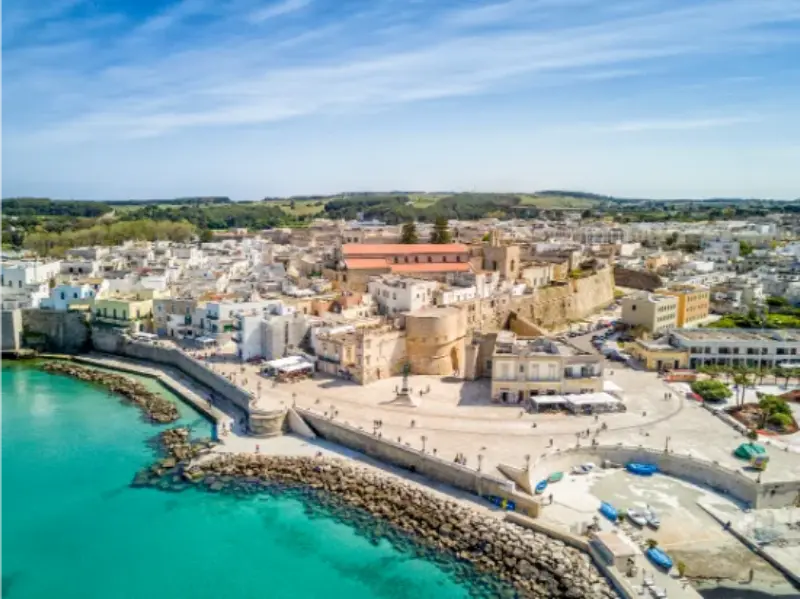
Aragonese Castle and the fortified town
The castle frames the entrance to the old town and makes the city’s defensive history visible immediately. Its current form developed after the 1480 attack, with towers, bastions and a moat designed for a changing age of artillery.
Interior exhibitions can vary, so decide whether you want a full visit or simply the exterior, walls and urban context. Even without a long castle visit, the transition from fortress to lanes to sea is central to Otranto’s character.
Walk the walls and old lanes before shopping takes over
The old town is compact, but it deserves more than a straight line between the castle and cathedral. Walk the perimeter where possible, use the sea views to orient yourself and then return through the lanes. Early morning is quieter; evening is busier but much more atmospheric.
Because the centre is small, shops and restaurants occupy a large share of the visible streetscape in summer. Step away from the busiest route and you will find quieter corners that better reveal the scale of the medieval settlement.
Baia dei Turchi and the beach question
Baia dei Turchi is one of the most sought-after stretches north of Otranto, but it should not be treated as a casual add-on with guaranteed parking beside the sand. Summer access, parking and walking conditions require planning, and the beach can feel very different at 09:00 than at 13:00.
If beach time matters, choose one beach and give it a real half-day. Constantly moving between Otranto, Baia dei Turchi and several coves produces more car time than swimming. Families especially benefit from deciding in advance whether the day is primarily cultural or coastal.
Punta Palascìa, quarry lakes and the coast south
The coast around Otranto rewards travellers with a car because scenery changes quickly outside town. Punta Palascìa, commonly associated with Italy’s easternmost point, gives a very different experience from the sandy beaches to the north.
South of Otranto the coastline becomes rockier and more dramatic. Treat these stops as a scenic drive with selected pauses rather than a race to collect pins. Wind and sea state can make one cove much more attractive than another on the same day.
How to plan the visit
For a first visit, protect the morning for the cathedral and old town. Use the hottest hours for lunch or swimming, then return for the walls and evening. This sequence avoids trying to appreciate medieval art after several hours in strong sun.
If you are coming from Lecce, one full day works well. If you are using Otranto as a base, separate beach days from town days; the area offers enough coastline that repeated short drives are less satisfying than choosing one strong destination each day.
Protect the first part of the day for the place or experience that matters most. In Puglia, heat, parking and long lunches are real parts of travel time. A plan with breathing room normally delivers more than a longer list of stops.
Getting there and getting around
Otranto can be reached from Lecce by public transport, but frequencies and seasonal patterns should be checked close to travel. A car gives more freedom for beaches and the coast, although it becomes a liability near the old town in peak summer.
Drivers should aim for signed parking outside the historic core and walk in. Do not design a July itinerary around finding the closest space to Porta Alfonsina. An earlier arrival often improves the day more than any clever parking trick.
Car, public transport or a mix?
Use transport according to geography rather than ideology. Trains work very well for selected Adriatic cities, while rural valleys, beaches and national-park routes reward a car. If a vehicle spends several days parked while you explore on foot, consider whether you need it for that part of the trip.
Parking and ZTL strategy
Historic centres often restrict traffic or become unpleasant to drive through even when access is technically possible. Save a peripheral parking location before departure, follow official signage and ask accommodation for exact arrival instructions when a ZTL is involved.
Where to stay
Stay inside or just outside the old town if evening atmosphere is the priority. Choose the northern side or a coastal property if beach access matters more. Travellers with a car should confirm private parking or a realistic public-parking plan before booking.
Otranto is a stronger base for the Adriatic side of Salento than for Gallipoli and the far Ionian coast. Trying to use it for every southern Puglia day trip creates cross-peninsula driving that becomes tiring over several days.
Before booking, compare the accommodation with your actual first morning route. Parking, stairs, dinner options, station distance and the last kilometre of a rural access road can matter more than a small difference in nightly price.
A realistic itinerary
Morning
Cathedral, mosaic, old lanes and the Aragonese walls while temperatures and crowds are lower.
Lunch
Lunch in town, then decide between a relaxed waterfront break or moving to one planned beach.
Afternoon
Beach time or a selected coastal stop such as Baia dei Turchi; return before sunset rather than adding a second distant beach.
Evening
Walk the old town after day-trippers thin out, then dinner with the waterfront and castle area as the evening backdrop.
Food and local character
Otranto is naturally strong for seafood, but the old town’s tourism pressure means it is worth reading menus before sitting down. Look for local fish, simple preparations, vegetables and Salento wines rather than assuming the most scenic terrace is the best kitchen.
For a quicker meal, combine a bakery or frisa-style lunch with a more relaxed dinner. This keeps the middle of the day flexible for beach time and makes the evening meal part of the reason to stay after the day-trip window.
Best time to visit
April to June
Late spring is excellent for city walking and day trips. May and June increasingly support beach time without the peak pressure of August.
July and August
Expect strong heat, high coastal demand and harder parking. Move cultural sightseeing to morning and late afternoon, keeping midday for lunch, rest or sea.
September and October
September remains strong for swimming and is often the best balance for coast plus culture. October is calmer and better for food and walking, with reduced seasonal services later in the month.
Winter
Cities remain rewarding and local life becomes more visible, but beach businesses and some seasonal transport reduce sharply.
Worth knowing before you go
Check operational information close to travel rather than assuming opening hours, beach services, event access or transport frequencies remain fixed. Save important ticket QR codes and addresses offline, especially when a timed reservation or boat departure anchors the day.
Puglia rewards simple geography. Put stops in the same direction on the same day and avoid crossing the region merely to add one more famous name. The resulting itinerary usually costs less, feels calmer and gives you more time on foot.
Families and accessibility
Families benefit from Otranto’s compact centre and accessible waterfront, but summer heat and parking can undo that advantage. Start early, choose a single beach with suitable access and keep the cathedral visit focused rather than turning the morning into a long church circuit.
Accessibility varies by individual sight. Stone paving, old stairs, steep lanes, sand and rural paths can change the experience even when the destination appears compact on a map. Check the exact attraction and parking-to-entrance route if step-free access matters.
Mistakes to avoid
- Arriving at midday in August and expecting easy parking.
- Seeing the cathedral only from outside and missing the mosaic.
- Trying to combine Otranto, Gallipoli and several beaches in one day.
- Assuming every famous cove has simple roadside access.
The pattern behind most of these mistakes is over-optimisation: trying to gain one more attraction while ignoring heat, parking, meals and transfer friction. Build the day around two or three priorities and leave secondary stops movable.
Key decisions that improve the trip
Otranto or Lecce for an overnight base?
Choose Otranto for sea access and a smaller evening atmosphere; choose Lecce for restaurants, transport and a larger cultural programme. A split stay works well if you have at least five nights in Salento.
Is Baia dei Turchi essential?
It is beautiful, but not at any cost. If access is crowded or the wind is wrong, another beach can produce a better day. Treat it as one option, not a compulsory checkpoint.
Can Otranto work without a car?
Yes for the old town and a focused stay. It becomes harder if your plan depends on multiple beaches, Punta Palascìa and rural coastal stops.
What would I prioritise with only half a day?
Cathedral and mosaic first, then the castle exterior, old lanes and waterfront. Do not add a remote beach unless the entire purpose of the visit is swimming.
On-the-ground strategy
Save parking points, accommodation directions and essential opening information before leaving Wi-Fi. Keep water, sun protection and a light layer in the car or day bag. Coastal wind and evening temperatures can change faster than the midday forecast suggests.
If driving, keep valuables out of sight and avoid loading luggage in exposed public parking longer than necessary. On a rail day, leave a margin before the final useful train; on a boat day, arrive early enough that parking does not become the reason you miss departure.
The final hour of a good Puglia day is often better spent over dinner or on a waterfront than squeezing in another town. Protect that flexibility.
Useful related guides
Continue planning with Lecce travel guide, 10-day Puglia itinerary, where to stay in Puglia, Puglia travel guide.
Official information to check before travel
Opening hours, access arrangements and local services can change. Before travelling, check the official or primary destination information and verify any ticket, parking, transport or seasonal service that is essential to your day.
Last updated: October 17, 2026
Leave a Reply