

Sassari is one of Sardinia’s great overlooked cities: a place of narrow streets, elegant civic squares, a cathedral with a theatrical Baroque façade and traditions that belong to local life rather than the beach economy. It feels unmistakably northern Sardinian, but in a very different way from Alghero or Castelsardo.
The city is the second largest in Sardinia and has deep civic identity, yet many road trippers pass around it on the way to La Pelosa or Alghero. That makes Sassari unusually rewarding for travellers who want to see an urban Sardinia that is lived year-round. This article focuses on what makes the destination distinctive, how to experience it without rushing and where it belongs in a wider Sardinia route.
If Sassari is part of a longer route through Sardinia, our Sardinia travel guide is a useful starting point for choosing the next stop.
Quick planning summary
| Best for | urban culture, local traditions, museums, architecture and travellers who want a real northern Sardinian city beyond the beach resorts |
|---|---|
| Time needed | One full day is enough for the historic core; two nights work well when Sassari becomes a base for north-west Sardinia. |
| Car | Not useful inside the centre. Park once, explore on foot and use the car only for Stintino, Porto Torres or the wider Nurra. |
| Main planning rule | Begin around Piazza d’Italia and the historic centre, walk to the cathedral and Rosello Fountain, then use the afternoon for one museum or local-food stop rather than trying to turn Sassari into a quick transit break. |
What makes this place special
Sassari does not rely on one postcard monument. Its appeal is cumulative: stone lanes, university life, noble façades, busy cafés, churches and public spaces that feel like part of a functioning city rather than a preserved resort centre.
The Descent of the Candelieri is one of the strongest expressions of city identity. Even when you are not visiting during the August celebration, learning why the huge ceremonial candles matter makes the streets and churches feel more connected to living tradition.
Why it is worth adding to your Sardinia trip
Begin around Piazza d’Italia and the historic centre, walk to the cathedral and Rosello Fountain, then use the afternoon for one museum or local-food stop rather than trying to turn Sassari into a quick transit break. The city is the second largest in Sardinia and has deep civic identity, yet many road trippers pass around it on the way to La Pelosa or Alghero. That makes Sassari unusually rewarding for travellers who want to see an urban Sardinia that is lived year-round.
The best decision is geographic as much as emotional. Sardinia is large, so a beautiful destination adds more value when it fits the same coast, mountain region or transfer direction as the rest of your trip.
What to see and experience
Piazza d’Italia
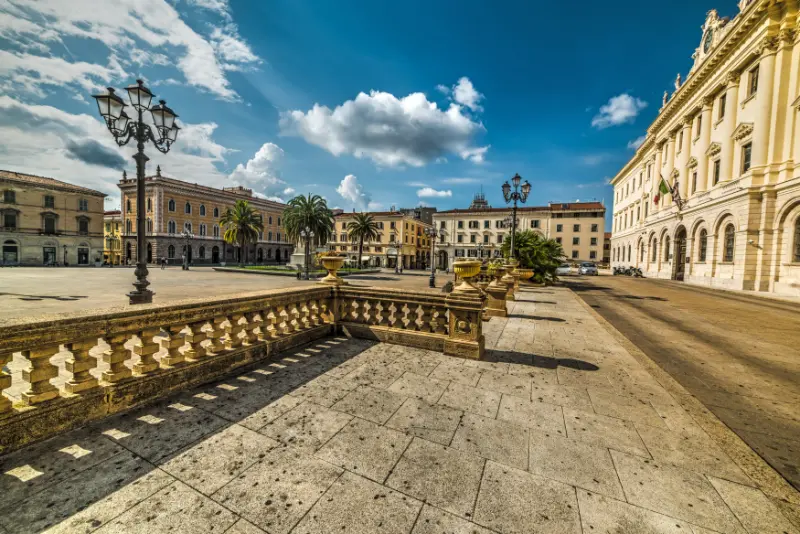
The monumental square is the city’s grand civic room and a useful starting point for understanding 19th-century Sassari.
Give this stop enough time to have its own identity. Check current access, parking, opening hours, weather or reservation requirements shortly before travel, especially for protected beaches, parks, ferries and archaeological sites.
Cathedral of San Nicola
The cathedral combines a Gothic core with a richly sculpted Baroque façade, one of the city’s defining architectural surprises.
Give this stop enough time to have its own identity. Check current access, parking, opening hours, weather or reservation requirements shortly before travel, especially for protected beaches, parks, ferries and archaeological sites.
Fontana di Rosello
The late-Renaissance fountain is Sassari’s symbol, with allegorical figures associated with the passage of time and the seasons.
Give this stop enough time to have its own identity. Check current access, parking, opening hours, weather or reservation requirements shortly before travel, especially for protected beaches, parks, ferries and archaeological sites.
Historic lanes and old walls
Narrow streets around the older core preserve the scale of pre-modern Sassari, with fragments and traces of the former defensive system.
Give this stop enough time to have its own identity. Check current access, parking, opening hours, weather or reservation requirements shortly before travel, especially for protected beaches, parks, ferries and archaeological sites.
Museo Nazionale G.A. Sanna
Archaeology and art collections help connect Sassari with the wider prehistoric, nuragic and historical story of northern Sardinia.
Give this stop enough time to have its own identity. Check current access, parking, opening hours, weather or reservation requirements shortly before travel, especially for protected beaches, parks, ferries and archaeological sites.
Candelieri tradition
The great August procession carries monumental wooden candles through the city in a ritual deeply tied to Sassari’s civic identity.
Give this stop enough time to have its own identity. Check current access, parking, opening hours, weather or reservation requirements shortly before travel, especially for protected beaches, parks, ferries and archaeological sites.
Mercato Civico and food culture
Markets and traditional shops are useful for seeing the city as locals use it rather than as a monument route.
Give this stop enough time to have its own identity. Check current access, parking, opening hours, weather or reservation requirements shortly before travel, especially for protected beaches, parks, ferries and archaeological sites.
Nurra and Gulf of Asinara access
Sassari is strategically placed for Porto Torres, Stintino, Asinara and north-western beaches, making it a practical cultural counterweight to the coast.
Give this stop enough time to have its own identity. Check current access, parking, opening hours, weather or reservation requirements shortly before travel, especially for protected beaches, parks, ferries and archaeological sites.
How to plan the day without flattening the experience
A good Sardinia day usually has one clear centre of gravity. Make the main beach, archaeological area, hike, boat trip or cultural district the priority, then add one complementary experience nearby instead of chasing a second headline destination across the map.
In summer, use cooler hours for archaeology, old towns and exposed walking. Beach parking and managed-access systems often reward earlier starts. Late afternoon is especially valuable for villages, viewpoints and waterfronts because day-trip pressure falls and the light becomes softer.
Keep weather-sensitive plans movable. Wind changes beach comfort, ferries and boat excursions; heat changes hiking; fire restrictions can affect nature areas. A flexible regional alternative is far more useful than an ambitious fixed schedule.
Getting there and getting around
Sassari is connected by regional roads and public transport with Alghero, Porto Torres and other northern towns. If driving, use a garage or peripheral parking and keep the historic centre car-free.
Driving strategy
Use the car to connect regions, not to move between every sight. Once you have reached a compact town or archaeological cluster, park and walk. The constant search for the closest parking space can consume more time than a ten-minute walk.
Transfer-day rule
When changing hotels, choose one substantial stop between bases. Luggage, check-out, road time, parking and check-in all make transfer days slower than normal sightseeing days.
Where to stay around Sassari
Stay near Piazza d’Italia or the central grid if you want dinner and culture on foot. For a beach-focused trip, Alghero or Stintino may be a better base and Sassari an excellent day trip.
Check evening logistics before booking. A spectacular remote room may be perfect for silence but frustrating if every dinner requires a dark rural drive. In a town, a central room can justify higher pricing by removing repeated parking and taxi costs.
A realistic itinerary
Start / Day 1
Start in Piazza d’Italia and walk into the historic centre before the day becomes busy.
Midday / Day 2
Visit San Nicola Cathedral, nearby civic architecture and the Rosello area, then stop for a proper lunch.
Afternoon / Day 3
Choose the Sanna Museum, another cultural institution or a slower market/food walk in the afternoon.
Evening / Extra time
Stay for an aperitivo or dinner in the city before returning to Alghero or your north-west base.
Food and local character
Northern Sardinian dishes, cheeses, breads and meat-based traditions deserve attention here. Sassari is a good place for a normal local lunch away from premium beach-town pricing.
Food should reinforce the geography of the trip. North-west fishing traditions, Gallura’s inland cuisine, Barbagia pastoral dishes and Sulcis island food are not interchangeable. One place-specific meal often tells you more than another generic sightseeing stop.
Best time to visit
April to June
Spring and early summer are excellent for culture, hiking and road trips. Landscapes are greener, temperatures are easier and the busiest beach-management period may not yet be at full pressure.
July and August
Peak summer brings the warmest sea, busiest ferries and fullest excursion schedules, but also the strongest heat, highest prices and greatest need for parking or reservation planning.
September and October
Early autumn is one of Sardinia’s best periods for combining sea and culture. Later in autumn, exposed islands and boat plans require more weather flexibility.
Winter
Cities, archaeology and inland culture can be rewarding, while small-island services and beach-resort infrastructure become much quieter.
Costs and what is worth booking
Spend first on the experience that defines the destination: a qualified park visit, meaningful boat trip, archaeological ticket, guide or strategically located accommodation. Save money by reducing unnecessary hotel changes and unused rental-car days.
Peak-season ferries, protected beaches, small-island rooms and capacity-managed experiences may require advance booking. Always check the current official procedure rather than assuming last year’s system still applies.
Families and accessibility
The city works well with families who need a break from beach logistics; museums and squares allow shorter, varied stops.
Main civic areas are more manageable than medieval hill towns, but older paving and individual historic buildings should be checked separately.
Families and travellers with mobility needs benefit from fewer bases and exact last-mile research. The return climb from a beach, distance from legal parking or ferry boarding can matter more than the headline attraction itself.
Common mistakes to avoid
- Using Sassari only as a road junction.
- Trying to drive through the historic core.
- Skipping the Rosello Fountain because it is outside the main square.
- Comparing the city to a resort town.
- Planning Stintino and a complete Sassari visit in the same short half-day.
How to fit it into a wider Sardinia route
For one week, two regional bases are usually enough. Ten days can support three. If this destination requires a long out-and-back from the opposite side of the island, it probably belongs in a different trip or deserves an overnight stay.
Count not only kilometres but also the number of mornings that begin with luggage. A route can look efficient geographically while feeling exhausting because every night is somewhere new.
The beauty test
Ask whether your schedule leaves time to experience the quality that made you choose the destination in the first place. If a famous beach gets forty-five minutes because the next town is waiting, or a village is reduced to one photograph from the car, the route is working against the destination.
A better itinerary protects one memorable period each day: an uncrowded morning, a long lunch, a late-afternoon walk or an evening when you can stay because the light and atmosphere are better than expected.
A practical backup plan
For every sea or weather-dependent day, keep one nearby cultural or landscape alternative. The backup should be in the same region so that a cancelled boat or windy beach does not trigger a cross-island emergency drive.
Before setting out, save the parking point, official access page and the final return option offline. This is particularly useful in protected areas and rural coast where reception may be weaker.
A slower version of this visit
If Sassari is one of the destinations you are genuinely excited about, give it more time than the minimum. The places that define Sardinia are often most beautiful before the first excursion arrives, during a long midday meal, or in the hour before sunset when there is no reason to move on.
I would also separate the main experience from the transfer day whenever possible. Arriving the night before a major hike, protected beach or ferry excursion gives you control of the start time and avoids losing the reservation because of road delays, parking or rental-car queues.
When choosing accommodation, compare the real morning departure rather than the hotel description. A room only a few kilometres away can still require a slow road, limited parking or a difficult walk. Conversely, a central base may let you leave the car untouched for an entire evening and make the destination feel much more relaxed.
What I would remove if the day becomes too full
Remove the secondary viewpoint, the second beach or the extra village first. Keep the experience that is unique to this place. A Sardinia trip improves dramatically when you stop treating every pin on the map as equally important.
That rule also protects driving safety. Long coastal or mountain roads are more demanding after heat, swimming or a large lunch, and reaching the hotel before dark can be more valuable than squeezing in one last stop.
Why Sassari deserves its own day
Sassari works best when you stop comparing it with Alghero. Alghero is compact, maritime and immediately photogenic; Sassari is broader, more civic and more layered. Its rewards come from moving between monumental squares, older working streets, religious buildings and museums rather than following a waterfront promenade.
If your trip already includes several beach bases, Sassari can provide exactly the contrast the itinerary needs. A full urban day resets the rhythm: no beach parking, no boat schedule and no need to chase weather. That makes the city especially useful after several days around Stintino or the Gulf of Asinara.
How to pair Sassari with the coast
The most logical combinations are Sassari with Alghero, Porto Torres or Stintino over separate days. I would not use Sassari as a short lunch stop between Alghero and La Pelosa; both the city and the beach deserve their own pace. Instead, sleep in one base and give Sassari the cooler half of a day or a full culture day.
If the Candelieri period is part of your travel dates, book accommodation and dinner earlier than usual. Major local celebrations change traffic, atmosphere and opening patterns, so they should become the centre of the day rather than something squeezed between normal sightseeing.
Related Sardinia guides
Alghero — useful for extending the route with content already public by this article’s publication date.
Castelsardo — useful for extending the route with content already public by this article’s publication date.
Sardinia Travel Guide — useful for extending the route with content already public by this article’s publication date.
Official information to verify before travel
Access rules, ferries, protected-area procedures and opening hours can change. Check the official or primary information source close to your travel date.
Last updated: October 17, 2026
Leave a Reply