
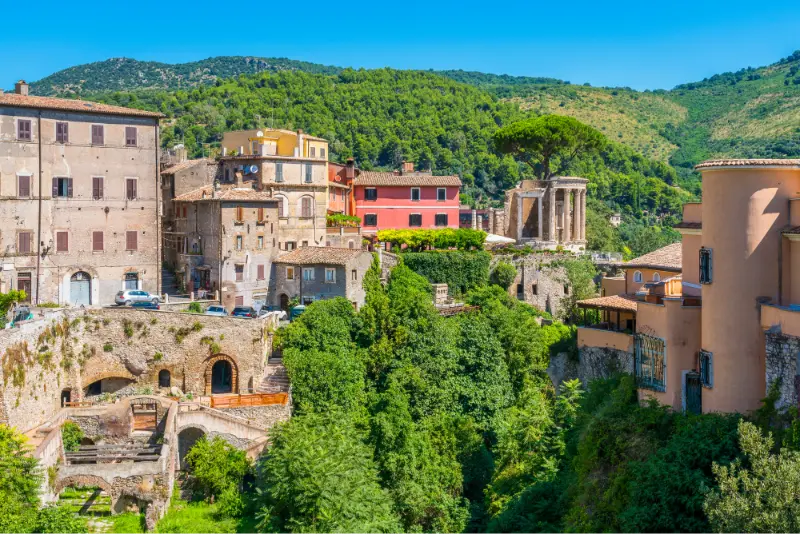
Tivoli is one of the rare day trips from Rome where two world-class sites can fit into the same day, but only if you treat Villa d’Este and Hadrian’s Villa as separate experiences and plan the transfer between them before you arrive.
At a glance
| Best for | Gardens, archaeology and a break from central Rome |
|---|---|
| Time needed | A full day; one night if you want a slower visit |
| Main sights | Villa d’Este and Hadrian’s Villa |
| From Rome | Regional train or bus, then local transport/taxi between sites |
| Best planning rule | Do not try to add every Tivoli attraction in one rushed day |
Why Tivoli is worth leaving Rome for
Rome already contains enough archaeology and art for several trips, so it is reasonable to ask whether Tivoli adds something genuinely different. It does. Hadrian’s Villa is not simply another Roman ruin: it is the remains of an enormous imperial retreat spread across a landscape of pools, residences, service buildings and gardens. Villa d’Este is a very different experience, built around Renaissance architecture, terraces and a theatrical system of fountains. Seeing both in one day creates a strong contrast between imperial Rome and the culture of the Renaissance court.
If you are planning several stops rather than just Tivoli Day Trip from Rome, start with the Rome Travel Guide for a sensible route and transport advice.
Tivoli also changes the pace of a Rome itinerary. After several days of churches, traffic and dense sightseeing, the town gives you open views, greenery and a reason to spend part of the day outdoors. That is why I place it high in the best day trips from Rome in Lazio. It works especially well on a four- or five-day Rome trip, when sacrificing an entire day outside the centre no longer feels expensive.
The mistake most visitors make: treating the two villas as if they were next door
Villa d’Este sits in central Tivoli, while Hadrian’s Villa is outside the historic centre in the Villa Adriana area. On a map the distance does not look dramatic, but walking between them is not the efficient choice for most visitors. Local buses exist, yet frequencies and stop locations can make a tightly timed itinerary fragile. A taxi or carefully checked local bus is usually the practical bridge between the two sites.

This matters because each villa deserves at least two hours, and Hadrian’s Villa can easily absorb three if you enjoy archaeology. Add the train or bus from Rome, lunch, the local transfer and time simply to find entrances, and the day fills itself. The day becomes unpleasant only when you add Villa Gregoriana, the Sanctuary of Hercules Victor, several churches and a long restaurant lunch on top. Those are good reasons to stay overnight rather than evidence that the basic day trip is too short.
How to get to Tivoli from Rome
Regional trains are the most straightforward option for many independent travellers. Services commonly run from Roma Tiburtina toward Tivoli, and the station in Tivoli is within walking distance of the old town and Villa d’Este, although the approach includes slopes and urban streets. Check the exact timetable for your date rather than relying on a screenshot from an older travel article, because regional schedules can change around engineering works and holidays.
Buses from Rome can also be useful depending on where you are staying and which villa you want to visit first. If your main priority is Hadrian’s Villa, a bus-plus-local connection may sometimes be more logical than travelling into central Tivoli and back out again. For a first visit, however, I usually prefer an early train, Villa d’Este or a quick walk through Tivoli first, then a taxi or local bus to Hadrian’s Villa. If you are already travelling through Lazio by car, Tivoli is easier logistically, but parking near the historic centre still deserves advance thought.
A realistic one-day itinerary
Start early enough that you are in Tivoli before the busiest part of the morning. If Villa d’Este is open in the morning on your day, begin there and give yourself roughly two hours for the palace rooms, terraces and gardens. The official VILLÆ website notes that Villa d’Este opens later on Mondays, so a Monday itinerary needs a different order; always check the official VILLÆ opening-times page before fixing transport.
After Villa d’Este, have a simple lunch in Tivoli rather than turning midday into a two-hour event. Then transfer to Hadrian’s Villa and reserve the larger part of the afternoon for the archaeological site. If you reverse the order, visit Hadrian’s Villa first while your energy is high and finish with the fountains and terraces of Villa d’Este. In warm months, that reverse order can work well because the open archaeological site is more exposed to heat than the centre of Tivoli.
Villa d’Este: how to visit rather than just photograph the fountains
The famous fountains are only part of the experience. Begin by noticing how the villa sits above the landscape: the garden is structured as a sequence of terraces, water axes and views rather than a flat collection of decorative features. The Hundred Fountains, the Oval Fountain and the Fountain of Neptune receive most attention, but the pleasure is in moving between shaded paths, sudden vistas and changes in sound. The garden makes more sense when you give yourself time to descend and climb rather than racing directly to the most photographed water features.
Footwear matters because the gardens include slopes, steps and surfaces that can become slippery. In summer, carry water and do not assume the garden will feel cool simply because it is green. The official site publishes seasonal opening hours and any temporary restrictions; use that information on the morning of your visit. If photography is important to you, the earlier part of the day often gives a calmer experience than arriving after lunch with large day-trip groups.
Hadrian’s Villa: think of it as a landscape, not a checklist
Hadrian’s Villa is large enough that trying to identify every structure can make the visit feel like an exam. A better approach is to understand a few anchors: the Maritime Theatre, the Canopus and Serapeum area, the great residential and thermal complexes, and the relationship between formal architecture and the surrounding landscape. The emperor’s retreat was a working complex as well as a place of display, and the less glamorous service areas help explain its scale.
Give yourself more time than you would for a compact museum. Shade is uneven, distances are substantial and the archaeological terrain requires comfortable shoes. The official VILLÆ information specifically advises suitable clothing and footwear because of paths and gradients. If one person in your group has limited mobility, read the accessibility information before travelling and decide whether shortening the route will make the day better.
Should you add Villa Gregoriana?
Villa Gregoriana is beautiful, but adding it to both major villas creates a very different day. The site is a landscape park shaped around waterfalls, woodland paths and the gorge of the Aniene. It involves walking and elevation change, so it is not a quick thirty-minute stop. If nature is more important to you than Roman archaeology, Villa Gregoriana plus Villa d’Este can be an excellent pairing. If this is your first trip to Lazio and you want the strongest historical contrast, I would keep Hadrian’s Villa and Villa d’Este as the core.
An overnight stay makes the three-site version much more enjoyable. Arrive from Rome in the late morning, visit one major site, have dinner in Tivoli, then see the remaining two the following day. That also lets you experience the historic centre after day-trippers leave. You can compare current accommodation in Tivoli on Booking.com, checking the exact address because some properties marketed as Tivoli are outside the walkable centre.
Lunch, coffee and the town itself
Do not treat Tivoli purely as the space between ticketed attractions. The historic centre contains narrow streets, small piazzas and viewpoints that make a short walk worthwhile. For lunch, choose something simple near the centre if you still have Hadrian’s Villa ahead of you. A heavy multi-course meal followed by an exposed archaeological site is rarely the best use of a summer afternoon.
If you stay later, dinner is a better moment to slow down. Lazio cuisine here can include handmade pasta, grilled meats, seasonal vegetables and local products without needing to search for a restaurant described as a hidden gem. I would use recent reviews to check consistency and opening days, then choose a place slightly away from the busiest approach to Villa d’Este. The goal is not to chase a single famous table but to enjoy the town as part of the trip.
Tivoli with children or in hot weather
Families can enjoy Tivoli, but the two villas ask for different kinds of attention. Villa d’Este gives children movement, water and changing spaces; Hadrian’s Villa requires more imagination because the scale is huge and interpretation is less immediate. Rather than forcing a long archaeological circuit, choose a handful of memorable structures and leave while everyone still has energy. A short explanation of who Hadrian was before the visit can make the ruins much more meaningful.
In July and August, heat changes the itinerary. Start with the more exposed site as early as possible, carry water, use hats and sunscreen, and build in shade. Do not count on every fountain or café inside a cultural site being available exactly when you need it. If temperatures are extreme, it is better to see one villa properly and return to Rome than to turn a day trip into an endurance test.
Common planning mistakes
- Booking a late Villa d’Este slot on a Monday without noticing the later opening pattern.
- Assuming Hadrian’s Villa is in central Tivoli and planning to walk there casually.
- Trying to combine both villas, Villa Gregoriana and several minor monuments in one day.
- Leaving Rome without checking seasonal closing times, transport changes or heat conditions.
- Wearing city shoes that are uncomfortable on archaeological paths and garden steps.
The broader lesson is the same one that applies across the Lazio travel guide beyond Rome: distances on a map do not describe the real effort of a day. Build around two strong experiences, not the maximum number of pins you can save. Tivoli is memorable because the atmosphere of the two villas is so different; give that contrast enough time to register.
When to go and when to stay overnight
Spring and autumn are the easiest seasons for a long outdoor day. Summer offers long opening hours and lush gardens but also serious heat, especially at Hadrian’s Villa. Winter can be calm and atmospheric, yet daylight is shorter and weather matters more. Weekdays outside holidays generally make logistics easier, although the exact advantage varies with school groups and events.
Stay overnight if you want to add Villa Gregoriana, if you are travelling with children at a slower pace, if you love gardens and archaeology equally, or if Tivoli is a stop on a wider Lazio road trip. A night here can also be a useful transition between Rome and northern or eastern Lazio. If your trip is only three days in Rome, however, I would usually keep the city itself as the priority and save Tivoli for a longer return.
Final thoughts
A good Tivoli day is not the one with the largest number of attractions. It is the one where Villa d’Este still feels playful rather than rushed and Hadrian’s Villa still feels like an imperial landscape rather than a final obligation before the train. Plan the transfer, check official hours, protect enough time for both major sites and let the town fill the spaces between them.
Last updated: October 17, 2026