
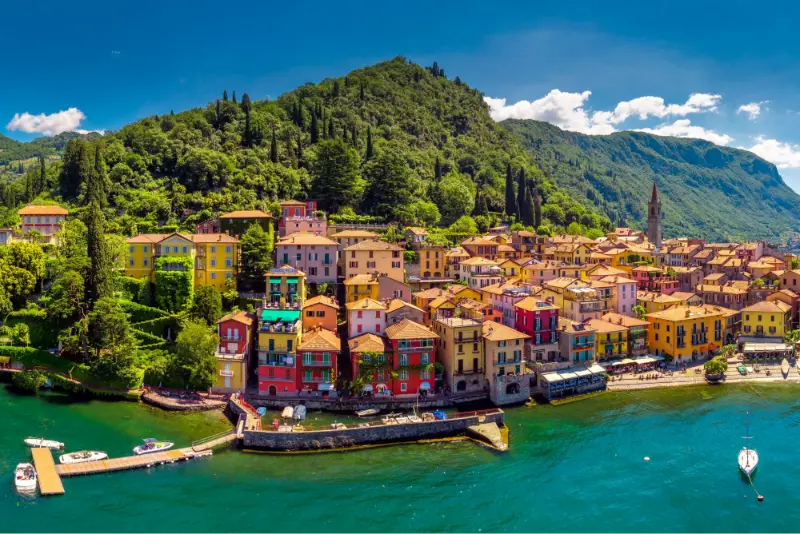
Varenna is one of the most useful places on Lake Como because beauty and transport happen in the same compact village. The railway brings you directly from Milan, ferries cross to Bellagio and Menaggio, and the waterfront, Villa Monastero and historic centre are all reachable on foot. The convenience is real, but so are the steep lanes and heavy midday crowds.
| Best length | Half day to 2 nights |
|---|---|
| Key advantage | Direct train + central ferries |
| Main sights | Villa Monastero, waterfront, Vezio |
| Watch for | Steep paths and crowded platforms |
How this guide fits into a Lake Como trip
Varenna sits on the eastern shore opposite Bellagio and near the centre of the lake. That position makes it a natural interchange between the regional railway and the central ferry network. For travellers without a car, few Lake Como bases offer a better combination.
If this is your first visit to the area, the Lake Como Travel Guide explains the main sights and how to fit them into one trip.
The village is small enough to understand quickly: the station lies above and north of the centre, the ferry pier is near the waterfront, and the old lanes climb behind Piazza San Giorgio. Distances are short, but gradients matter.
Getting there and moving around
Trenord currently advertises direct Milano Centrale–Varenna-Esino trains in roughly 64 minutes with regular hourly departures. The line continues north along the eastern shore, so Varenna can also connect to other lake and alpine destinations.
From the station, follow signed pedestrian routes toward the ferry or centre. With rolling luggage, use the smoother route even if a staircase looks shorter. On peak trains, allow time to leave the platform because many passengers transfer immediately to boats.
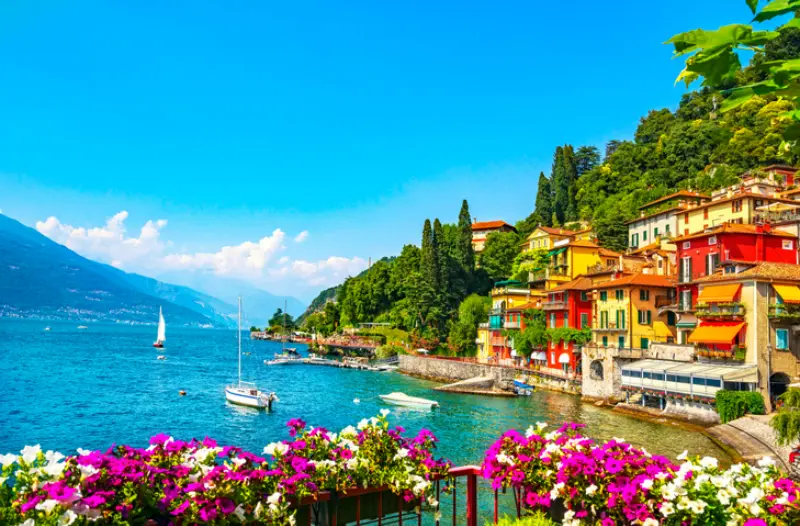
Ferries connect Varenna with Bellagio, Menaggio and Cadenabbia in the central lake. Check whether your service is passenger-only or part of the vehicle ferry network; boarding points and queues can differ.
Walk the waterfront and Passeggiata degli Innamorati
The short waterfront path near the ferry approach is one of Varenna’s signature walks, linking transport with the old village rather than functioning as a separate attraction. Use it slowly and be considerate when the path is crowded because parts are narrow.
Early morning and evening are transformed compared with midday. If you stay overnight, this is where the decision pays off most clearly: the lakefront becomes a place to sit rather than a corridor between tour groups.
Use Piazza San Giorgio as the village centre
The main square provides churches, cafés and orientation before you descend or climb through the lanes. It is a better place to reset the day than trying to navigate every alley from the waterfront.
The historic centre is compact, so resist the urge to rush. Varenna’s appeal lies partly in the sequence of stairs, glimpses of water and small spaces between larger sights.
Visit Villa Monastero for gardens and interiors
Villa Monastero stretches along the lake with a long botanical garden and a house museum. The linear garden rewards time because viewpoints unfold gradually rather than concentrating in one terrace. It is especially strong in spring and early summer when planting becomes part of the experience.
Check the official site for seasonal opening, ticket combinations and temporary closures. If you have limited time, decide in advance whether the garden, interiors or both are your priority.
Climb toward Castello di Vezio only if the route fits you
The castle above Varenna gives a very different perspective, but the climb is not equivalent to a flat village stroll. Wear proper shoes, carry water and allow for heat. Travellers with limited time or mobility can enjoy Varenna fully without treating the castle as compulsory.
The reward is the elevated relationship between Varenna, the central lake and surrounding mountains. On a hazy day, however, the effort may not deliver the same panoramic value.
Use Varenna as a transport base, not just a sight
The combination of station and ferry allows efficient day loops. You can sleep in Varenna, cross to Bellagio in the morning, continue to Menaggio or Tremezzina, then return by ferry without touching a car.
This is why accommodation near the station-pier corridor can outperform a more glamorous property farther uphill. Convenience compounds over several days.
A realistic way to plan your time
For a half-day visit, choose either Villa Monastero or the Vezio climb, not both. Add the old centre and waterfront around that anchor. With a full day, you can do one major sight in the morning, lunch, then a short ferry crossing or relaxed village time.
With two nights, use Varenna as a base for a central-lake day and keep one early morning for the village itself. That is more satisfying than trying to sleep in three different towns.
Where to stay and who this base suits
Stay close to the station and ferry if you will make daily excursions. Stay closer to Piazza San Giorgio if evenings in the old centre matter more. Hill properties can have exceptional views but ask about steps before booking.
Varenna is particularly strong for solo travellers, couples and anyone arriving by train. Families with strollers should study the route carefully because the village is visually compact but physically steep.
Food, coffee and sensible breaks
Waterfront restaurants fill quickly at lunch. If your ferry schedule is tight, eat earlier or choose a place away from the immediate pier. Dinner is calmer once day-trip traffic falls, which is another reason an overnight stay changes the experience.
Pack water before the castle climb and do not rely on finding a shop at exactly the point you become thirsty. In the centre, cafés are plentiful enough for flexible breaks.
Best season and weather strategy
Spring and early autumn are especially good for walking and gardens. Summer maximises transport but also heat on the climb to Vezio and crowd pressure around the station and ferry.
In winter, verify Villa Monastero and other seasonal sites before travelling. Varenna remains beautiful, but the trip becomes more about scenery and quiet than a full attraction schedule.
Crowds, queues and timing
The train-to-ferry transfer creates predictable surges. If you are not catching an immediate boat, let the crowd move first and enjoy the waterfront later. At departure time, reach the platform early because long weekend trains can be busy.
Villa Monastero is easier to appreciate near opening or later in the day than during the densest arrival window. Use transport knowledge to shift your sightseeing hours.
Families, mobility and slower travel
Children who like trains and ferries often enjoy Varenna, but steep stairways can tire them quickly. Build the day around one climb, not several. A simple boat ride can be the main activity rather than filler between adult sights.
Mobility-limited travellers should prioritise the station-pier-waterfront corridor and confirm access to specific attractions. The old centre contains unavoidable gradients in some routes.
Budget and booking priorities
Varenna can be expensive to sleep in, but it may save money and time by eliminating taxis or car rental. Calculate the whole trip, not only the hotel rate. A well-located room can turn three transport days into easy walks.
Book accommodation and any must-do villa entry first. Ferries are important, but most ordinary travel planning should remain flexible around weather.
Common planning mistakes
Do not assume “Varenna-Esino” means the station is in a different town far away; it is the useful rail stop for Varenna. Conversely, do not underestimate the walk between the platform, ferry and a hill hotel when carrying bags.
Avoid combining Villa Monastero, Vezio, Bellagio and Menaggio in one short day. That schedule produces transport anxiety instead of a lake holiday.
How to combine this with the rest of the lake
Cross to Bellagio for the classic promontory experience or to Menaggio for the western-shore promenade and mountain access.
For a completely car-free trip, continue with Lake Como Without a Car and the ferry guide.
Extra practical details that make the trip easier
Before departure, save the current ferry and train information offline and take a screenshot of the last useful connection for your route. Mobile coverage is generally good, but a delayed boat or a crowded platform is easier to manage when you already know the next realistic alternative. On Lake Como, a plan that has one backup connection is usually more robust than an itinerary timed to the minute.
Pack for elevation as well as the waterfront. Even on a warm day, shaded ferry decks, evening breezes and hill paths can feel noticeably cooler than the promenade. Shoes with grip matter on stone steps and sloping lanes, while a refillable bottle is useful because the most scenic walking sections are not always the places where you want to stop simply to buy water.
If photography matters, use the first and last hours of the day rather than blocking narrow lanes at midday. The lake changes with cloud, haze and boat movement, and the best view is often the one found while waiting rather than the most famous social-media pin. Respect private entrances, hotel terraces and residential stairways; beautiful architecture does not make every doorway a public viewpoint.
Leave at least one uncommitted hour in the day. Ferry services can run on time and still produce queues, and a villa visit may take longer than expected because the gardens invite slow walking. The spare hour is not wasted time: it is what allows an aperitivo, a swim stop where permitted, or a waterfront bench without turning the next reservation into a sprint.
For luggage, verify storage rather than assuming every small station or pier has lockers. If changing hotels, ask your accommodation whether it can hold bags before check-in or after check-out. Carrying a suitcase over cobbles, stairways and crowded boats can turn a simple transfer into the hardest part of the trip, especially in Varenna and other compact villages with steep lanes.
Tours and tickets: when booking adds value
A guided experience is most useful when it solves a real problem: limited time, difficult transport, a villa with controlled access, or the need for historical interpretation. Compare meeting points, cancellation terms and whether ferry or entrance tickets are actually included rather than assuming every Lake Como tour covers the same route.
Where to stay
Accommodation prices around Lake Como move sharply with weekends, weddings and the warm-season peak. Compare location against ferry and rail access, not just the nightly rate. Compare hotels and apartments for this Lake Como stay and check the exact walking route from the station or pier before booking.
Useful official sources
- Navigazione Laghi – Lake Como tickets and timetables
- Trenord – regional trains in Lombardy
- Varenna official tourism
- Villa Monastero official site
Final planning advice
Lake Como rewards selective planning. Choose one or two anchor experiences, leave space for the lakefront and ferry views, and build the day around the actual transport timetable. That approach produces a calmer trip than trying to collect every famous village in a single sweep.
Last updated: October 17, 2026