

Civita di Bagnoregio is visually spectacular, but the most rewarding visit begins before you cross its famous footbridge: the wider landscape of the calanchi, the town of Bagnoregio and the fragile geology are part of the experience, not just the backdrop to a photograph.
At a glance
| Best for | Landscape, medieval atmosphere and a distinctive Tuscia day |
|---|---|
| Access | On foot via the pedestrian bridge |
| Time needed | 3–4 hours for Civita and Bagnoregio; longer with nearby stops |
| Car needed? | Strongly recommended for a wider Tuscia itinerary |
| Best planning rule | Arrive early or stay late enough to experience the village between peak visitor waves |
Why Civita needs more context than a viewpoint photo
Civita rises from a tuff plateau cut away by erosion, surrounded by the clay ridges and valleys known as calanchi. The bridge makes the village look isolated, but its story is really about the unstable relationship between settlement and geology. Erosion, landslides and human intervention have shaped the place for centuries. Once you understand that, the nickname often translated as ‘the dying town’ stops being a marketing slogan and becomes a description of a genuinely vulnerable landscape.
That context matters because the modern visitor experience can otherwise become very thin: park, photograph, cross, buy something, leave. Slow down enough to look from Bagnoregio’s belvedere before the bridge, notice the layers of rock below the houses and use the visit as an introduction to northern Lazio rather than a self-contained social-media stop. It fits naturally with Viterbo and Lake Bolsena.
How access works
Civita is reached on foot across the long pedestrian bridge from the Bagnoregio side. There is no normal visitor traffic driving into the village, which is part of what preserves the atmosphere but also makes the physical approach unavoidable. The bridge climbs toward the gate, and the gradient can feel demanding in heat, with luggage or for anyone with limited mobility.
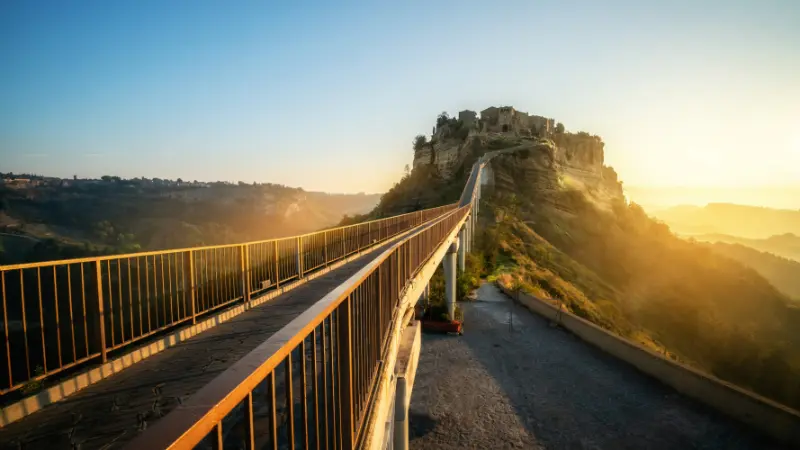
Access is managed through a paid-entry system whose price and hours can change with season, events and local decisions. Check the official local information shortly before travelling rather than copying a number from an older article. The regional tourism page for Bagnoregio and Civita is useful for orientation, while local municipal or ticketing pages should be treated as the live source for access arrangements.
Getting there from Rome, Viterbo or Orvieto
Civita is not a simple direct-train day trip. From Rome, public transport normally means combining rail and bus connections, often through Viterbo or Orvieto depending on the route. Timetables can be sparse enough that a missed connection changes the entire day. For that reason, a rental car or organised transfer is far more practical when Civita is one stop in a larger Lazio itinerary.
From Viterbo, driving is straightforward and lets you combine Civita with Lake Bolsena, Montefiascone or another Tuscia stop. From Orvieto, the road distance is also modest, which is why Civita sometimes appears in Umbria itineraries even though it lies in Lazio. If you use public transport, plan the return first: know the last realistic bus connection before you cross the bridge.
Where to park and what the approach feels like
Parking areas are on the Bagnoregio side, not at Civita itself. From parking, you walk through or around Bagnoregio toward the viewpoint and bridge. Depending on which lot you use, the total walking distance can be substantial before you even begin the final climb. Small shuttle services may operate under local arrangements, but availability should be checked rather than assumed.
This is why comfortable footwear matters. The bridge is modern but exposed, the village streets are uneven and the approach includes slopes. In summer, carry water before starting. In rain or strong wind, slow down and treat the exposed crossing seriously. The walk is part of the visit; it should not be squeezed into a ten-minute gap between parking and a lunch reservation.
What to see inside Civita
Enter through Porta Santa Maria and resist the urge to race straight to the central square. The scale is small, so the interest lies in details: stone doorways, tiny lanes, gardens glimpsed through gates, views that open unexpectedly toward the valley and the way buildings sit directly on the tuff. The Church of San Donato anchors the main piazza, but the village is best understood by walking beyond it.
Because the settlement is compact, two hours can feel generous on a quiet day and too short on a crowded one. The difference comes from pace. Sit for coffee, look from more than one edge of the plateau and let the streets empty slightly between groups. If you visit only to reproduce the famous bridge photograph, the experience can feel disproportionately expensive and crowded; if you engage with the landscape, it becomes much richer.
Do not skip Bagnoregio
Bagnoregio is the functional town next to Civita and deserves at least a short walk. The historic centre, cathedral and local streets help correct the impression that the area is only a single suspended village. San Bonaventura was born here, and the town maintains religious and civic traditions that continue independently of tourism to Civita.
Spending lunch in Bagnoregio can also be more comfortable than insisting on eating inside Civita at the busiest hour. Restaurants and shops are more numerous, and you can return to the viewpoint later when visitor patterns change. A slow itinerary sees Bagnoregio and Civita as two connected places rather than treating one as a car park for the other.
The calanchi landscape
The clay gullies around Civita are not just scenic decoration. They are active geomorphological formations shaped by water, wind and slope instability. The contrast between the harder volcanic tuff supporting the settlement and softer surrounding materials helps explain why the plateau appears so dramatically isolated. This is also why preservation is complex and why visitors should remain on authorised paths and respect barriers.
If you enjoy landscape photography, conditions change significantly across the day. Morning light can reveal texture in the valley, while late afternoon produces long shadows and a warmer colour on the rock. Mist and winter weather create an entirely different atmosphere. Do not climb onto unstable edges or leave marked viewpoints for a better photograph; erosion is not an abstract story here.
Best time of day and season
Early morning and later afternoon generally give the best chance of experiencing Civita with more space, especially in spring and autumn. Midday is often when organised groups and day-trippers overlap. In summer, the bridge and exposed viewpoints can be extremely hot, so early arrival improves comfort as well as atmosphere.
Winter can be beautiful and quiet, but weather becomes more important. Rain, fog and wind can affect visibility and walking conditions. Spring brings green valleys; late summer and autumn change the colours of the calanchi. Weekdays outside holidays are usually calmer than weekends. If your schedule allows an overnight stay nearby, seeing the area outside peak hours is the strongest reason to sleep locally.
Where to stay
You can stay in Bagnoregio, in countryside accommodation nearby or use Viterbo as a larger base. Bagnoregio is best when Civita itself is the priority and you want to walk to the viewpoint early. Viterbo offers more restaurants, transport and evening activity. Rural agriturismi are attractive for a driving itinerary but can be isolating without a car.
Compare current accommodation around Bagnoregio on Booking.com and read the map carefully. Properties may use Civita in their marketing even when they are several kilometres away. If you are carrying luggage, remember that visitor access to the historic village itself is pedestrian and may not suit a normal hotel-transfer routine.
What to combine with Civita
Lake Bolsena is one of the most natural additions because it gives the day a completely different landscape without requiring a return toward Rome. Bolsena town, Montefiascone, Marta and Capodimonte all work in wider itineraries, though not all belong in the same day. Viterbo is another strong pairing for an overnight base, while Orvieto can make sense geographically on a route toward Umbria.
If you only have a single day from Rome, combining too much reduces the visit to logistics. Civita plus a relaxed lunch and one lake stop is enough. For a multi-day road trip, build a triangle around Viterbo, Civita and Lake Bolsena. The Lazio travel guide explains how these places fit into a broader regional route.
Civita with children or limited mobility
Children often enjoy the bridge and compact medieval streets, but the approach can be tiring in heat. Carry less than you think you need, schedule breaks and avoid the hottest part of the day. Strollers are possible on some surfaces but awkward on slopes and uneven paving; a carrier may be more practical for very young children.
Visitors with limited mobility should research current access assistance before travelling. The final bridge is a real gradient, not a symbolic inconvenience, and historic streets add further unevenness. Do not assume that a short distance on a map means an easy physical visit. Local services and accessibility arrangements may evolve, so contact the destination directly if step-free access is essential.
Common mistakes to avoid
- Arriving at noon in July and underestimating the exposed uphill bridge.
- Assuming a train takes you directly to Civita di Bagnoregio.
- Visiting only for the bridge photograph and ignoring Bagnoregio and the calanchi.
- Trying to combine Civita, Viterbo, Bolsena and Orvieto in one rushed day.
- Booking a “Civita” accommodation without checking its actual location and luggage access.
Civita is small, but the experience is not. The approach, geology, surrounding town and northern Lazio context are what prevent the visit from becoming a fifteen-minute photo stop. Treat the bridge as the beginning of the story, not the whole story.
Final thoughts
Civita di Bagnoregio is worth visiting when you give the landscape as much attention as the village. Arrive outside peak hours, walk the approach consciously, spend time in Bagnoregio and use the trip as a doorway into Tuscia rather than racing back to Rome as soon as the photograph is taken.