
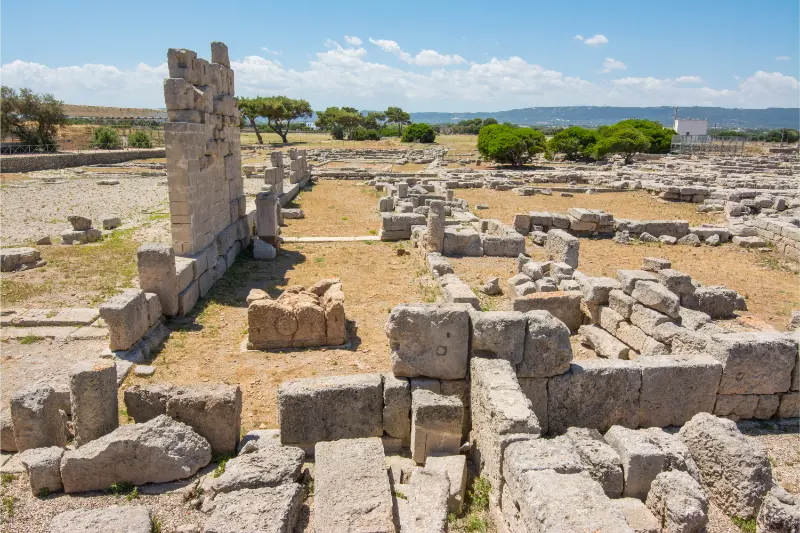
Scolacium is one of the most rewarding archaeological landscapes in southern Italy for travelers who want to see history in its physical setting rather than only behind museum glass. Near Roccelletta di Borgia on Calabria’s Ionian side, the park brings together evidence of a Greek settlement, a Roman city, a dramatic Norman basilica and later agricultural life. Ancient theaters and monumental fragments stand within a landscape famous for its olive trees. The result is beautiful, but it can be confusing if you expect every period to be displayed in a single chronological row. This guide explains what to look for, how the city changed over time, why the basilica matters and how to plan a visit responsibly when museum access or restoration conditions change.
In this guide
- What is Scolacium and where is it?
- From Greek Skylletion to Roman Scolacium
- The Roman theater: the site’s great outdoor landmark
- The amphitheater and the Roman city’s public spaces
- Portraits, sculpture and the museum collections
- The Norman basilica at Roccelletta
- Olive trees, the Mazza estate and industrial archaeology
- How to organize the visit efficiently
- Admission, hours and the need to confirm closures
- Reaching Scolacium from Catanzaro and the coast
- What to pair with a visit to Scolacium
- Accessibility, climate and family learning
- The value of a careful, unhurried visit
- Frequently asked questions
What is Scolacium and where is it?
The national archaeological park lies in the territory of Borgia, close to Roccelletta on the Ionian coast of the Catanzaro area. The Ministry of Culture identifies it as the Museo e Parco archeologico nazionale di Scolacium. This exact name matters when planning transportation, because ‘Borgia,’ ‘Roccelletta’ and ‘Scolacium’ may produce different navigation results. The visitor entrance is not necessarily in the historic center of Borgia or at a nearby beach. Check the official address and current arrival instructions before setting off.
Our Calabria travel guide places Scolacium Archaeological Park in the context of the wider region, including travel times and alternative bases.
Scolacium is not just a Roman theater in a picturesque olive grove. Its sequence stretches from the earlier Greek city traditionally called Skylletion through Roman redevelopment and later medieval use of the location. A modern traveler sees only parts of that long sequence, but the layering is the attraction. Give yourself time to identify which ruins belong to which period; it changes the entire experience from a pleasant walk to a meaningful encounter with Calabria’s history.
From Greek Skylletion to Roman Scolacium
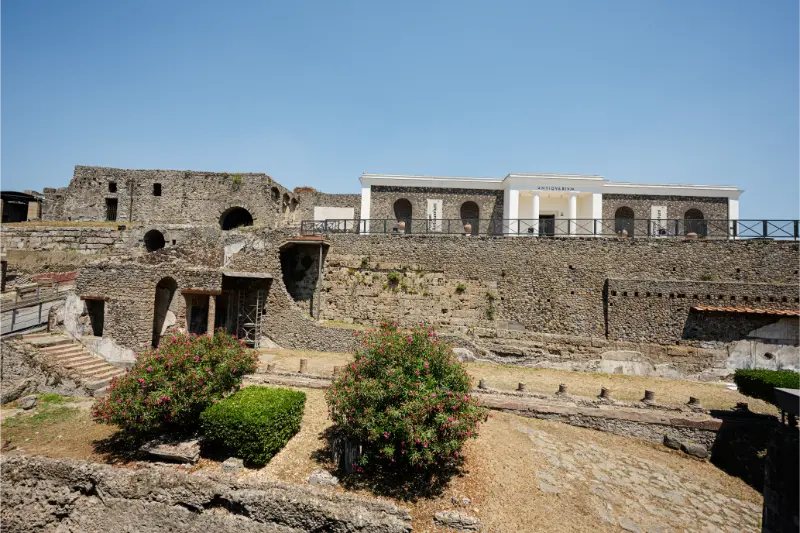
Ancient sources associate the area with Skylletion, a Greek settlement whose origin was later surrounded by foundation traditions. The Ministry notes the later Roman colony of Minervia Scolacium, developed after the wars that transformed southern Italy’s political landscape. Roman imperial investment brought important public buildings, including the theater and amphitheater. These layers tell a story of continuity and change rather than a simple replacement of one culture by another overnight.
When looking at the ruins, distinguish what archaeology securely documents from legendary attributions to Greek heroes. Founding stories are part of the ancient imagination, but they should not be presented as modern historical fact. The more useful question is how the coastal settlement connected with routes, agriculture and political centers during different periods. The transition to Roman urban life affected public architecture, commemorative sculpture and the organization of civic space. A guided interpretation can make those changes easier to visualize.
The Roman theater: the site’s great outdoor landmark
The theater is one of Scolacium’s most recognizable surviving structures. Its curved seating form and architectural footprint help visitors understand where public performances and civic gatherings took place. Imagine the relationship between spectators, stage structures and the surrounding city rather than focusing only on how many seats were once available. In archaeological parks, reconstructed diagrams are often more informative than attempts to walk through every ruined tier.
Stay on designated visitor paths. Some stones may be loose and particular sections can close for safety or preservation. An ancient theater is not an unrestricted amphitheater for climbing or dramatic photo poses. From approved viewpoints, the structure’s geometry is already legible, and the olive groves around it create a striking visual relationship between archaeological and agricultural landscapes. If tours are offered, ask how the theater’s date and later modifications have been established.
The amphitheater and the Roman city’s public spaces
The archaeological record also includes an amphitheater and other public monuments, though the degree to which each area is visible can change. An amphitheater served different events from a theater, and it is worth learning to distinguish the two in Roman urban life. They are not interchangeable labels for any circular-looking ruin. The park also preserves evidence of commemorative buildings, inscriptions and statuary associated with civic representation in imperial times.
If one monument is inaccessible, use the museum’s interpretation or site panels to understand its position within the city. The surviving remains may be lower than expected, but foundations and fragments can still reveal a deliberate public plan. Avoid claiming that every ancient road has been fully reconstructed. Archaeology proceeds by excavated evidence and scholarly interpretation, often across multiple campaigns. The park is a place of ongoing research, not a fixed display finalized decades ago.
Portraits, sculpture and the museum collections
The archaeological museum has displayed finds ranging across many centuries of local occupation, including Roman portrait sculpture and objects illuminating everyday life. The Ministry describes notable sculptural material and an unusual colossal bronze forearm among the finds. These objects can help visitors understand the scale of public representation and the connection between monumental architecture and political imagery. They also show why museum time complements, rather than duplicates, the outdoor walk.
Crucially, museum access has at times been affected by renovation projects. The Ministry’s published visitor notices have described temporary closures of museum spaces while the park continued to welcome visitors. Do not assume a museum gallery is open simply because the overall site is listed as open. If a particular sculpture is central to your trip, contact the institution to confirm its display status. Allow yourself to enjoy the outdoor archaeology even if a museum room is closed, without pretending that the two experiences are identical.
The Norman basilica at Roccelletta
One of the park’s most memorable features is the ruined Norman basilica, often called the Basilica della Roccelletta. It introduces a much later chapter in the site’s history. The Ministry dates its development to the Norman era, when this area again played a role in the cultural and religious geography of the region. The surviving walls can appear startlingly large against the landscape, making the basilica an evocative contrast to the low Roman remains.
Look for the relationship between scale, surviving openings and the building’s setting. The structure draws on a different architectural world from the theater, yet it occupies territory with a long earlier history. This does not mean the basilica was simply built as part of Roman Scolacium; it reflects a later society using an important location. Stay outside fenced or unstable areas, and do not climb masonry. A photograph from a safe marked point can show the walls’ monumental presence more effectively than standing inside a restricted section.
Olive trees, the Mazza estate and industrial archaeology
Scolacium’s landscape is distinctive because the ruins sit among extensive olive trees. These groves are not decorative park landscaping alone: they connect the modern visitor to centuries of agricultural use. The Ministry also describes the former Mazza estate and a twentieth-century oil mill that adds an industrial-heritage layer to the complex. If the mill interpretation is available, it can help explain how the land continued to produce and support communities long after the classical city changed.
The olive grove can be an atmospheric walking environment, but remember that trees and agricultural structures require care. Stay on visitor paths, do not climb the trees and do not treat working or conserved equipment as a playground. In bright summer light the site can be exposed despite the groves, so bring water and a hat. The important insight is that Scolacium is not an isolated ruin preserved on empty land; its history includes the productive landscape that surrounded it across many centuries.
How to organize the visit efficiently
If the museum is open, begin with the orientation displays to understand the chronology. Then walk the designated outdoor route from the Roman remains toward the great basilica, pausing at interpretation panels. If museum access is unavailable, begin with the official site map and focus on identifying the theater, monumental areas and medieval church. Allow a generous half day rather than racing through in an hour. Uneven ground, photographic stops and summer heat can all slow the visit.
You do not need to inspect every stone individually. Concentrate on three contrasts: Greek versus Roman urban history, Roman public life versus Norman religious architecture, and archaeology versus later olive cultivation. These themes provide a clear narrative for visitors unfamiliar with classical history. If a guided tour is offered by authorized staff or qualified local guides, it may be especially helpful because the visible fragments can be difficult to connect without explanation.
Admission, hours and the need to confirm closures
The Ministry of Culture provides the official listing for Scolacium, including contact information and current opening updates. Historical web pages can show ticket prices or hours that are no longer reliable, particularly when galleries close temporarily for improvements. Check the actual status close to your visit, and distinguish access to the archaeological park from access to the museum and oil-mill displays. Never state a future ticket price as if it were fixed.
If traveling with a group, enquire about educational tours and accessibility options in advance. Some official listings may indicate that advance booking is not generally required, but special events and guided services can have different arrangements. Allow time for ticketing, restrooms and orientation. For a planned visit in 2028, rules published in 2026 are valuable context but cannot guarantee what will be open two years later. The appropriate editorial approach is to link visitors to the institution rather than offering false certainty.
Reaching Scolacium from Catanzaro and the coast
A car is often the simplest way to reach the park and combine it with other parts of the Ionian coast. Use the museum’s precise address near Roccelletta di Borgia rather than navigating to Borgia’s upper town. Road works or temporary event arrangements may change parking, so follow current signs. Do not stop on a highway shoulder because a map makes the ruins seem close. Arrive early enough to locate a proper entrance before the hottest part of the day.
If you are staying in Catanzaro or Catanzaro Lido without a car, research actual local bus or taxi options. The presence of urban services in the wider area does not mean a frequent bus stops beside the park gate. Confirm both outbound and return routes before leaving, especially on Sundays or holidays. A prearranged return transfer may be sensible if the site has limited public transport. Comfortable walking shoes are essential even if transport delivers you close to the entrance.
What to pair with a visit to Scolacium
The most natural companions are other stops in the Catanzaro Ionian area, such as a relaxed meal by the water, a town walk or nearby cultural heritage. If you enjoy archaeology, Kaulon and Locri make excellent thematic comparisons on a wider regional itinerary, but their distances mean they deserve separate days rather than a frantic sequence. Scolacium’s special quality is its long chronology in one place; rushing elsewhere immediately can diminish the impact.
A good day could begin at the park, continue with lunch in the Catanzaro Lido area and finish with a modest seaside walk. Alternatively, spend longer on a guided archaeological visit and keep the afternoon free. Families often appreciate the second approach because children may need a break after uneven outdoor walking. If your schedule includes a major evening commitment, do not underestimate travel time on busy coastal roads during summer.
Accessibility, climate and family learning
The park is an outdoor heritage landscape with potentially uneven surfaces, changing levels and exposed stretches. Ask the institution which areas have accessible routes and whether a visitor with limited mobility can see the major landmarks. A wheelchair-friendly entrance does not mean every ruin is reachable without obstacles. Similarly, parents with strollers should check the terrain and may prefer a baby carrier for some sections, provided conditions are safe.
For children, turn the visit into a comparison of building types: what happens in a theater, what an amphitheater was used for and why a medieval basilica looks different. Use the olive groves to talk about how land keeps changing purposes over time. In hot weather, take frequent water breaks and avoid the most exposed hours where possible. After rain, stone surfaces and earth paths may become slippery. Stay within open visitor areas even if an enticing ruin is visible beyond a barrier.
The value of a careful, unhurried visit
Scolacium rewards visitors who accept that history is not always neatly restored for them. Greek, Roman, Norman and later agricultural evidence coexist, and not every fragment has a simple explanation. Read the site’s official material, ask qualified guides about uncertainties and resist attractive but unsupported legends. The park is also an active conservation environment, so closures and protective measures are signs that its heritage is being cared for.
Take photographs respectfully, leave archaeological material untouched and avoid encouraging others to enter off-limits spaces. The basilica may become your favorite image, but the museum objects, theater and olive-mill story give that image depth. A visit that considers all those layers provides a far richer understanding of Calabria than the idea that its past is limited to classical ruins or picturesque medieval villages. Scolacium is both, and much more, in one remarkable landscape.
At a glance
| Destination | Roccelletta di Borgia, Calabria |
| Main attraction | Roman theater and monumental remains in olive groves |
| Other periods | Greek Skylletion and the Norman Roccelletta basilica |
| Complement | Museum collections and former Mazza olive mill if open |
| Watch out for | Separate museum closures and uneven outdoor ground |
| Time to allow | A generous half day for the main visit; extend it for a second stop |
Related Calabria guides
- Calabria Travel Guide: Where to Go, Stay and How to Plan
- Catanzaro: Historic Streets, Views and the Ionian Waterfront
- Ancient Locri Epizefiri: Greek Ruins and Archaeological Museum
- Crotone and Capo Colonna: Greek Heritage on the Ionian Coast
Official information and travel planning
Confirm access, visitor arrangements and protected-area rules at the relevant official sources before departing: cultura.gov.it, cultura.gov.it.
Frequently asked questions
Where is Scolacium?
The national archaeological park lies near Roccelletta di Borgia on the Ionian side of the Catanzaro area.
Is it only a Roman archaeological site?
No. It preserves Greek, Roman, Norman and later agricultural history in one landscape.
Can I enter the museum as well as the park?
Museum spaces may close separately for restoration. Verify current Ministry of Culture notices.
Is the Norman basilica part of the visit?
Yes, the impressive basilica ruins are one of the most distinctive later features of the park, subject to site route restrictions.
How long should I allow?
Allow a generous half day to see the outdoor monuments and museum collections when accessible.
Last updated: October 17, 2026