

Choosing where to stay on Lake Como is primarily a transport decision disguised as a hotel decision. The towns are not interchangeable: some have railway stations, some depend on ferries and buses, some are steep, and some place the most famous villas directly outside your door. Pick the base that makes your priority day easiest, not the one with the prettiest single photograph.
| Best for easiest arrival | Como |
|---|---|
| Best for rail + central ferries | Varenna |
| Best iconic village feel | Bellagio |
| Best flatter western-shore base | Menaggio |
| Best for villas | Tremezzina |
How this guide fits into a Lake Como trip
Como is a small city at the southwest end of the lake, with rail links, a large hotel market and urban services. Varenna is a compact east-shore village on the railway and faces Bellagio and Menaggio across the central lake. Bellagio occupies the famous promontory but has no railway station. Menaggio sits on the western shore with central ferry connections. Tremezzina stretches through several western-shore hamlets near major villas.
For a fuller understanding of the surrounding area, use our Lake Como Travel Guide alongside these more focused recommendations.
This means hotel value cannot be judged only by room quality. A cheaper room that requires two buses and a long uphill walk every day can cost more in time and energy than a more expensive place near the pier. Always map the journey from the exact accommodation to the first transport you expect to use each morning.
Getting there and moving around
For an evening arrival from Milan, Como is the simplest low-stress option because the train brings you into a functioning city with taxis, restaurants and multiple stations. Varenna is also straightforward by direct regional train, but the final walk can involve slopes and steps depending on the property.
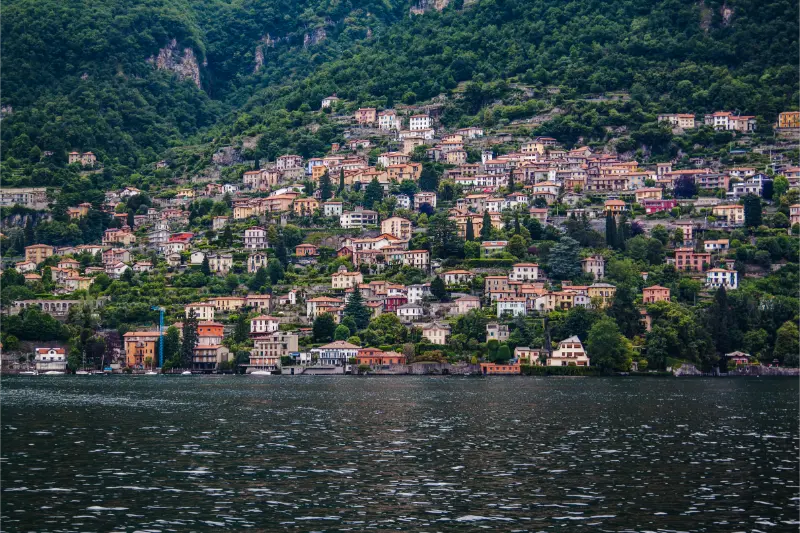
Bellagio is usually reached by boat, bus or road. Menaggio and Tremezzina depend on western-shore road and ferry links. If you are carrying large luggage, do not assume a short distance on the map means an easy transfer; lakeside villages often separate roads, piers and hotels vertically.
If you are arriving through Milan, the Milan airports and transfers guide helps you decide whether to sleep in Milan first or continue directly to the lake.
Como: best for infrastructure and a mixed city-lake trip
Choose Como when your schedule is short, you arrive late, you want many restaurants, or you prefer a city base with a cathedral, museums and the Brunate funicular. It also gives you a straightforward Milan connection and plenty to do if rain makes a full boat day unattractive.
The trade-off is distance from the central-lake triangle. You can reach Bellagio by boat, but the journey itself is part of the day rather than a quick transfer. Read the Como city guide if you want to make the base part of the holiday rather than just a dormitory.
Varenna: best for car-free central-lake access
Varenna is unusually strong for a first car-free stay because the railway and ferry network meet in one small village. You can arrive directly from Milan, cross to Bellagio or Menaggio, visit Villa Monastero and walk the historic centre without using a car.
The disadvantages are steep lanes, limited space and intense daytime crowds. Accommodation supply is smaller than Como, so prices rise quickly on popular dates. A room near the station may be practical; a room high above the centre may have a spectacular view but require a climb every time you return.
Bellagio: best when the iconic setting is the point
Bellagio works when you actively want to wake up in the village that many day visitors only see at midday. Early morning and evening are the reward: the waterfront is calmer, the lanes feel more residential, and dinner no longer has to fit around a return ferry.
The trade-off is arrival complexity. There is no train station in Bellagio, so every stay involves boat, bus, taxi or car at some stage. If your itinerary includes frequent train travel to other parts of Lombardy, Varenna or Como may be more efficient.
Menaggio: best for a practical western-shore base
Menaggio has a broad lakeside promenade, a usable town centre and frequent central-lake connections. It can feel less vertically constrained than Varenna and gives quick access by ferry to Bellagio and Varenna while keeping you on the western shore for hikes and road connections.
It is a strong choice for travellers who want a relaxed base rather than the most photographed village. The tourist office publishes local walks and mountain itineraries, making Menaggio useful for stays that mix ferry sightseeing with active days.
Tremezzina: best for villas and the Greenway
Tremezzina is the name for a group of western-shore communities including Tremezzo, Lenno, Mezzegra and Ossuccio. Staying here puts Villa Carlotta, Villa del Balbianello, the Greenway and Isola Comacina close to your daily route.
The area is more linear than a single compact town centre, so exact location matters. A hotel described simply as “Tremezzina” may be perfect for one attraction and inconvenient for another. Check the nearest ferry pier, bus stop and gradient before booking.
A realistic way to plan your time
For a two-night first trip, choose either Como or Varenna and avoid changing hotels. For three or four nights, one central-lake base is still usually enough unless you deliberately want both a city experience and a villa-heavy western-shore stay.
Split stays make more sense when you have five nights or more, or when the second base removes a difficult onward transfer. Moving every night creates luggage friction and steals the quiet morning hours that are one of the reasons to sleep on the lake.
Where to stay and who this base suits
Couples seeking atmosphere often gravitate toward Bellagio or Varenna; families may prefer a flatter location near a promenade and easy meals; rail-focused travellers usually benefit from Como or Varenna. Hikers can use Menaggio or northern-lake bases depending on the trail network they want.
Do not filter by “lake view” before transport. A partial-view room two minutes from the pier can produce a better trip than a dramatic terrace that requires a steep 20-minute climb after every dinner.
Food, coffee and sensible breaks
The busiest waterfront strips can be convenient but noisy. If dinner quality matters, walk away from the most photographed square and compare menus. In smaller bases, reserve the restaurants you care about on Friday and Saturday nights because the number of tables is finite.
Self-catering can work well for breakfast and picnic supplies, but verify supermarket opening hours and the uphill return to your accommodation. On arrival day, a nearby café and simple dinner are often worth more than saving a few euros through an extra bus ride.
Best season and weather strategy
Summer maximises ferry frequency and outdoor dining but also hotel rates and crowds. Shoulder seasons can be excellent for gardens and walking, with cooler evenings and a greater chance of rain. Winter is peaceful but some hotels, restaurants and attractions close or reduce hours.
A base with indoor alternatives matters more outside summer. Como has museums and urban choices; small villages can become very quiet. Choose atmosphere intentionally rather than interpreting seasonal quiet as poor planning after you arrive.
Crowds, queues and timing
In Bellagio and Varenna, midday crowding can make central lanes feel completely different from early morning. Staying overnight lets you shift key walks to quiet hours and use the busy middle of the day for a ferry, long lunch or garden.
At check-in, ask about the exact pedestrian route from the pier or station. Hotel websites sometimes show linear distance, while the real path includes staircases or cobbled climbs that matter with luggage.
Families, mobility and slower travel
Families should prioritise room space, easy dinner options and a manageable walk from transport. Menaggio and Como can be easier for strollers in central areas, while Varenna and Bellagio include steep lanes and steps. A child who enjoys ferries may still tire quickly after repeated uphill walks.
Travellers with limited mobility should request precise access information from the hotel, including lifts, entrance steps and taxi drop-off. “Accessible room” does not automatically mean the route from the public pier is step-free.
Budget and booking priorities
Lake-view premiums can be substantial. Consider whether you will actually spend daytime hours in the room. A garden or side-street room can fund a villa visit, better dinner or an extra night, which may add more value than a balcony used for ten minutes.
Book accommodation before optional tours on peak dates. The best-located rooms disappear earlier than ordinary ferry capacity, and a poor base can distort every subsequent transport decision.
Common planning mistakes
Do not choose Bellagio merely because it is the most famous name, and do not choose Como merely because it is the easiest train. Match the base to your priority experiences. Fame and convenience are different criteria.
Avoid moving luggage across the lake during the busiest hour if you can. Check out, store bags when possible, enjoy the morning, then transfer after the main day-trip surge.
How to combine this with the rest of the lake
Use Lake Como Travel Guide for the overall geography and Lake Como Without a Car if rail and ferry access will drive your decision.
Once you choose a base, the individual guides to Varenna, Bellagio, Menaggio and Tremezzina help turn that decision into realistic day plans.
Tours and tickets: when booking adds value
A guided experience is most useful when it solves a real problem: limited time, difficult transport, a villa with controlled access, or the need for historical interpretation. Compare meeting points, cancellation terms and whether ferry or entrance tickets are actually included rather than assuming every Lake Como tour covers the same route.
Where to stay
Accommodation prices around Lake Como move sharply with weekends, weddings and the warm-season peak. Compare location against ferry and rail access, not just the nightly rate. Compare hotels and apartments for this Lake Como stay and check the exact walking route from the station or pier before booking.
Useful official sources
- Navigazione Laghi – Lake Como tickets and timetables
- Trenord – regional trains in Lombardy
- Menaggio official tourism
- Varenna official tourism
Final planning advice
Lake Como rewards selective planning. Choose one or two anchor experiences, leave space for the lakefront and ferry views, and build the day around the actual transport timetable. That approach produces a calmer trip than trying to collect every famous village in a single sweep.
Last updated: October 17, 2026