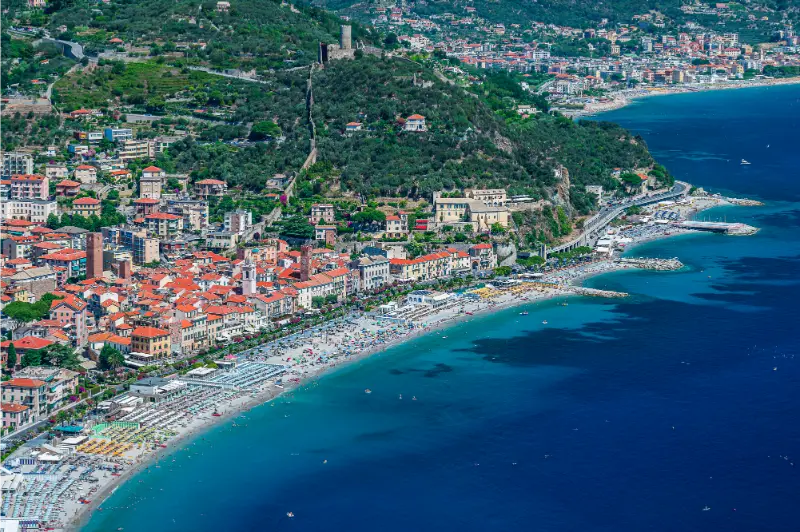
Seborga is a small hilltop village above the western Ligurian coast, celebrated for stone lanes, wide views and a curious ‘principality’ identity. Visitors sometimes arrive expecting a functioning independent state, complete with a passport stamp and formal border. In reality Seborga is an Italian municipality. The modern principality story is a local cultural tradition and self-proclaimed micronation, not recognition as a sovereign country. Understanding that distinction allows you to enjoy the village’s sense of humor and historical imagination without repeating a misleading claim.
The strongest reasons to visit are simpler and more enduring: the hilltop setting, compact historic center, quiet squares and an opportunity to explore a part of the Riviera dei Fiori beyond the beaches. Seborga combines naturally with Bordighera, Ospedaletti or Sanremo, but it deserves more than a token photo stop. Allow time to see how the town’s unusual identity is expressed in shops and signs while appreciating the very real heritage around it.
You can pair Seborga, Liguria with other places in Liguria; the Liguria travel guide gives an overview of realistic connections and where to stay.
| Focus | Seborga |
|---|---|
| Region | Liguria, Italy |
| Best approach | Check the official access and transport information close to your travel date |
| 2028 planning note | Timetables, prices and restricted access may change before publication |
In this guide: The principality story, without the confusion · Walk the compact historic center · Piazza San Martino and the village church · Flags, coins and local identity · Views and countryside around Seborga · A gentle Seborga half-day itinerary · How to get to Seborga · Where to stay for a Seborga excursion · When to go and what to pack · Food, traditions and respectful travel · The easy mistakes to avoid · Frequently asked questions

The principality story, without the confusion
Seborga’s historical claims have roots in complex medieval landholding and later local interpretations of political status. In the modern era, the idea of the Principality of Seborga has been revived through symbols, ceremonies and local institutions. You may encounter the title of princess, flags and references to the luigino currency. Those expressions are part of the place’s distinctive story and contribute to its visitor appeal.
They do not replace the Italian legal and administrative reality. Residents use ordinary Italian institutions, and travelers do not cross an internationally recognized frontier on the hill road. The appropriate way to write about Seborga is to distinguish folklore and self-asserted status from official sovereignty. That does not make the story uninteresting: it is a fascinating example of how local identity can be developed and celebrated over time.
Walk the compact historic center
The old village is small enough to explore without a rigid list of numbered attractions. Stone buildings, narrow lanes and small shops give the center a cohesive appearance. Wander slowly and look back at the surrounding hills as you move between streets. On a clear day the view can reach toward the coast; low cloud may limit visibility but make the village feel more atmospheric.
The best approach is to park or arrive outside the tightest lanes and continue on foot. Expect some gradients and uneven paving typical of hill villages. Local residents use these streets every day; avoid blocking entrances to photograph a flag or decorative sign. A visit that includes time for coffee and watching village life feels more authentic than collecting a series of novelty ‘principality’ souvenirs.
Piazza San Martino and the village church
The church of San Martino and its square provide one of the natural focal points of the center. The religious and civic setting grounds the village in a longer history than the modern micronation narrative. Take time to study the façades, paving and scale of the space. If the church is open, enter respectfully and follow local rules. Do not assume it operates with museum-style visiting hours or that access is guaranteed on every day of the week.
The square also helps you orient yourself. From here, small lanes lead toward other corners of Seborga. A quick loop can be completed rapidly, but the place is best enjoyed without pressure. Look for ordinary details—stone doorways, gardens and views over the terraced hills—that would be missed by focusing exclusively on the principality theme.
Flags, coins and local identity
Seborga’s flags and the luigino provide memorable visual motifs. Travelers may see souvenir coins or other items bearing the principality name, but should not assume they are legal tender in ordinary Italian commerce. Treat such objects as locally meaningful memorabilia rather than practical travel money. If buying from a shop, ask politely about the story behind the display and check the price as you would anywhere else.
For children, the distinction between a micronation story and a recognized country can be an engaging geography lesson. Explain how communities create symbols of belonging and how a flag can carry different meanings. This prevents the novelty from overshadowing the real village and encourages curiosity about local history rather than a simple ‘is it a real country?’ argument.
Views and countryside around Seborga
The surrounding landscape is part of the experience. Terraces, wooded slopes and the distant Riviera coast show how dramatically the geography changes above Bordighera and Ospedaletti. The village’s position also explains why it feels so different from the waterfront. A few kilometers as the crow flies can mean an uphill journey on winding roads, so calculate transfer time realistically.
Walk only on signed public paths and avoid assuming that a road into the countryside will complete an easy loop. Some paths cross agricultural land or involve steep sections. If you plan an extended hike, check route maps and weather rather than improvising from an attractive viewpoint. Many visitors will get enough scenery from the village itself without embarking on a strenuous walk.
A gentle Seborga half-day itinerary
| Stage | Suggested focus | Practical detail |
|---|---|---|
| Arrival | Settle in and locate the center | Expect hill roads and limited parking |
| First walk | Stone lanes and little squares | Take time for village details |
| Main stop | San Martino and principality symbols | Distinguish heritage from modern folklore |
| Break | Coffee or lunch if available | Confirm opening, especially off-season |
| Finish | Coastward viewpoint | Check weather before expecting a panorama |
A half-day is sufficient for most travelers, although a slow lunch or countryside walk could extend the trip. Pairing Seborga with a coastal destination makes sense if you have a car or a suitable transfer plan. Avoid treating Seborga as a stepping-stone between many other hill villages: repeated winding drives can make a short geographical itinerary surprisingly tiring.
How to get to Seborga
The village sits inland from the western Riviera, reached by hill roads from the coastal area. Driving is often the most flexible choice, but consider narrow curves and parking before committing. Travelers without a car should check whether current bus services align with their intended arrival and return. A taxi may be possible from a coastal town, though arranging the return in advance is wise.
Train travel is excellent along the Ligurian coast, but Seborga has no railway station in its center. If your base is in Sanremo, Bordighera or Ventimiglia, the final segment needs a separate plan. Do not calculate a journey as if the entire route were on a flat urban street. Buses may have limited frequencies and local timetables can change seasonally.
Where to stay for a Seborga excursion
Most visitors benefit from accommodation on the coast, where dining, transportation and day-trip options are wider. Bordighera has a relaxed coastal atmosphere, while Sanremo provides more city-style services and a broader range of lodging. Ospedaletti is another option for travelers wanting a quieter waterfront base. From any of these, choose Seborga as a half-day inland contrast.
An overnight stay in or near Seborga may appeal to travelers seeking peace and countryside views. Check practical details carefully: evening restaurant openings, car access, stairs and whether breakfast is included. A remote-looking guesthouse may be beautiful but inconvenient without transport. For a first multi-stop Liguria trip, convenience often matters more than a secluded panorama.
When to go and what to pack
Spring and autumn are generally comfortable for exploring stone lanes and viewpoints, while summer can be warm even above the sea. Winter days may be crisp and quiet, though some services will be reduced and evening darkness arrives early. If the main aim is a coastal panorama, check the forecast for visibility before driving up. Fog or low cloud can create atmosphere but conceal the view you expected.
Wear grippy shoes for uneven paving, carry drinking water and bring a light layer when weather is changeable. If you are visiting with young children, plan a shorter loop and a break rather than aiming for every viewpoint. Travelers with limited mobility should research which areas of the historic center are easiest to reach and whether their chosen restaurant or accommodation has steps.
Food, traditions and respectful travel
Western Ligurian cooking reflects olives, vegetables, herbs, fish from the nearby coast and inland products. Small village restaurants can offer a more relaxed meal than crowded waterfront spots, but their openings may be limited. Look at actual menus and reserve ahead if an establishment is important to your plans. A souvenir related to the principality may be fun, yet purchasing local food or craftwork can also support the community.
Remember that residents do not live in a theme park. Respect private doorways, avoid treating people as props for a novelty political story, and ask before taking photographs inside shops. The self-proclaimed principality is one part of Seborga’s identity; the village’s enduring physical setting and everyday life are equally important.
The easy mistakes to avoid
Do not describe Seborga as a sovereign state or suggest you need border documents to enter. Do not plan to use a novelty luigino as ordinary travel currency. Do not assume public buses run frequently from the coast or that every hillside lane is step-free. And do not reduce the place to a joke: the local history, stone center and inland landscape justify the excursion even for travelers who have little interest in micronations.
Frequently asked questions
Is Seborga an independent country?
No. Seborga is in Italy. The principality is a modern local micronation claim and cultural tradition, not an internationally recognized state.
Do I need a passport to enter Seborga?
No special border document is needed to reach the village from the rest of Italy. Normal travel document requirements for Italy apply to your overall trip.
Can I spend the luigino currency in shops?
Treat luigino items as local symbols or souvenirs, not a substitute for euros in everyday travel. Ask individual sellers about any commemorative merchandise.
How long does a visit take?
A relaxed half-day is a good starting point. More time makes sense if you want lunch or a countryside walk and have suitable transport.
What coastal town pairs well with Seborga?
Bordighera, Ospedaletti and Sanremo all provide plausible bases or second stops depending on your route. Choose based on actual road or transport connections rather than map distance alone.
More Liguria guides to help plan the trip
Continue planning with Dolceacqua in the Nervia Valley, Alassio and the Bay of the Sun, Sanremo Beyond the Festival, and Where to Stay in Liguria. Each link leads to a separate guide already published on MyItalyExperience.
Official information and planning updates
Before traveling, consult Official visitor information. Check access, weather, seasonal opening hours and transport close to your departure, particularly for a trip in 2028.
Accommodation disclosure: The following hotel-search link is an affiliate link. It does not change the price you pay under normal booking conditions, but MyItalyExperience may earn a commission.
Last updated: October 17, 2026