
Visit Santa Croce in Florence with Giotto’s chapels, Michelangelo and Galileo tombs, Cimabue’s Crucifix, Pazzi Chapel, cloisters and realistic timing.
Santa Croce Florence Guide works best when you decide what the main experience is before you arrive. This guide is designed around that decision, with realistic timing, access cautions, seasonal planning and combinations that make sense on the ground rather than on a crowded checklist.
If you are planning several stops rather than just Santa Croce Florence, start with the Florence Travel Guide for a sensible route and transport advice.
| Best for | Giotto frescoes, Renaissance sculpture, major Italian tombs, Franciscan history and travellers who want church, museum and cloister in one coherent visit |
|---|---|
| Realistic time | Allow 1.5–2.5 hours for the basilica, chapels, sacristy, Pazzi Chapel, cloisters and museum route. |
| Main planning challenge | Santa Croce contains much more than the famous tombs. Visitors who focus only on Michelangelo and Galileo can miss Giotto, Cimabue, Donatello, Taddeo Gaddi and the architecture of the convent complex. |
| Best anchor | Begin with the nave and major chapels, then make the sacristy and museum route non-negotiable rather than optional extras. |
Why Santa Croce deserves a full visit, not a tomb checklist
Santa Croce is often introduced as the “Pantheon of Italian glories” because Michelangelo, Galileo, Machiavelli, Rossini and other famous figures are commemorated here. That description is useful but incomplete. The basilica is also one of Florence’s richest places for understanding Franciscan patronage, fourteenth-century painting and the transition toward Renaissance architecture. The strongest visit moves from the large Gothic interior to intimate frescoed chapels, then out into the cloisters and Pazzi Chapel. Think of it as a complex rather than a single church.
Giotto in the Bardi and Peruzzi chapels
The Bardi and Peruzzi chapels are among the key reasons art lovers come to Santa Croce. Giotto and his workshop created cycles here that reward slow looking. You do not need a specialist background to enjoy them: notice how figures occupy believable space, how faces react to events and how architecture organizes the narrative. Crowds can cluster around the best-known monuments in the nave, while the chapels feel like a different museum entirely. If frescoes matter to you, visit them before fatigue sets in.

Michelangelo, Galileo and the problem with famous names
The monumental tombs create a powerful sense of national memory, but do not let name recognition determine the whole route. Michelangelo’s tomb by Vasari and Galileo’s monument are important partly because they reveal how later generations chose to honour cultural heroes. Compare them with quieter memorials and floor tombs to see how the church became a layered civic archive. The visit becomes richer when you ask who was commemorated, when, and by whom, rather than simply photographing inscriptions.
Cimabue’s Crucifix and the memory of the 1966 flood
In the sacristy, Cimabue’s Crucifix is one of the most emotionally charged works in Florence because it was severely damaged in the 1966 flood. Its surviving surface makes conservation history visible. This is a good place to discuss with children or first-time art visitors why restoration sometimes preserves damage rather than hiding it. The flood is not a side story: it changed Florence’s relationship with conservation and brought international attention to endangered artworks throughout the city.
Pazzi Chapel, cloisters and the museum route
The visit continues beyond the church into the convent spaces. Brunelleschi’s Pazzi Chapel is a compact lesson in Renaissance proportion and calm geometry, while the cloisters give you breathing room after the dense interior. The museum and former refectory add Taddeo Gaddi’s great Tree of Life and Last Supper composition, detached frescoes and sculpture. These spaces are why Santa Croce can comfortably fill two hours. If you are short on time, reduce the number of tombs you inspect rather than cutting the Pazzi Chapel and museum completely.
Piazza Santa Croce and when the atmosphere changes
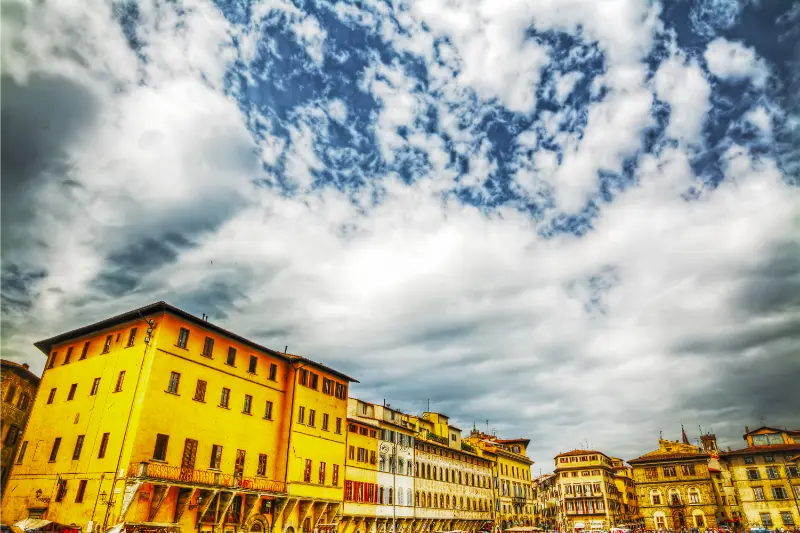
The square outside is one of Florence’s great urban spaces, but its character changes with events. In June it can be transformed for Calcio Storico, with temporary seating and a very different visual experience. At other times, the broad square is ideal for stepping back to read the nineteenth-century façade and the surrounding palaces. If your visit coincides with an event, check access and crowd conditions before assuming the normal walking route will be open.
What to prioritize if you have less time
If you only have a short window, protect the feature that cannot be replicated elsewhere in Florence and cut the secondary layers first. That usually means keeping the main interior or collection, then choosing one nearby outdoor space rather than adding a second large museum. Central Florence encourages over-planning because distances look short, but security lines, ticket checks, stairs, church services and simple crowd movement all consume time. A focused ninety-minute visit followed by an unhurried walk is usually more rewarding than three rushed entrances.
Getting there and moving around
For central Florence, walking and public transport are the practical defaults. If you arrive by train, Firenze Santa Maria Novella is within walking distance of most historic-centre sights, though luggage, summer heat and cobbles can make a taxi sensible on arrival day. Driving into the historic centre is rarely the easiest choice because of the ZTL, one-way streets and limited parking. If your accommodation offers authorised access or partner parking, obtain the exact route and licence-plate procedure before entering restricted streets. For a museum day, the simplest strategy is to leave the car outside the core and walk.
Best time of day and best season
For indoor Florence sights, the first part of the day is often easiest because your attention is fresh and the streets have not yet reached their afternoon density. Late opening slots can also be attractive when available, but do not assume they exist every day. Spring and autumn offer the easiest balance of daylight and walking temperatures; summer requires earlier starts, water and deliberate breaks; winter can be wonderfully quiet but brings shorter daylight and more variable schedules. Religious sites may adjust access around services, while towers and outdoor routes can change with weather.
Where to stay
Staying near Santa Croce can make an early visit easy, but choose accommodation according to the whole Florence itinerary rather than one attraction. The historic centre suits first-time visitors who want to walk almost everywhere; Santa Maria Novella is convenient for train-based day trips; Oltrarno offers a more residential evening rhythm. Check lift access, air conditioning in summer and whether a room faces a noisy street or square. If you are driving, written parking and ZTL instructions matter more than being fifty metres closer to a monument.
Food and pacing the day
Do not let lunch become the accident that makes you late for the only timed ticket of the day. Florence restaurants and trattorias can turn a proper meal into a ninety-minute pause, which is a pleasure when planned and a problem when squeezed between reservations. If you have a fixed museum or church entry, visit first and eat afterward. For a quick meal, avoid choosing solely by proximity to the busiest monument. Walk a few streets away and look for a menu that reflects seasonality rather than a wall of photographs. Tuscan soups, crostini, fresh pasta, lampredotto, bistecca and local wines all belong to different eating occasions; you do not need to force them into one day.
Visiting with children
Families generally do better with one major cultural visit before lunch and an outdoor activity afterward. Give children a concrete task: find a lion, compare two sculptures, spot a Medici symbol, identify a map or count towers. That turns the visit into observation rather than endurance. Pushchairs are manageable in much of central Florence but steps, old thresholds and crowded rooms can still complicate movement. If a site offers family activities or kits, reserve them when possible; they often provide far more value than trying to translate an adult audio guide on the spot.
Accessibility and limited mobility
Historic Florence is compact but not automatically easy. Cobblestones, steps, narrow passages and tower climbs create very different accessibility conditions from street-level museums. Use the official accessibility information for the exact building and, if step-free access is essential, contact the site before travel. Do not assume that because a museum is accessible every optional route, terrace or historic staircase is accessible too. Taxis can reduce walking between districts when conserving energy matters.
Useful places to combine nearby
- Florence travel guide
- Uffizi Gallery guide
- Pitti Palace and Boboli guide
- Three days in Florence
Choose one or two of these rather than all of them. A strong Tuscany day normally has one structured attraction with fixed hours and one open-ended neighbourhood, village or landscape stop. That leaves enough flexibility for queues, a slow meal, weather changes or an unexpected place that deserves more time.
Common planning mistakes
- Stacking several major museums because the map makes them look only minutes apart.
- Relying on a screenshot of opening hours instead of checking the official site close to the visit.
- Driving into the historic centre without understanding the ZTL and parking procedure.
- Booking a tower, dome or outdoor route without a weather alternative.
- Leaving no buffer for security, ticket collection, church services or simply moving through crowds.
- Treating the surrounding piazza or neighbourhood as dead time between attractions.
A simple itinerary that works
Start early enough that Santa Croce feels unhurried. Use the first part of the day for the main interior, when your attention is highest. Take a proper break afterward, then move through the surrounding district on foot rather than jumping straight into another long museum. Keep one optional stop for late afternoon: a viewpoint, church, market or riverside walk. If the main visit runs long, drop the optional stop without feeling that the day has failed.
Official sources and what to recheck
Historical and planning details in this guide were checked against official or institutional information available in 2026. Because the article is scheduled for later publication, recheck opening hours, admission prices, reservation rules, temporary closures, special exhibitions, religious services, transport and accessibility shortly before travel. Use the official source as the final reference when it conflicts with an old blog post or reseller page.
The decision that makes this visit better
Santa Croce is best when you treat it as a basilica, fresco gallery, memorial space and convent museum in one. Give the chapels and Pazzi complex the same priority as the famous tombs.
Last updated: October 17, 2026
Leave a Reply